
Hot Tub Circulator Pump: Diagnose Low Flow Before Replacing It
Check hot-tub circulation pump symptoms, filters, water level and airlocks, then confirm electrical diagnosis and replacement fit before buying parts.
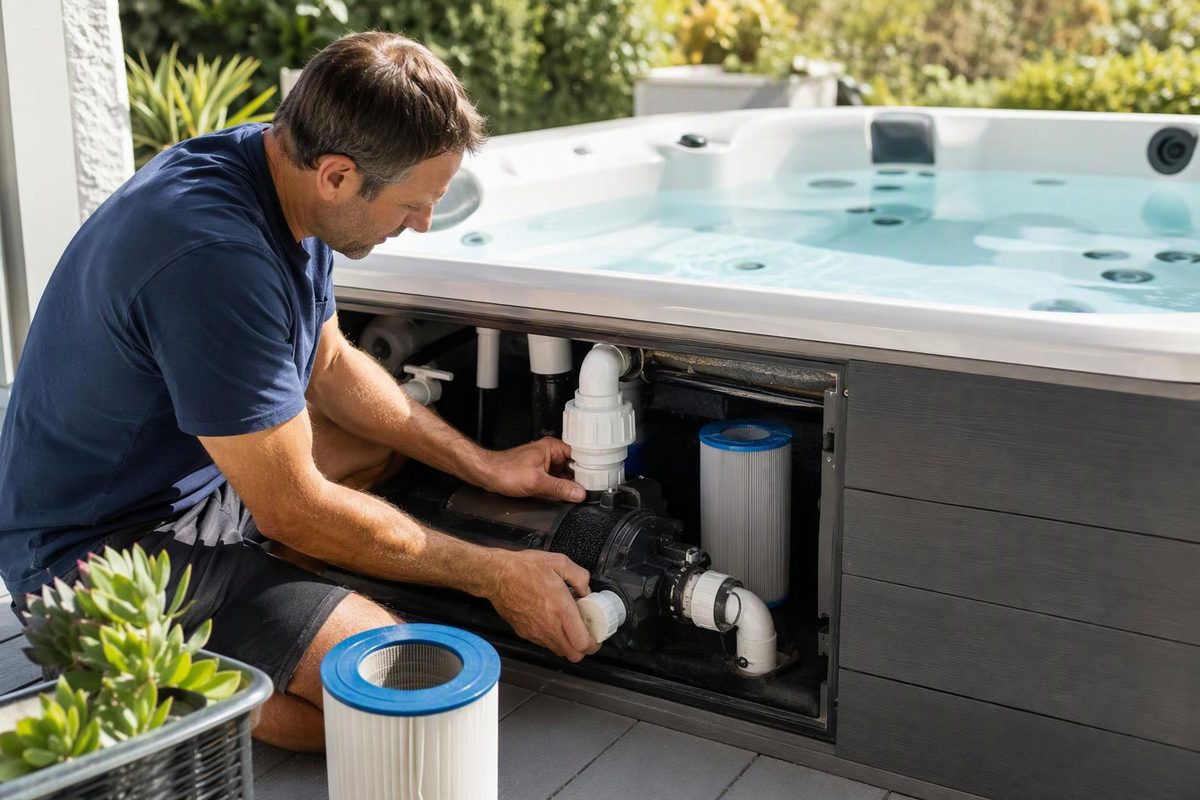
A hot tub circulator pump—usually called a circulation pump or circ pump—moves water through the heater on spas fitted with a dedicated pump. Other spas use the low-speed setting of a two-speed pump for that job. Identify your system before ordering parts: a working jet pump does not prove that a separate heater-circulation pump is working. Balboa’s TP700 guide explains both arrangements.
This guide covers hot-tub circulation pumps, not swimming-pool filter pumps or household hot-water circulators.
1. Confirm that the pump should be running
Record the spa’s make, model and serial number, the displayed water temperature, set temperature and exact error message. Note whether the problem began after draining, refilling or servicing.
Check the owner’s manual for the circulation schedule. Not every circ pump runs continuously. For example, Balboa’s TP700 documentation describes continuous operation, continuous operation with a high-temperature pause, and operation tied to temperature checks, filtration and other conditions. Those circulation modes are manufacturer-configured; they are not simply interchangeable user settings. Source: Balboa TP700 user guide.
Observe the circulation return identified in your spa manual, rather than judging flow only by the massage jets. A quiet pump or an idle return outside its scheduled operation is not enough to diagnose failure.
Stop: If the breaker or GFCI will not reset, or trips again, leave the spa off and arrange service. Do not keep resetting it to force the pump to run. Hot Spring directs owners to service when a GFCI will not reset. Source: Hot Spring troubleshooting guide.
2. Rule out restricted water flow
Before removing filters or inspecting inside the cabinet, disconnect power at the spa’s disconnect or breaker—not just the control panel. Do not open an electrical enclosure or handle wiring. Xylem’s Laing instructions require power disconnection before service and qualified electrical work. Source: Laing E-Series manual.
Work through these checks:
- Water level: Bring it to the operating level specified for your spa. Do not substitute a generic fill height.
- Filters: Remove and clean them using the spa’s instructions. Rinse between cartridge pleats and reinstall correctly before restarting. A clean, compatible spare can help distinguish a restricted cartridge from another fault.
- Valves and hoses: With power isolated, visually check accessible circulation plumbing for a kink or a service valve left closed. Confirm valve positions against the manual; do not turn unfamiliar valves at random.
- Leaks: Look for water beneath the pump and around connections without touching electrical components. If water is reaching the motor or electrical equipment, leave power off and arrange service. Laing requires a dry motor location and warns against handling the pump on a wet surface. Source: Laing manual.
Hot Spring lists clogged filters and airlocks among causes of no heat even when jets and lights still work. Laing’s troubleshooting chart also lists suction-line obstruction, kinks and closed lines among causes of poor priming. Hot Spring guide; Laing manual.
Restore the spa’s covers and guards before restarting. If normal circulation returns after cleaning, that points toward a restriction—not proof that the motor needed replacement.
3. If it started after a refill, check for an airlock
A pump can have power yet fail to move water because air remains trapped in the plumbing. Follow your spa’s filling and priming procedure, including its time limit and stop instructions.
Do not borrow another model’s button sequence or loosen a pump union while powered. Balboa’s TP700 guide warns against prolonged unprimed operation and directs owners to shut off power and call for service if priming fails. Laing likewise requires a filled system and purged air before operation; running dry can severely damage the pump. Balboa guide; Laing manual.
4. Separate a pump fault from a control fault
After the basic checks, use the symptom to frame the service request:
| Observation | What still needs checking |
|---|---|
| Pump is silent when operation is expected | Power supply, wiring, control output, protective cutout or motor fault |
| Pump makes noise but circulation is weak or absent | Trapped air, restriction, debris or worn pump components |
| Pump stops and later restarts outside normal programmed cycling | A protective cutout may be operating; find the cause rather than repeatedly restarting |
| Flow appears normal but a flow-related error remains | Actual heater flow and the pressure switch or flow sensor may need diagnosis |
These are diagnostic branches, not verdicts. Laing’s troubleshooting chart lists multiple causes for a non-running or noisy pump, and Jacuzzi identifies pressure-switch or flow-sensor faults as possible reasons for persistent flow issues.
A technician should verify the supply and control command before condemning the pump. Never bypass a flow switch or heater safety device to make the spa heat. If circulation is restored but heating is not, the heater and its controls need a separate diagnosis—not an automatic pump replacement.
5. Match the replacement—not just its appearance
Use the spa manufacturer’s approved part number or confirmed supersession. Provide photographs of the old pump label and connections, taken with power isolated.
Confirm:
- Full model number, voltage and electrical ratings.
- Cord, connector and control compatibility.
- Hose-barb, threaded or union connections and their sizes.
- Inlet/outlet direction, mounting orientation and available clearance.
- The specified hydraulic performance for that spa.
“E10” alone, for example, is not a complete specification: Laing’s E-Series manual lists different voltages, housing materials and connections within the family. It also specifies mounting restrictions and flow-direction arrows. Source: Laing E-Series manual.
Have the installer verify leak-free connections, successful priming, normal circulation and heating after replacement. A pump that fits the space but not the electrical or plumbing requirements is not the right replacement.