
Is It Safe to Use a Hot Tub That Has Been Sitting?
Use a practical safety check for sanitizer, temperature, circulation, warning signs, and maintenance history before entering an idle hot tub.
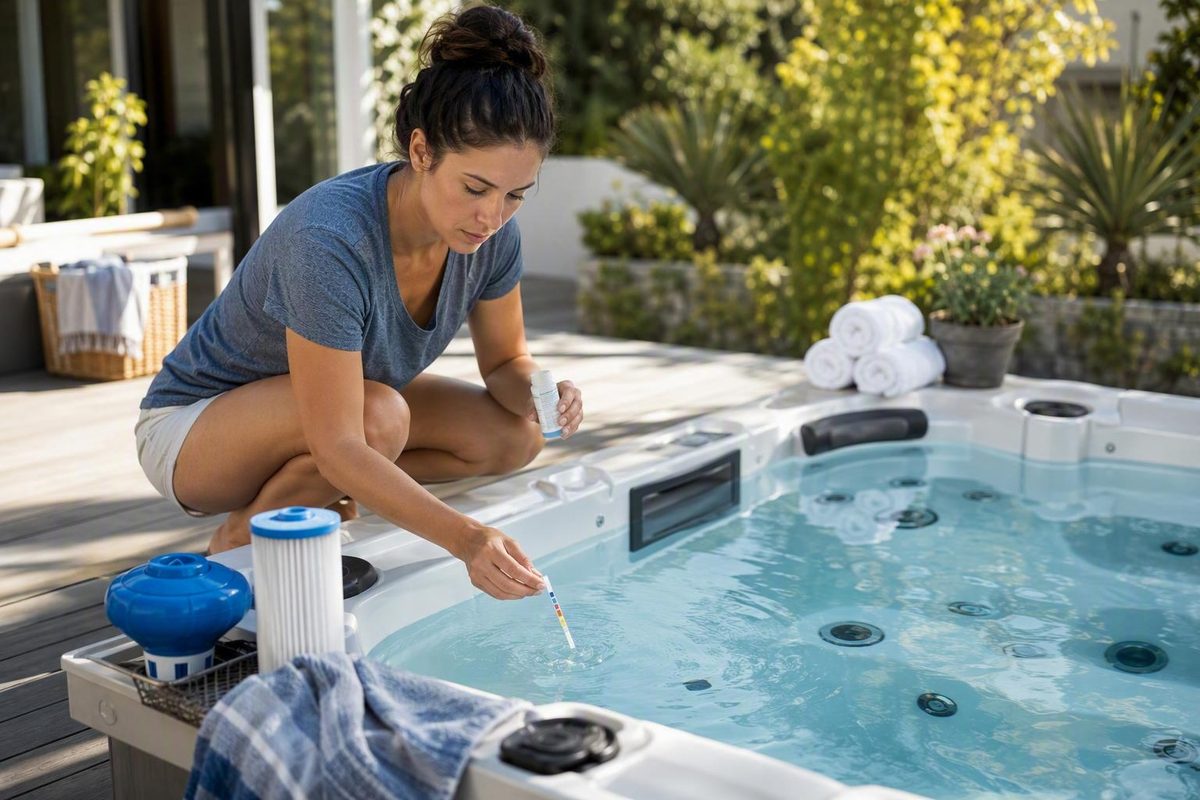
No—do not use a hot tub that has been sitting unless current testing confirms an appropriate sanitizer level and the circulation, filtration, structure, and electrical system are sound. Water at 100°F to 104°F with no measurable sanitizer for days is a stay-out-and-treat case. Drain and refill if the water is visibly neglected or its history is substantially uncertain. At a rental, the owner’s assurance is not a test result.
Enter the tub’s current readings and condition; the checker will show the safest next step.
This conservative checker uses current measurements, maintenance evidence, circulation, and visible warning signs. It cannot test for Legionella or replace the spa manual, chemical label, technician, or public-health direction.
The default example is 102°F water with zero measurable sanitizer, an uncertain maintenance history, and unverified circulation.
- Keep bathers out.
- Verify the equipment and test with an appropriate kit.
- Treat according to the spa manual and sanitizer label, circulate, then retest.
| Observed Condition | Result | Required Response |
|---|---|---|
| 100°F–104°F, zero sanitizer for one or more days | Test and treat first | Keep out, restore treatment, circulate, and retest. |
| Slime, cloudiness, discoloration, persistent foam, odor, or contamination | Drain and refill | Inspect, clean, service the filter, and address plumbing as directed. |
| Unknown or failed circulation | Test and treat first | Correct equipment faults before relying on chemistry. |
| Rental with no current test or credible records | Do not soak | Ask the host to keep it closed and arrange proper service. |
| Current sanitizer within labeled range, normal circulation, credible history, no warnings | Soak criteria met | Confirm all other required chemistry and equipment checks. |
| Illness or official contamination concern | Keep closed | Follow public-health and professional remediation directions. |
Sources: CDC MMWR investigation of the 2024 New York vacation-rental outbreak; Jacuzzi manufacturer cleaning and chemistry guidance. The 7.2–7.6 pH example and approximately 8 ppm startup example are manufacturer-specific, not universal bathing targets.
Warm, Unsanitized Water Is the Main Concern
Time alone does not decide whether an idle tub is safe. A covered spa that remained circulating, filtered, tested, and sanitized is different from one left full with its pump off or sanitizer depleted.
Hot tubs combine warm water, a small water volume, concealed plumbing, and jets that produce mist. Inadequate disinfection can allow microbial contamination to develop or persist in the water, filter, and plumbing.
One concern is Legionella, the bacterium that causes Legionnaires’ disease. Temperatures around 100°F to 104°F can favor its growth and accelerate disinfectant decay. Jets can aerosolize contaminated water, exposing bathers through inhaled mist.
A CDC report published in June 2026 traced a 2024 western New York outbreak to a private vacation-rental hot tub maintained at 100°F to 104°F. Two guests developed confirmed Legionnaires’ disease. Legionella pneumophila was found in all three hot-tub samples, and genomic evidence identified the poorly disinfected tub as the likely exposure source. The owner had self-cleaned the tub, used an unapproved testing method, and reopened it against state orders, according to the CDC outbreak investigation.
That outbreak does not mean every idle tub contains Legionella. It shows why warmth, clear water, active jets, and an owner’s assurances cannot establish that a tub is safe. CDC also says about half of travel-associated Legionnaires’ disease cases report hot-tub use, as discussed in CIDRAP’s outbreak summary.
Clear Water Does Not Prove Proper Sanitation
Do not enter if sanitizer was not regularly measured and replenished, circulation stopped, or the maintenance history cannot be verified. Keep the tub closed if the water is cloudy, discolored, slimy, unusually odorous, persistently foamy, or contaminated with debris.
A normal appearance cannot reveal contamination in a filter or pipe. Draining the visible shell may leave residual water in pumps, manifolds, pipes, and low points. Biofilm can remain attached to those internal surfaces. Manufacturer cleaning guidance therefore includes plumbing flushing when a deep clean is needed to address hidden buildup (Jacuzzi cleaning guidance).
These shortcuts do not establish bathing safety:
- Reheating old water
- Running the jets briefly
- Adding one sanitizer dose without later testing
- Draining only the visible shell when substantial neglect or internal buildup is suspected
- Judging sanitation by smell, clarity, or water temperature
Home strips and drop kits help manage routine chemistry, but they cannot prove that Legionella is absent. If illness or a formal contamination concern is connected to the tub, close it and follow public-health instructions.
The Tub’s History Determines the Next Step
A maintained but unused tub may only need inspection, current testing, chemistry correction, circulation, and retesting. Confirm that its filter is seated correctly, its scheduled filtration ran, and its sanitizer remained within the ranges specified by the spa manufacturer and treatment-product label.
A full, neglected tub should normally be drained rather than rescued through repeated chemical additions. That is particularly appropriate when the history is unknown, readings will not stabilize, or the water has slime, persistent foam, cloudiness, discoloration, odor, or debris.
A drained tub still needs inspection. Ordinary draining can leave water in its plumbing, while seals, fittings, pumps, and filter housings may deteriorate during storage. A tub stored for months or years needs a whole-system assessment, including the shell, cabinet, cover, jets, seals, accessible pipes, pumps, controls, pad, and availability of model-specific parts.
A winterized tub requires its model-specific reopening procedure. If winterization is uncertain, inspect for cracked fittings, damaged pumps, displaced components, and deteriorated seals before filling. Stop and call a spa technician if freeze damage is possible.
Mechanical and Electrical Faults Keep the Tub Closed
Sanitary-looking water does not offset defective equipment. Do not use the tub if its pump fails to start, circulation is weak or intermittent, the filter is damaged or clogged, valves are stuck, flow errors persist, or debris emerges from the jets.
Inspect the shell, cabinet, equipment compartment, accessible plumbing, fittings, and surrounding pad. Cracks, significant leaks, wet insulation, brittle seals, structural movement, and water near electrical components require attention before startup.
Keep power off if wiring is damaged, the installation history is unknown, breakers trip, or GFCI protection is questionable. Wiring, bonding, grounding, control-board, GFCI, and heater work belong with a qualified professional when they exceed the owner’s training.
Turn off or disconnect power as the manual directs before draining or hands-on cleaning. Never operate the pumps or heater while the spa is empty.
Restart a Neglected Tub in System Order
Inspect Before Draining
Find the owner’s manual and review its drain, fill, filter, priming, air-lock, and startup instructions. Examine the cover, shell, cabinet, jets, controls, pumps, filter housing, seals, accessible fittings, and electrical compartment before disturbing anything.
Stop if you find suspected freeze damage, major leakage, structural damage, pest-damaged wiring, corrosion at electrical components, or water where electrical equipment should be dry.
Discard Neglected Water and Clean the Shell
Drain substantially neglected water by the method specified in the manual. Check local wastewater or environmental rules before selecting a discharge location, and keep the water away from people, pets, plants, and sensitive surfaces.
Use products and nonabrasive tools approved for the shell and components. Clean the shell, waterline, jet faces, removable pillows, compatible fittings, and cover, then rinse away residue. Household detergent, bleach, solvents, abrasive pads, and pressure washing are not universally compatible with spa finishes and seals.
Inspect the Filter and Hidden Plumbing
Remove the cartridge and look for tears, collapsed pleats, deformation, heavy deposits, brittleness, persistent odor, or damaged fittings. Clean a serviceable filter by its manufacturer’s method. Replace it when damaged, heavily contaminated, unable to restore normal flow, or of unverifiable condition.
Surface cleaning does not reach internal pipes. For substantial neglect, unknown history, or suspected buildup, the manual and a compatible purge-product label may call for a refill, line-cleaner circulation, another drain, and a final rinse. Do not guess the dose, contact time, temperature, valve position, or whether the filter stays installed. These details vary by product and spa.
Not every routine water change requires two drains. The refill-purge-drain sequence is for conditions that justify deeper plumbing treatment. One manufacturer’s old-spa process includes filter and shell cleaning, plumbing flushing, another drain, and a final fresh refill (Master Spas restart guidance).
Refill, Sanitize, Circulate, and Retest
Close drains and reinstall required plugs, filters, fittings, and valves. Fill through the point specified by the manufacturer, which may help prevent trapped air. Watch the cabinet, equipment area, underside, jets, and fittings as the level rises.
After restoring power at the instructed stage, confirm normal circulation and filtration. Test and adjust every parameter required by the spa manual and water-care system. Add sanitizer and perform any startup or shock treatment according to the product label.
Allow the prescribed circulation period and retest. A reading taken immediately after adding chemicals is not enough. Do not enter until the readings remain within the manufacturer’s operating ranges and the chemical label’s bathing ranges.
Sanitizer Targets Must Come From the Spa and Product Instructions
The supplied evidence does not provide one universal free-chlorine or bromine bathing target for every hot tub. Systems and labels differ, so compare the measured reading with the range specified by the tub manufacturer and sanitizer product.
Jacuzzi gives a manufacturer-specific pH range of 7.2 to 7.6. That is an example, not a universal specification for every spa. Some manufacturers also describe startup chlorination of approximately 8 ppm, but that is not a normal bathing target, a universal dose, or proof that neglected plumbing has been decontaminated.
There is likewise no universal waiting period after shocking. The correct interval depends on the chemical, dose, water volume, sanitizer system, circulation, and measured results. Shock is a treatment step. Entry depends on the subsequent test.
Before bathing, confirm all of the following:
- Sanitizer and required balance readings are within the applicable bathing ranges.
- Circulation, filtration, jets, and controls operate normally.
- The filter is properly installed and flow remains adequate.
- No leak or unresolved error code appears during operation.
- Jets do not release flakes, slime, or other residue.
- Cloudiness, persistent foam, slime, or unusual odor does not return.
- Chemistry remains stable after circulation and retesting.
Rental Hot Tubs Require Verifiable Evidence
Ask the host when the tub was last serviced, how disinfectant is measured and maintained, when the water and filter were last serviced, and whether the tub was recently closed, repaired, or remediated. Dated service records are stronger evidence than “we added chemicals.”
Do not use a rental tub if its maintenance history is vague, circulation cannot be verified, no current sanitizer measurement is available, or warning signs are present. Renters should not attempt to purge, shock, repair, or independently reopen someone else’s spa.
Use stronger caution when a prospective bather is older, smokes, has a weakened immune system, or has an underlying medical condition. These groups face greater risk from Legionnaires’ disease, according to CDC information on risk factors.
In the New York outbreak, reopening required professional cleaning and disinfection, approved follow-up sampling, and official clearance. Two successive sampling rounds found no viable Legionella. Those were measures for a specific disease investigation, not requirements for every residential water change.
Symptoms After Exposure Need Prompt Evaluation
Legionnaires’ disease is a serious form of pneumonia. Symptoms can include cough, fever, headache, muscle aches, and shortness of breath. Confusion, diarrhea, and nausea can also occur. Symptoms usually begin 2 to 14 days after exposure, although onset can take longer.
Seek prompt medical evaluation for compatible symptoms after using a questionable hot tub. Tell the clinician where and when the exposure occurred. Do not self-diagnose; several respiratory illnesses can produce similar symptoms.
Most healthy people exposed to Legionella do not become ill, but CDC states that approximately one in ten people who develop Legionnaires’ disease die from complications. If multiple people become ill after using the same tub, report the shared exposure and keep the tub closed for public-health direction.
The Safe-Entry Rule Is Measured, Not Visual
An idle tub is ready only when its history is credible, equipment is sound, circulation and filtration work, and current tests meet the manufacturer’s and chemical label’s bathing ranges. If any of those points remain uncertain, nobody should enter.
For a substantially neglected tub, discard the water, clean the accessible surfaces, address the filter and hidden plumbing as directed, refill, sanitize, circulate, and retest. If the recommissioned tub is sanitary and mechanically sound but does not heat, follow How to Diagnose and Repair a Hot Tub Heater or call a technician.