
Chlorinating Granules for a Hot Tub: Dose by Test Result
Identify the granules, calculate the label dose from hot-tub volume, circulate, retest, and know when chlorine or pH means nobody should enter.
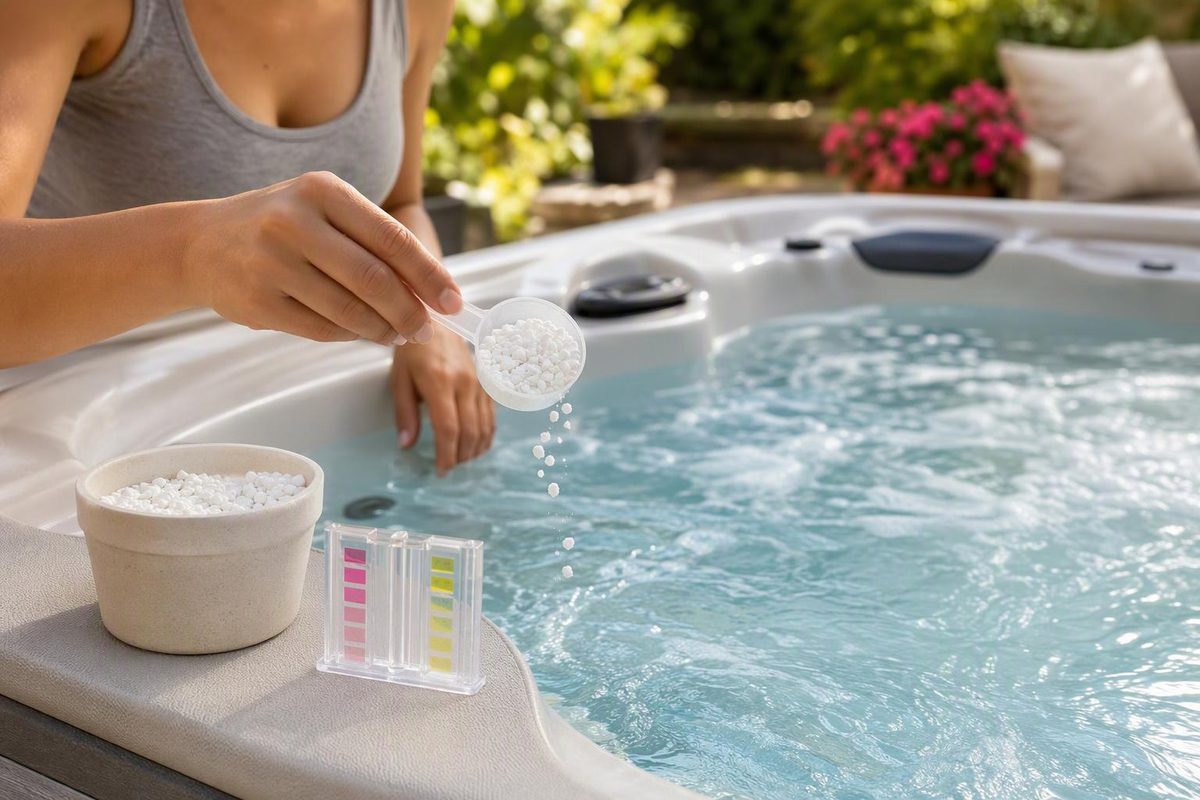
Chlorinating granules should be dosed from three facts: the hot tub’s water volume, the product’s available-chlorine strength and the current free-chlorine reading. A generic scoop-per-tub rule can underdose a 500-gallon spa or overdose a 200-gallon one.
First, identify what is in the container
Read the active ingredient and directions—not just “granules” or “shock” on the front.
- Spa-labeled dichlor: Usually sodium dichloro-s-triazinetrione, often around 55%–56% available chlorine. It can serve as a sanitizer and a shock treatment when its label says so. One current manufacturer describes its Spa 56 product as a concentrated dichlor formula intended to sanitize and shock spa water (Leisure Time).
- Pool-only chlorine granules: Do not assume they are suitable for a hot tub. Use them only if the container expressly includes spa or hot-tub directions and your spa manual permits that chemistry.
- Non-chlorine shock: This is not chlorinating granules and does not establish a free-chlorine residual. Follow its separate label.
Dichlor is stabilized chlorine and introduces cyanuric acid (CYA). The CDC recommends not using CYA or chlorine products containing CYA in hot tubs, even though EPA-registered dichlor labels and some spa manufacturers provide hot-tub directions (CDC). Check the sanitizer specified by your spa manufacturer and any applicable local requirements rather than treating every dichlor product as interchangeable.
Use this test-led dosing sequence
1. Confirm the actual water volume
Use the filled-water capacity in the owner’s manual, not the model’s external dimensions. If the tub is filled below its nominal level, use the actual working volume where known.
2. Test before adding anything
Measure free chlorine and pH with a DPD test kit or suitable strips. The CDC says DPD testing is more accurate than strips and recommends at least 3 ppm free chlorine and pH 7.0–7.8 in residential hot tubs. It also advises testing chlorine and pH at least twice daily, and more often under heavy use (CDC).
Do not enter if the sanitizer is below its required minimum. Bring an out-of-range pH into the applicable range with a separately labeled treatment before relying on chlorine: chlorine becomes less effective as pH rises, particularly above 8.0.
3. Calculate from your product’s label dose
Use:
Your dose = label dose × actual tub volume ÷ label reference volume
For example, one EPA-registered, 55%-available-chlorine dichlor label states that ½ teaspoon per 500 gallons raises free chlorine by 1 ppm (spa-product label). For that exact product and claim, a one-ppm increase scales as follows:
| Water volume | Dose for an approximate 1 ppm increase |
|---|---|
| 250 gallons | ¼ teaspoon |
| 350 gallons | 0.35 teaspoon |
| 400 gallons | 0.4 teaspoon |
| 500 gallons | ½ teaspoon |
This is a worked example, not a universal dosing chart. A different active ingredient or available-chlorine percentage requires that product’s directions. Where the calculated quantity is awkward to measure, use the marked measure supplied or recommended by the manufacturer; do not estimate with a heaped kitchen spoon.
4. Add it exactly as directed
Turn on circulation and keep bathers out. Follow the container on whether to broadcast the granules directly or use another application method. Never improvise by premixing. The cited spa-dichlor label says to add the granules to the water with the jets running; it also warns never to add water to the product, to use only clean, dry utensils and not to put it into equipment containing remnants of another product (spa-product label). Moisture or contamination can release hazardous gases or cause fire or explosion.
Keep the product dry, tightly closed and in its original container, away from other chemicals. Wear the protective equipment required by its label and avoid breathing dust.
5. Circulate, then retest
Wait for the label’s stated circulation interval, then test free chlorine again. If it is still low, repeat only the labeled incremental dose and circulation period. Do not keep adding granules based on odor or water appearance.
If a DPD test unexpectedly reads zero after a large addition, stop dosing. The CDC notes that chlorine above 10 ppm can bleach the test and produce a false low or zero result. Confirm the level with the test manufacturer’s documented high-range procedure or obtain a reliable water test.
Nobody should enter until free chlorine and pH are within the ranges required by the product label and spa manufacturer. The example dichlor label directs users to wait after superchlorination until chlorine has fallen to 3 ppm (spa-product label). Your product may specify a different re-entry range or waiting period.
Stop dosing when chlorine will not hold
Rapid chlorine loss can reflect heavy bather waste, dirty filtration, poor circulation or contaminated plumbing—not merely too small a dose. Clean the filter as directed and verify that water is moving normally. If the tub has been idle, smells unusual, has slime or has an uncertain maintenance history, use the fuller safety check for a hot tub that has been sitting rather than repeatedly adding granules.
Drain, clean and refill when the water has become difficult to manage or when testing shows chemistry that the approved treatment method cannot correct safely. Never combine leftover products in one container or feeder.