
Pool Chlorinator: Types and Low-Chlorine Troubleshooting
Identify tablet and salt pool chlorinators, diagnose low chlorine with water and flow checks, and find model-specific safety limits before replacing equipment.
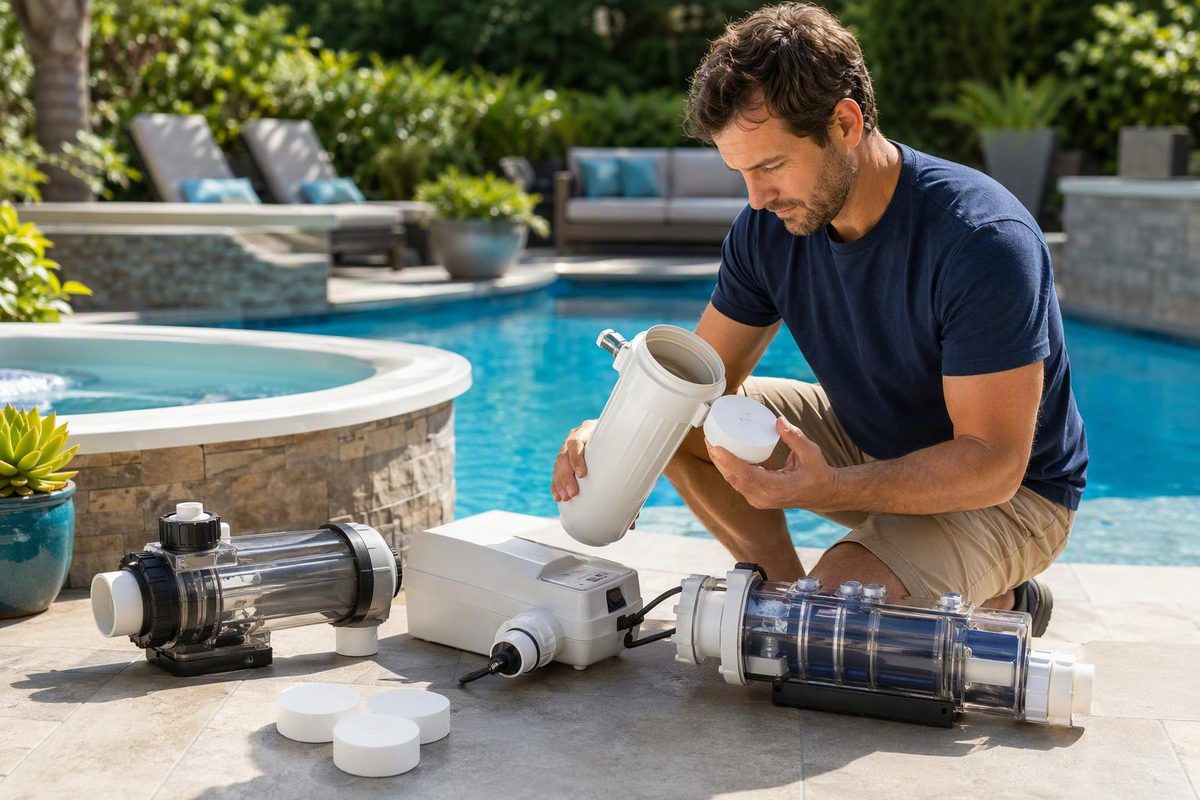
A pool chlorinator either feeds chlorine into the water or generates it from dissolved salt. If chlorine is low, do not replace the chlorinator first: test the water, confirm circulation, then check the equipment’s settings and condition. A flow fault, unsuitable operating schedule or water-chemistry problem can leave the pool short of chlorine without proving the chlorinator has failed.
The checks below cover plumbed tablet feeders and salt chlorine generators for swimming pools—not hot-tub dosing or liquid-chlorine dosing pumps.
Select your chlorinator, water-test status and equipment symptom to find the next check.
Test Water Before Changing Output
Measure sanitizer and pH against the product’s applicable ranges. Identify the chlorinator before using a refill, salt-addition or cleaning procedure.
Swimming status is not established. Verify the water readings; keep swimmers out if sanitizer or pH is outside range, and follow chemical-label re-entry restrictions.
No replacement verdict yet: water tests and equipment checks are needed.
Sources: Hayward CL-series and Pentair IntelliChlor IC15/20/40/60 manuals; CDC water-testing guidance summarized in the article. Other models require their own instructions.
Identify the Chlorinator Before Servicing It
| Type | How to Recognize It | Checks Before Servicing |
|---|---|---|
| Inline tablet feeder | Tablet chamber directly in the return pipe | Approved chemical, connections and flow |
| Offline tablet feeder | Chamber connected by small inlet and outlet tubes | Connection points, tubing and check valves |
| Salt chlorine generator | Electrical cell with controller or status lights | Salt range, capacity, runtime and compatibility |
Hayward’s CL100/200 inline feeders belong after the heater—or after the filter if there is no heater. Its CL110/220 offline models use an inlet connection between the pump and filter, with the outlet after the heater or filter. Do not assume every feeder uses the same plumbing layout: match the exact model’s diagram. Hayward CL-series manual
A saltwater pool still uses chlorine. The cell produces it through electrolysis; it does not eliminate water testing. Pentair specifically states that its IntelliChlor IC15/20/40/60 generates chlorine but does not monitor or control the pool’s chlorine concentration. Pentair IntelliChlor manual
Record Water Readings Before Adjusting Output
Record pool volume in gallons or litres; free and total chlorine in ppm; pH; and cyanuric acid (CYA) in ppm. For a salt system, also record independently measured salt concentration in ppm and water temperature.
Alongside those readings, note the chlorinator setting, pump speed, daily operating hours and any recent heavy swimming, rain, debris accumulation or change in pump schedule. These separate a change in chlorine demand from a change in equipment operation.
Use the sanitizer product’s label to establish the operating range. CDC’s home-pool guidance gives a typical chlorine range of 1–4 ppm and pH of 7.0–7.8, while directing owners to follow their product’s instructions. It recommends checking sanitizer and pH at least twice daily, more often during heavy use. CDC home-pool guidance
For pools using CYA or stabilized chlorine such as trichlor, CDC specifies at least 2 ppm chlorine, rather than its 1 ppm minimum for pools without stabilizer. That is a minimum, not a universal operating target; equipment and product instructions may specify a narrower range.
If a DPD test unexpectedly reads low or zero after a large chlorine addition, verify it before adding more. CDC warns that concentrations above 10 ppm can bleach the test and produce a false-low result. Follow the test-kit manufacturer’s instructions. CDC water-treatment and testing guidance
Keep swimmers out if sanitizer or pH is outside the applicable range, until you have corrected it and verified the result. Follow chemical-label re-entry restrictions as well.
Do not select a universal dial number or tablet count. Hayward’s cited CL-series manual notes that chlorine demand changes with usage, temperature and sunlight, and that the correct setting depends on the pool and filtration cycle. Any separately added corrective treatment must be calculated from pool volume, the measured deficit and the product’s stated strength—not from the feeder’s dial position. There is no universal corrective dose for every pool.
Check Tablet Chemistry, Circulation and Supply
If a tablet chlorinator is not keeping up, work through these checks in order:
- Confirm the chemical. Read both the container label and feeder manual. Hayward’s cited CL-series manual permits only slow-dissolving trichlor tablets—not fast-dissolving tablets, calcium hypochlorite, liquid chlorine or other chemicals.
- Confirm circulation and operating time. Compare the present pump schedule with the schedule used when chlorine was stable. On an offline feeder, visually check for damaged or kinked tubing without disconnecting it under pressure.
- Check the setting and tablet supply. Use the model’s safe opening procedure before inspecting the chamber. Change one operating variable at a time, record it and retest.
- Separate consumption from performance. Tablets disappearing shows that chemical is being consumed; the pool-water test establishes whether enough sanitizer remains.
Never mix chlorine types in a feeder, even if both products are tablets. Hayward warns that mixing trichlor with calcium hypochlorite or other concentrated chemicals can cause fire or explosion. Wear the specified protection, avoid inhaling fumes and never open a pressurized feeder.
Follow the complete shutdown, pressure-release and refill procedure for your model. Installations below pool water level can require additional isolation-valve steps. Hayward safety and refill instructions
Also check CYA. Repeated use of stabilized chlorine tablets can raise it over time, making chlorine less effective. If CYA is above your intended operating range, investigate the chemistry before buying a larger feeder. Pentair water-chemistry guidance
For the chemistry trade-off, see liquid chlorine versus tablets and how to reduce pool CYA.
Use Salt-Cell Status Lights to Choose the Next Check
Read the actual fault or status indication—not just the output percentage.
| Status or Symptom | Next Check |
|---|---|
| Low/no flow | Circulation, pump priming, baskets, filter and valves |
| Low salt | Independent salinity test before adding salt |
| Cold water | Exact model’s production cutoff |
| Inspection warning or scale | Safe inspection; cleaning only as directed |
| Normal status, low chlorine | Output percentage and actual operating hours |
For a flow warning, use the relevant equipment instructions to check circulation, pump priming, baskets, filter condition and valve alignment. Do not bypass the flow switch.
For a low-salt warning, confirm salinity with a separate water test before adding salt. Use the exact cell’s specified range; another model’s target is not interchangeable.
Cold water can stop production without indicating cell failure. IntelliChlor IC15/20/40/60 stops producing below approximately 52°F, with a ±3°F tolerance. That cutoff applies to those models, not every salt chlorinator.
For an inspection warning or visible scale, inspect only after safely shutting down and depressurizing the system. Do not acid-clean a cell merely because chlorine is low. Pentair specifies hose cleaning first and warns that excessive acid washing damages the blades.
If status is normal but chlorine is low, review output percentage and actual operating hours. Both affect daily production; neither measures chlorine remaining in the pool. These checks follow the IntelliChlor operating and maintenance manual; use your model’s thresholds and procedures.
Persistent faults, damaged cables or a leaking or cracked housing require professional service. Electrical wiring and interlocking questions belong with a qualified professional. A salt generator must not produce chlorine without water circulation; Pentair warns that improper wiring can allow hazardous gas buildup. IntelliChlor safety instructions
Replace Only After Confirming Inadequate Delivery
Give the installer your pool volume, water readings, pump schedule, equipment models and observed faults. For a tablet feeder, confirm approved chemicals and plumbing compatibility.
For a salt system, compare rated chlorine production with the hours it can actually operate, and verify that the pool surface, structure and surrounding materials are suitable for saltwater use. The cited IntelliChlor manual specifically excludes storable or steel pools; do not assume every salt system suits every above-ground pool. IntelliChlor compatibility and capacity guidance
Choose replacement capacity only after confirming that inadequate delivery—not an unresolved flow fault or water-chemistry problem—is what needs fixing.