
Liquid Chlorine vs Tablets: CYA, Speed and Dosing
Switching stops new CYA from being added through trichlor, but liquid chlorine does not remove CYA already in the water.
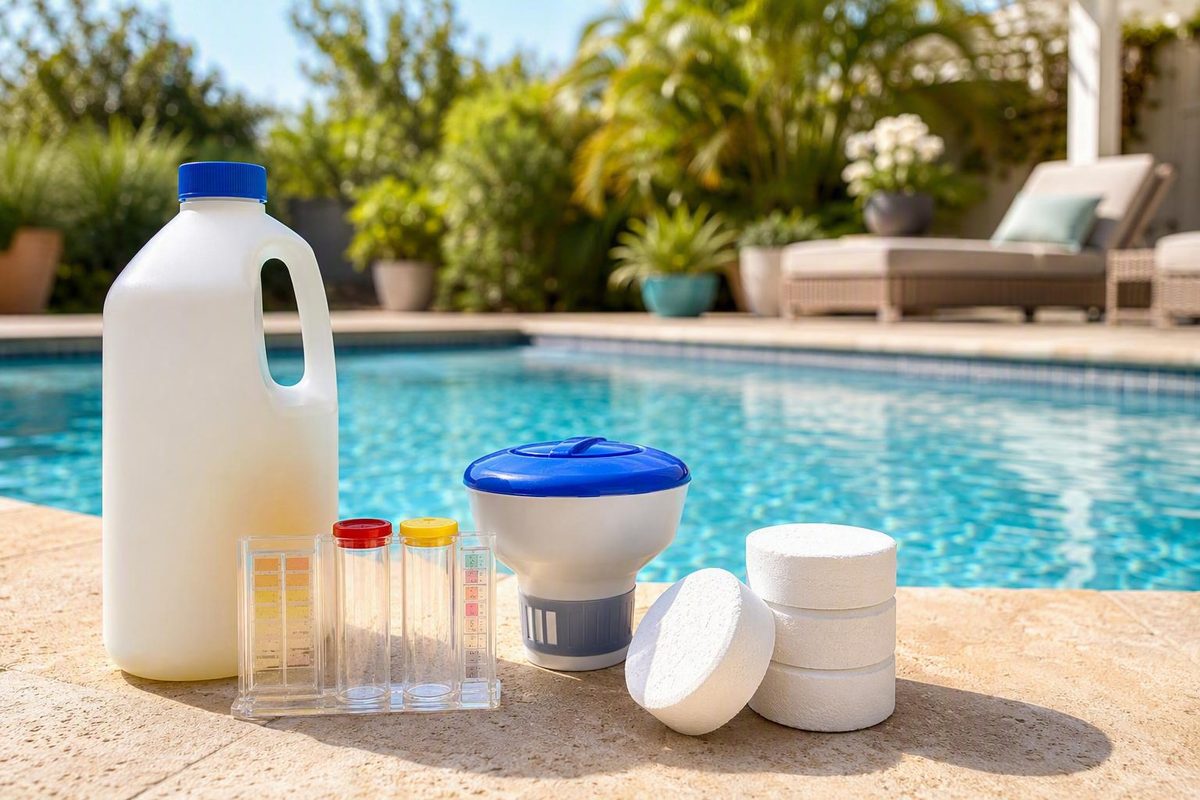
The short answer: liquid for control, tablets for slow release
Neither liquid chlorine nor chlorine tablets are universally better. The right choice depends first on what the water needs and then on how often you can test and dose.
Both correctly dosed sodium hypochlorite and trichlor can sanitize pool water. Liquid chlorine is already in solution, so it disperses quickly and supports prompt, test-guided free-chlorine adjustments. Trichlor tablets dissolve gradually, supplying chlorine over several days while also adding cyanuric acid (CYA), the stabilizer used to protect chlorine from rapid sunlight loss in outdoor pools.
That makes liquid chlorine better for control and tablets better for slow delivery—not better in every circumstance.
Start with reliable free-chlorine, pH, and CYA test results:
- If CYA is already sufficient or elevated: Liquid chlorine raises free chlorine without adding more stabilizer.
- If CYA is low and more stabilizer is intentionally needed: Limited trichlor use can supply both chlorine and CYA.
- If free chlorine must rise promptly: Liquid is more suitable than waiting for tablets to dissolve.
- If nobody will be available to dose for several days: Tablets may provide useful unattended delivery through a compatible, label-approved floater or feeder.
- If frequent manual liquid dosing is impractical: A compatible sodium-hypochlorite metering system may reduce the workload.
A selective combination can also work. An owner might use liquid for normal maintenance but use trichlor temporarily during a vacation when slow delivery and some additional CYA are both acceptable. That is a hybrid routine based on separate uses—not permission to mix the concentrated products.
| Factor | Liquid chlorine | Trichlor tablets |
|---|---|---|
| Active ingredient | Sodium hypochlorite solution | Trichloro-s-triazinetrione, usually called trichlor |
| Delivery speed | Disperses rapidly because it is already in solution | Dissolves gradually over several days |
| CYA contribution | None | Adds CYA with every dose |
| pH tendency | High-pH product; may create upward pH-management pressure | Acidic product; sustained use can lower pH and total alkalinity |
| Dosing method | Measured manual addition or compatible metering pump | Compatible floater or tablet feeder |
| Storage behavior | Loses strength relatively quickly, especially with heat, light, and age | Compact and generally retains strength longer when stored correctly |
| Maintenance effort | Frequent testing and additions unless automated | Less frequent handling, but free chlorine, CYA, pH, and alkalinity still require testing |
| Best fit | Prompt adjustments, adequate or high CYA, chemistry-focused control | Unattended slow feed, vacations, or intentional CYA addition |
Commercial product guidance consistently describes sodium hypochlorite as fast-dispersing and unstabilized, and trichlor as slow-dissolving, stabilized, and acidic. One manufacturer-authored comparison reports common liquid-chlorine concentrations of approximately 10% to 12.5%, while trichlor products are much more concentrated by weight; those percentages still cannot be compared without considering product quantity and pool volume (HASA).
The available evidence for this comparison comes largely from retailers, manufacturers, service companies, and product educators. It supports the broad chemical and operational distinctions, but it does not establish one universal CYA target, dosing schedule, or maintenance method for every residential pool. Current product labels, equipment instructions, applicable local rules, and the standard used for your pool must control the actual dose and operating targets.
Whatever routine you choose, never let concentrated liquid chlorine contact tablets, tablet residue, acid, or another chlorine formulation.
What liquid chlorine and chlorine tablets actually are
Liquid chlorine and tablets are not simply the same chemical in two physical forms. Both ultimately provide chlorine to the water, but their active ingredients and companion chemistry differ.
Pool-grade liquid chlorine is a sodium-hypochlorite solution. The commercial sources supplied for this comparison commonly report concentrations around 10% to 12.5% available chlorine, although the labeled strength varies and can decline during storage. Because the product is already dissolved, it can be measured and added without waiting for a solid to dissolve.
The tablets in a typical liquid-chlorine-versus-tablets comparison are trichlor tablets. Trichlor is a concentrated, stabilized chlorine product designed to dissolve slowly. Supplied commercial guides commonly report approximately 85% to 90% available chlorine for trichlor products, although formulation and labeling vary (iopool).
Those percentages do not mean a product labeled at 90% is automatically nine times the value of one labeled at 10%. A meaningful dose or cost comparison requires:
- The pool’s actual water volume.
- The current free-chlorine result.
- The desired free-chlorine increase under the applicable operating guidance.
- The product’s labeled available-chlorine strength.
- The weight or volume of product being added.
- Any loss of liquid strength during storage.
A percentage on a liquid container describes the concentration of a solution. A percentage on a tablet describes the concentration of a solid by weight. The products also come in different package sizes and release chlorine at very different rates. Comparing front-label percentages alone therefore does not establish dose equivalence, convenience, or value.
Their companion chemistry is more important than their physical form:
- Sodium hypochlorite adds chlorine without adding CYA or calcium hardness.
- Trichlor adds chlorine and CYA and has an acidic effect.
That difference continues to affect the pool after the immediately supplied chlorine has been consumed.
Check the active ingredient on every label. “Tablet,” “granular chlorine,” and “shock” describe product forms or marketing categories, not complete chemical identities. Trichlor is not interchangeable with every other dry chlorine product.
For example:
- Dichlor is another stabilized chlorine and therefore also adds CYA, but its concentration, dissolution behavior, and pH characteristics differ from trichlor.
- Calcium hypochlorite is unstabilized and adds calcium rather than CYA.
- Trichlor is stabilized, slow-dissolving, and acidic.
- Sodium hypochlorite is a liquid, unstabilized chlorine source.
Do not assume every tablet contains trichlor or every granular chlorine contains stabilizer. Read the active ingredient, concentration, application directions, incompatibility warnings, and equipment requirements before calculating a dose.
This comparison is intentionally limited to sodium-hypochlorite liquid and trichlor tablets. Saltwater chlorine generators, mineral products, UV equipment, and other sanitation approaches involve different equipment, cost, and chemistry questions and should not be folded into the same package-level comparison.
Why cyanuric acid should drive the decision
For an outdoor pool, CYA is useful because it protects chlorine from rapid loss in sunlight. Choosing unstabilized liquid chlorine does not mean an outdoor pool should contain no CYA. It means CYA must be tested and managed separately instead of being included automatically with every sanitizer dose.
Liquid chlorine adds no CYA. It can therefore increase free chlorine without simultaneously increasing stabilizer. That becomes especially useful once the pool has reached its selected CYA range or when measured CYA is already higher than intended.
Trichlor works differently. Every dose supplies CYA along with chlorine. A commercial technical guide reports that each 1 ppm of free chlorine supplied by trichlor adds approximately 0.6 ppm of CYA. The same guide describes trichlor as approximately 90% available chlorine and about 52% CYA by weight (In The Swim).
The cumulative relationship is:
Approximate CYA added over time = cumulative free chlorine supplied by trichlor × 0.6
For example, if trichlor supplies a cumulative 10 ppm of free chlorine, it also contributes approximately 6 ppm of CYA before accounting for splash-out, backwashing, leaks, overflow, or other water replacement. This is not a tablet-dose recommendation. It illustrates why repeated trichlor use changes the water gradually even when each individual addition appears routine.
Three practical scenarios follow.
Low measured CYA: Limited trichlor use may be sensible when the pool genuinely needs more stabilizer and slow chlorine delivery is also useful. Continue testing so an intentional increase does not become unnoticed seasonal accumulation.
Appropriate existing CYA: Favor a CYA-free sanitizer when no additional stabilizer is wanted. Liquid chlorine lets you respond to chlorine demand without attaching another CYA addition to every adjustment.
Elevated CYA: Avoid making the situation worse through continued routine trichlor use. Liquid chlorine stops further CYA addition from the sanitizer, although free-chlorine management must still account for the water’s existing chemistry and applicable operating guidance.
Switching from trichlor to liquid chlorine does not remove CYA already in the pool. It only stops adding CYA through that sanitizer. Where CYA must be reduced, partial water replacement is commonly used, as a regional pool-service comparison notes while distinguishing the effects of changing sanitizer from the separate task of lowering existing CYA (Crowne Hill Pools).
“Chlorine lock” is sometimes used as shorthand for problems associated with excessive stabilization, but the term is imprecise. A single CYA reading does not prove that chlorine has become completely ineffective. The more useful approach is to measure CYA and free chlorine and then manage them together under the framework applicable to the pool.
The supplied commercial evidence does not establish one universal CYA threshold for every residential pool. Indoor versus outdoor use, local requirements, the selected test method, sunlight, operating conditions, and the chlorine-management framework all matter. Use current governing guidance and sanitizer labels to establish targets rather than copying a generic number from a product comparison.
Speed, dosing frequency, and day-to-day convenience
Liquid chlorine is already in solution. Once added correctly with suitable circulation, it disperses rapidly and is better suited to a prompt, measured increase in free chlorine than a slow-dissolving tablet.
Trichlor tablets are designed for a different job. They dissolve gradually in a compatible floater or feeder and release chlorine over time. That can smooth delivery between maintenance visits, but it makes tablets poorly suited to rapid corrections. Adding more tablets does not make them dissolve like liquid; delivery still depends on the product, dispenser setting, water flow, and operating conditions.
Commercial pool guidance distinguishes rapidly dispersing liquid chlorine from tablets that release chlorine over several days (Leslie’s).
The day-to-day tradeoff is straightforward:
- Manual liquid routine: Test frequently, calculate the required dose, add it as directed, circulate, and retest when appropriate.
- Tablet routine: Load a compatible dispenser less often, but continue testing free chlorine, CYA, pH, and alkalinity.
- Automated liquid routine: A compatible sodium-hypochlorite metering system can reduce hand feeding while preserving CYA-free dosing.
Automation does not eliminate testing or maintenance. A metering system still requires chemical supply, equipment inspection, calibration, and adjustment as pool demand changes. It simply removes the assumption that liquid chlorine must always be poured by hand.
No universal dosing schedule works because chlorine demand and product delivery vary with:
- Pool volume
- Labeled product strength
- Current free chlorine
- Sunlight exposure
- Water temperature
- Rainfall and water replacement
- Circulation and feeder flow
- Swimmer load
- Organic contamination
- The age and storage history of liquid chlorine
This is also why one tablet cannot be declared equivalent to a fixed volume of liquid chlorine. Tablet weight and composition vary, liquid strength varies, and stored liquid may no longer deliver its original nominal concentration.
Use a label-based comparison instead:
- Confirm the pool’s water volume.
- Test current free chlorine.
- Determine the desired increase under the operating guidance applicable to the pool.
- Read each product’s labeled strength.
- Use the product label’s dosing table or a calculator that accepts both pool volume and product strength.
- Compare the amount of each product needed to deliver the same increase.
- Account separately for delivery time, CYA addition, pH tendency, and storage loss.
A rapid treatment should be framed as a measured need to raise free chlorine—not as an automatic instruction to “shock” every pool on a weekly calendar. Test results and the reason for treatment should determine the response.
Convenience should also be evaluated honestly. If you cannot test and add liquid often enough to maintain the required sanitizer level, an otherwise attractive chemistry choice may become a poor operating method. Conversely, tablets are not genuinely low-maintenance if they create unwanted CYA accumulation or repeated downward pH and alkalinity trends.
The best routine is the one that fits both the measured water chemistry and the owner’s realistic availability.
Water-balance effects beyond chlorine
Sanitizer choice affects more than free chlorine. It can create recurring trends in pH, total alkalinity, CYA, and dissolved solids, although the complete pool system—not the package pH alone—determines what will be observed over time.
Trichlor is acidic. Supplied commercial sources report a product pH of approximately 2.5 to 3, while sodium hypochlorite is commonly reported near pH 13 (iopool).
Sustained trichlor use can create downward pressure on pool pH and total alkalinity, particularly when trichlor is the dominant sanitizer and the pool has limited opposing influences. A pool that repeatedly needs pH and alkalinity raised should prompt a review of how much acidic trichlor it receives.
Sodium hypochlorite’s high product pH can create upward pH-management pressure, but product pH is not a complete model of long-term pool-water behavior. Dose size, chlorine consumption, aeration, fill water, alkalinity, water features, pool surfaces, and other chemical additions all influence the measured trend.
Do not assume every liquid-chlorine dose automatically requires acid. Test first. A pool with recurring high pH needs an evaluation of the entire system rather than an automatic conclusion that liquid chlorine is solely responsible.
The cumulative companion additions also differ:
- Liquid chlorine: Adds some sodium or salt-related dissolved solids but no CYA or calcium hardness.
- Trichlor: Adds CYA rather than calcium and tends to push pH and alkalinity downward.
- Calcium hypochlorite: Adds calcium, which is one reason it should not be treated as equivalent to trichlor.
- Dichlor: Adds CYA but differs from trichlor in concentration and pH characteristics.
These effects are not inherently good or bad. They are useful or undesirable according to the current water.
A pool with low CYA may benefit from an intentional, limited trichlor contribution. A pool with sufficient CYA and recurring low pH may be poorly matched to heavy trichlor reliance. A pool with low calcium hardness does not gain calcium from either trichlor or sodium hypochlorite.
Sanitizer selection should therefore respond to measured chemistry rather than substitute for complete water-balance testing. At minimum, continue monitoring free chlorine, pH, and CYA. Total alkalinity and other balance factors should be checked according to pool type, surface, equipment, fill water, and applicable guidance. Clear-looking water is not a substitute for reliable testing.
Storage, freshness, handling, and real-world cost
Trichlor tablets are compact and generally retain their strength longer than liquid chlorine when stored correctly. That makes them easier to keep for intermittent use, but they remain reactive oxidizing chemicals and require secure, dry, separated storage.
Liquid chlorine is bulky and heavy relative to the amount of available chlorine transported. It also loses potency faster with age, heat, and light. A degraded container may deliver less chlorine than a calculation based on the original label concentration predicts.
There is no defensible universal shelf life for every liquid-chlorine product in the supplied evidence. Commercial estimates range from weeks to months because concentration, manufacturing date, temperature, light exposure, container conditions, and the definition of “usable” potency are not standardized. A manufacturer-authored comparison nevertheless agrees with retailer guidance on the broader point: tablets generally store longer, while liquid chlorine requires attention to freshness and cool, shaded storage (HASA).
Practical steps include:
- Buy from a supplier with reasonable product turnover.
- Purchase quantities that can be used while reasonably fresh.
- Store the product in its original container as directed by the label.
- Keep liquid chlorine in the cool, shaded, ventilated location specified by its label.
- Avoid buying more than your routine and storage conditions justify.
- Recheck the assumptions behind a dose if an older product produces a smaller test-measured increase than expected.
That last point is a diagnostic prompt, not proof that age is the only cause. An unexpected result can also reflect inaccurate pool volume, testing error, unusual chlorine demand, circulation, or a labeling assumption.
Package price alone does not establish which option costs less. Neither does the advertised chlorine percentage. A fairer comparison is:
Cost per delivered free-chlorine increase for the actual pool volume
To compare products, determine how much of each is required to deliver the same free-chlorine increase using the pool volume and current labeled strength. Then divide the package price by the number of equivalent doses it contains. For liquid, consider whether storage loss means the later portion of a package may deliver less than its original rating.
Other ownership costs may include:
- Test reagents and testing time
- Liquid lost to aging or unsuitable storage
- pH- or alkalinity-adjustment chemicals
- A compatible tablet feeder or floater
- A liquid metering pump, tubing, and maintenance
- Labor or pool-service visits
- Water replacement if CYA accumulates beyond the selected target
- Suitable storage space and containment
No supplied evidence supports declaring either form categorically cheaper in every market. Local prices, season length, chlorine demand, storage temperature, water rates, existing equipment, and owner labor can change the result. The evidence also does not establish that either product is always safer to transport or environmentally superior.
Real-world value is the cost of maintaining the required water conditions—not the price of the package with the largest percentage printed on it.
A CYA-first decision tree for choosing or combining them
Begin with reliable free-chlorine, pH, and CYA measurements. Do not choose a sanitizer based only on water appearance, habit, or the day of the week.
1. Is CYA already sufficient or elevated under the guidance you use?
If yes, favor liquid chlorine for additional sanitation. It raises free chlorine without adding more stabilizer. Continue measuring CYA because leaks, splash-out, overflow, backwashing, and intentional water replacement can change it over time.
2. Is CYA low, and is an increase intentionally needed?
Limited, test-guided trichlor use may serve two purposes: slow chlorine delivery and gradual CYA addition. Estimate the cumulative CYA contribution, monitor the actual result, and stop using trichlor when no more stabilizer is wanted.
3. Does free chlorine need to be raised promptly?
Use a label-calculated liquid-chlorine dose rather than waiting for tablets to dissolve. Base the dose on actual pool volume, current free chlorine, desired increase, and the product’s current labeled strength. Circulate and retest as directed by the product label and testing method.
4. Will the pool be unattended for several days?
Consider trichlor tablets in a compatible, label-approved floater or feeder. Before leaving, confirm through testing that the pool can accept the additional CYA and acidic contribution. Do not make an untested last-minute change to the dispenser or feeding method.
5. Is compatible liquid automation available?
A properly selected sodium-hypochlorite metering system can combine controlled, CYA-free delivery with less manual feeding. It still requires chemical storage, inspection, calibration, and regular water testing.
Commercial and regional sources disagree about which product should be the default. Some favor tablets for residential convenience; others favor liquid for chemistry control. Those recommendations often reflect local climate, service frequency, or the publisher’s commercial perspective. Testing resolves the decision more usefully than choosing a universal side.
When switching from tablets to liquid:
- Test free chlorine, pH, and CYA.
- Stop adding tablets if no more CYA is wanted.
- Follow the product and dispenser instructions when removing or allowing existing tablets to dissolve.
- Confirm pool volume and the labeled liquid-chlorine strength.
- Calculate the liquid dose from the product label.
- Add it separately at the label-approved location.
- Circulate as directed.
- Retest and continue dosing from measured demand rather than the former tablet schedule.
A hybrid routine means assigning each product a defined job at different times. It does not mean pouring liquid onto tablets, using both products in the same feeder, or sharing contaminated tools.
The final choice also depends on sunlight, water temperature, season length, swimmer load, rainfall, water replacement, storage conditions, circulation, automation, and how often someone can test. CYA is the first branch of the decision tree, not the only branch.
Non-negotiable chlorine handling and dispensing rules
Warning: Never mix concentrated chlorine products directly with one another or with acids. Never pour liquid chlorine into a feeder, skimmer, container, or tool that contains tablets or tablet residue.
Contamination involving chlorine products can release toxic gas and may produce intense heat, fire, or an explosion. Mixing chlorine with acid can generate chlorine gas, while mixing incompatible chlorine formulations can also cause a violent reaction. Virginia Poison Center guidance recommends handling one product at a time, working in an open area, using separate clean tools, and wearing gloves and goggles (VCU Health).
Follow these evidence-supported rules:
- Read the product label before opening, handling, or dosing.
- Add only one chemical at a time.
- Work outdoors or in an adequately ventilated area.
- Use separate, clean tools for different chemicals.
- Wear the gloves and eye protection specified by the label.
- Keep chlorine products dry or otherwise stored exactly as their labels direct.
- Keep incompatible chemicals physically separated.
- Store products sealed in a cool, dry, secure, well-ventilated location.
- Keep every pool chemical away from children and pets.
- Follow the product, equipment, and applicable local requirements.
Use trichlor tablets only through a compatible dispensing method permitted by both the tablet label and the equipment instructions, generally a suitable floater or purpose-built feeder. Commercial product guidance also advises against placing tablets directly on pool surfaces (In The Swim).
Do not casually put tablets in a skimmer. When circulation stops, concentrated acidic chlorinated water can remain in the skimmer and connected plumbing. When flow resumes, that water can pass through pool equipment. The tablet label and the instructions for the feeder, pump, and other equipment govern the acceptable dispensing location.
Liquid chlorine must never be poured into a skimmer, feeder, or other location that contains tablets or tablet residue. Saying that both products can be used in one pool means the pool water can receive each through separate, approved methods. It does not mean the concentrates are compatible.
Contact Poison Help at 1-800-222-1222 for significant exposure concerns. Call 911 for severe symptoms such as breathing difficulty, chest pain, or loss of consciousness; these response recommendations are provided by VCU Health and the Virginia Poison Center.
Frequently Asked Questions
Is liquid chlorine or tablets better for everyday pool maintenance?
Liquid chlorine is often the better everyday choice when CYA is already where it should be under the operating guidance you follow. It supplies chlorine without continually adding stabilizer and suits owners who test frequently or use a compatible metering system.
Trichlor may be more convenient when slow unattended delivery is important and the pool can intentionally accept more CYA. That convenience must be weighed against cumulative stabilizer addition and the product’s acidic tendency.
The answer can change during the season. A pool might use limited tablets while CYA is low, switch to liquid once no more CYA is wanted, and use tablets selectively during an absence.
Can I use liquid chlorine and tablets in the same pool?
Yes, they can be used in the same body of water at different times and for defined purposes. Liquid might handle ordinary test-guided dosing while tablets provide temporary slow delivery during a vacation.
The concentrated products must never contact each other. Do not pour liquid chlorine into a tablet feeder or a skimmer containing tablets, place tablets in a liquid-chlorine container, or transfer either product with a contaminated tool. Use each only through its label-approved method and keep the products physically separate during storage and dispensing.
Will switching from tablets to liquid chlorine lower my CYA?
No. Switching stops new CYA from being added through trichlor, but liquid chlorine does not remove CYA already in the water.
If measured CYA must be reduced, partial water replacement is commonly required. The amount should be based on the measured starting concentration, the selected target, and the replacement water—not a generic draining percentage. Follow pool-specific and local guidance before removing a substantial volume of water.
Can liquid chlorine be used to raise chlorine quickly?
Yes. Because sodium hypochlorite is already in solution, it disperses much faster than slow-dissolving trichlor tablets and is better suited to a prompt, measured free-chlorine increase.
Calculate the dose from current test results, pool volume, desired increase, and labeled product strength. Do not assume an old container retains its original concentration, and do not copy a fixed volume from another pool. Rapid treatment should respond to a measured need rather than an automatic calendar-based shock routine.
Should chlorine tablets go in the skimmer, a floater, or a feeder?
Use tablets only where both the tablet label and equipment instructions permit—generally in a compatible floater or purpose-built feeder. Do not place them directly on pool surfaces.
Avoid casual skimmer placement. Tablets can create highly concentrated, acidic chlorinated water in the skimmer and connected plumbing, especially while circulation is off. Never add liquid chlorine to a skimmer, feeder, or any other location containing tablets or tablet residue.
The final rule is simple: test first. Use liquid chlorine when the pool needs fast, controllable chlorine without more CYA. Use trichlor selectively when slow unattended delivery and additional stabilizer are both useful. Recheck free chlorine, pH, and CYA as conditions change, calculate every dose from the product label and pool volume, and keep all concentrated chemicals physically separate.