
Can Pool Chlorine Tablets Catch Fire From Water?
See how plain water triggered trichlor decomposition and fire, then check whether a garage or shed exposes chlorine tablets to leaks or flooding.
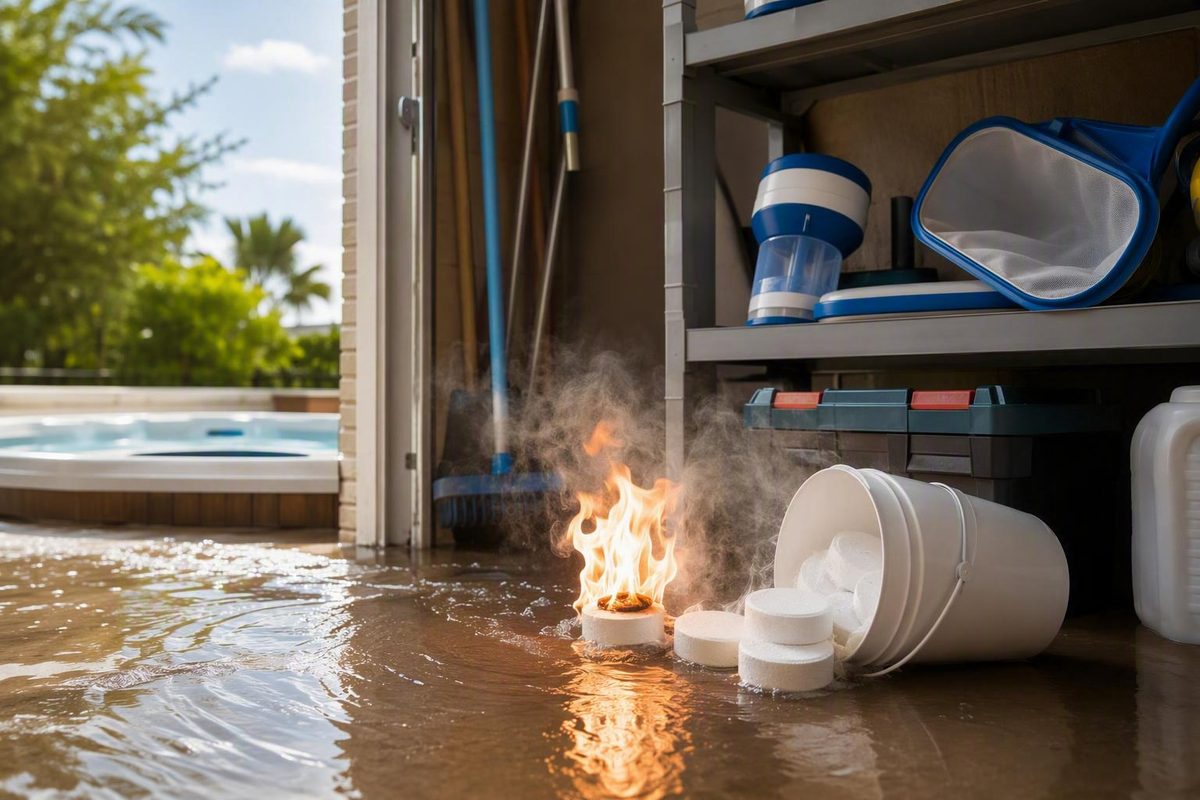
Yes. Plain water alone can initiate a heat-producing decomposition and fire involving concentrated trichlor tablets; bleach, acid, bromine, or another pool chemical does not have to be present. The industrial-scale proof is the 2024 Bio-Lab fire in Conyers, Georgia, whose toxic release led roughly 90,000 people to shelter in place, according to the U.S. Chemical Safety Board’s final investigation.
That does not mean an intact tablet routinely bursts into flame during normal household storage. Chlorine tablets are oxidizers rather than ordinary fuels, and the Bio-Lab warehouse held nearly 14 million pounds of chlorinated isocyanurates and other reactive chemicals. The backyard lesson is narrower: a bucket in a garage or shed needs protection from roof leaks, sprinkler overspray, plumbing drips, wet floors, flooding, and damp tools—not merely separation from other chemicals.
Select your container, water exposure, shelf position, and ventilation; the checker identifies which side wins for that storage spot.
Chlorine-Tablet Storage-Spot Checker
This planning screen prioritizes direct water paths. Its 0–100 score organizes the checklist; it is not a measured probability of fire and does not replace the product label or Safety Data Sheet.
Describe the Storage Spot
Move the bucket out from beneath the sprinkler path. Having no other chemicals nearby does not remove this direct water trigger.
Chemical-separation assumption: No acid, bleach, bromine, cal-hypo, fuel, or other incompatible product is nearby. The default still rates high because plain water is enough to initiate decomposition.
| Storage Factor | Current State | Screen Effect | Required Response |
|---|---|---|---|
| Sprinkler water | Direct path identified | +55 | Relocate outside the spray and drip area |
| Roof or pipe water | No path selected | +0 | Confirm during rain and inspect overhead joints |
| Floor or flood water | No path selected | +0 | Keep drainage and runoff under review |
| Floor position | Raised 12 inches | +0 | No height guarantees flood protection |
| Container | Bucket with secured lid | +8 | Retain the original labeled container |
| Ventilation | Ordinary garage or shed ventilation | +5 | Improve only as the label directs |
| Other chemicals | None assumed nearby | +0 | Continue separating acids, shock, fuels, and combustibles |
Editorial scoring: direct water path +55 each; floor placement +15 when the container is at 0 inches; package screen +5 to +15; ventilation screen +0 to +10. Scores are capped at 100. These weights rank inspection priorities and are not incident probabilities or product specifications.
Source: U.S. Chemical Safety Board final Bio-Lab Conyers investigation; Atlanta Journal-Constitution summary of the final findings. The CSB found that sprinkler water initiated decomposition of chlorinated-isocyanurate material without another chemical triggering the event.
The Usual Separation Advice Is Correct but Incomplete
The received wisdom is that chlorine tablets must be separated from muriatic acid, calcium hypochlorite shock, bromine products, fuels, oils, and organic material. That advice is sound.
Trichlor and calcium hypochlorite can react violently when their concentrated forms or residues mix, producing intense heat, fire, an explosion, or toxic gas. Acid contacting chlorine product or residue can release toxic chlorine gas. Gasoline, solvent, oily rags, cardboard, leaves, and sawdust can supply fuel that an oxidizer helps burn more intensely. The Virginia Poison Center’s pool-chemical guidance therefore calls for one product at a time and clean, dedicated tools.
Separation, however, does not address the initiating event identified at Bio-Lab. The CSB found that water from a corroded sprinkler contacted chlorinated-isocyanurate pool chemicals at about 5 a.m. on September 29, 2024. No second chemical was needed to begin the reaction.
For home storage, that changes the order of inspection. First look above and below the container for water paths. Then check chemical separation, combustibles, heat, security, and ventilation. A bucket stored alone beneath a suspect roof valley is not made safe by the absence of acid or shock.
Plain Water Started the Bio-Lab Decomposition
The CSB reported that approximately 5,000 sacks, each holding 2,205 to 2,805 pounds, decomposed after sprinkler water reached the stored material. The reactions produced substantial heat and off-gassing, additional sprinklers activated, more material became wet, and the incident escalated into fires and a major toxic release.
The resulting smoke contained chlorine, hydrogen chloride, bromine, and other substances. Roughly 17,000 people were evacuated, about 90,000 sheltered in place, and a shelter advisory remained in effect for 17 days within a 2-mile radius.
The sprinkler leak was not an unforeseeable event. Inspections in 2021 and 2022 had identified hundreds of corrosion deficiencies, but sprinkler heads were left to “run to failure,” according to The Atlanta Journal-Constitution’s account of the final findings.
Storage design then magnified the consequences. Sacks were double-stacked against a barrier area known as “the bunker,” restricting access to the leak for employees and responders. Inventory, storage density, water access, delayed intervention, industrial packaging, and warehouse design all affected the scale.
Those facts do not establish that one consumer tablet will behave like a warehouse inventory. They do establish the reaction pathway: localized water contact can make concentrated chlorinated isocyanurate decompose, release heat and gas, and become self-sustaining. At home, the relevant prevention step is eliminating credible water paths before they reach the original container.
Pool Water and Water Inside a Bucket Are Different Conditions
Trichlor is intended to dissolve into a pool when used exactly as its label directs. That controlled addition into a large circulating volume is different from a small amount of water entering concentrated dry product in a container.
Inside a bucket, water can create a localized reaction before heat and gases have room to disperse. The outcome depends on the active ingredient, product quantity, amount of water, temperature, contamination, confinement, container condition, ventilation, and nearby materials. The available evidence does not provide a universal amount of water that will start a household-container fire.
Moisture exposure also does not guarantee visible flames. A damp container may heat, smoke, off-gas, or build pressure. Chlorine-containing gas can accumulate in a closed container and be released toward the person opening it, as described in pool-chemical container guidance from The Redwoods Group.
Keeping the lid secured is preventive advice for normal storage. It is not a reason to approach or open a container that is hot, swollen, smoking, visibly reacting, burning, or releasing fumes.
Water Exposure Comes First in a Storage Inspection
A garage, shed, basement, or pump room is not safe or unsafe by name. Its suitability depends on the actual paths by which water, incompatible chemicals, heat, or combustible material could reach the product.
| Inspect First | Unsafe Condition | Safer Arrangement |
|---|---|---|
| Overhead water | Sprinkler, pipe, roof valley, gutter joint, or condensation above the container | Move the container outside the possible drip and spray area |
| Floor water | Flood-prone slab, doorway runoff, groundwater, or routine washdown | Use stable storage away from the water path; no shelf height is universally safe |
| Container | Damaged, unlabeled, reused, or improperly closed package | Keep the product in its original labeled container and close it as directed |
| Surroundings | Acid, shock, fuel, oils, cardboard, leaves, heat, or ignition sources | Segregate incompatibles and remove combustible clutter |
Start by looking up. A sound shelf does not protect a bucket from a corroded sprinkler, plumbing joint, sweating pipe, or leaking roof directly above it. Roof valleys and penetrations deserve particular scrutiny because water can appear far from the visible exterior defect.
Then look down. Raising a container can reduce contact with ordinary floor dampness, but the draft evidence provides no validated shelf height that guarantees protection during flooding. Do not invent one. Consider the site’s actual drainage, flood history, doorway runoff, and applicable product instructions.
Check the container itself. Keep tablets in the original labeled package, with the active ingredient and emergency directions readable. Do not transfer trichlor into a household pail or a bucket that previously held another pool product. “Empty” equipment can retain incompatible residue in seams, screens, plumbing, or beneath a rim.
Finally, inspect the surrounding area. Separate tablets from muriatic acid, calcium hypochlorite shock, ammonia, fertilizer, gasoline, paint, solvents, oil, grease, rags, cardboard, leaves, sawdust, trash, heaters, sparks, and smoking areas. Good separation remains necessary even though it would not have prevented the initiating sprinkler leak at Bio-Lab.
The Active Ingredient Determines the Incompatibilities
“Chlorine” describes the sanitizing job, not one interchangeable chemical. Slow-dissolving pool tablets commonly contain trichloroisocyanuric acid, or trichlor. Other products may contain dichlor, calcium hypochlorite, or sodium hypochlorite.
Do not identify a product by tablet shape, package color, bucket size, or brand familiarity. Read the active ingredient and concentration on the original label, then follow that product’s current Safety Data Sheet.
A bag labeled “shock” is not interchangeable with trichlor tablets. Never pour calcium hypochlorite shock into a trichlor feeder, place trichlor in equipment that held cal-hypo, or use one scoop for both. Do not combine old and new batches, unidentified remnants, or spilled material for convenience.
Use a clean, completely dry, dedicated tool for each product. A wet scoop introduces the trigger discussed here; a contaminated scoop can introduce another reactive chemical. Never return excess material to a container if its identity, purity, or dryness is uncertain.
Heat Worsens a Problem but Does Not Prove Spontaneous Ignition
The evidence does not show that correctly stored, intact tablets routinely ignite solely because a garage or shed becomes warm. Heat can accelerate decomposition and make moisture exposure or contamination progress faster, but ordinary warmth is not by itself proof of spontaneous ignition.
Keep the product cool and shaded as its label requires. Avoid direct sunlight, heaters, boilers, hot motors, flames, sparks, and enclosed spaces where heat accumulates. The draft evidence supplies no universal storage temperature for every formulation, so the exact product label and Safety Data Sheet control.
Ventilation also matters, but it does not cancel a water path. Better airflow may reduce the accumulation of heat or fumes in normal storage; it cannot make sprinkler water or a roof leak harmless. Likewise, a tightly closed container can help keep routine moisture out but may become hazardous to open after suspected contamination.
Wet or Reacting Tablets Require Distance, Not Inspection
A suspected reaction is not the time to identify the product by smell, lift the lid, or carry the bucket outdoors. Chlorine-containing and corrosive vapors can injure the eyes and respiratory tract even when no flame is visible.
If a tablet container is dangerously hot, smoking, burning, visibly reacting, swollen, or releasing fumes:
- Move away immediately.
- Keep children, pets, neighbors, and bystanders out of the area.
- Call emergency services or the fire department from a safe location.
- State that pool chlorinating chemicals or an oxidizer may be involved.
- Follow responders’ instructions.
Do not open, move, sniff, stir, sweep, vacuum, or attempt to separate the contents. Do not add another chemical or pour a small amount of water into the container. Do not assume a household fire extinguisher is suitable.
Professional firefighting guidance may call for large quantities of water applied from a distance under controlled conditions. That is different from adding limited water to concentrated product in a bucket. CANUTEC’s swimming-pool chlorine incident guidance advises evacuation and fire-department involvement for most fires and leaves suppression decisions to trained responders.
If a container may have been damp previously but shows no heat, smoke, swelling, visible reaction, fire, or fumes, do not casually open it to check. From a safe location, consult the label and Safety Data Sheet, then contact the manufacturer, local fire authority, or household hazardous-waste program. Provide the active ingredient, approximate quantity, visible container condition, and suspected exposure without manipulating the product.
A Dry, Separated Container Is the Defensible Standard
For ordinary household quantities, the evidence supports a scoped answer: intact tablets stored correctly are not shown to ignite routinely on their own. The Bio-Lab findings nevertheless remove the assumption that another pool chemical must be involved before trichlor becomes a fire hazard.
The defensible storage order is to eliminate overhead and floor-level water exposure, retain the original labeled container, separate incompatible chemicals and fuels, remove combustible clutter, control heat, and provide the ventilation and security required by the label. If a storage location fails the water check, chemical separation alone does not rescue it.