
Robotic Pool Cleaner Battery Fire Risk and Recalls
See which pool robot recalls are confirmed, when charging becomes unsafe, where to charge, and which battery symptoms mean stop using it now.
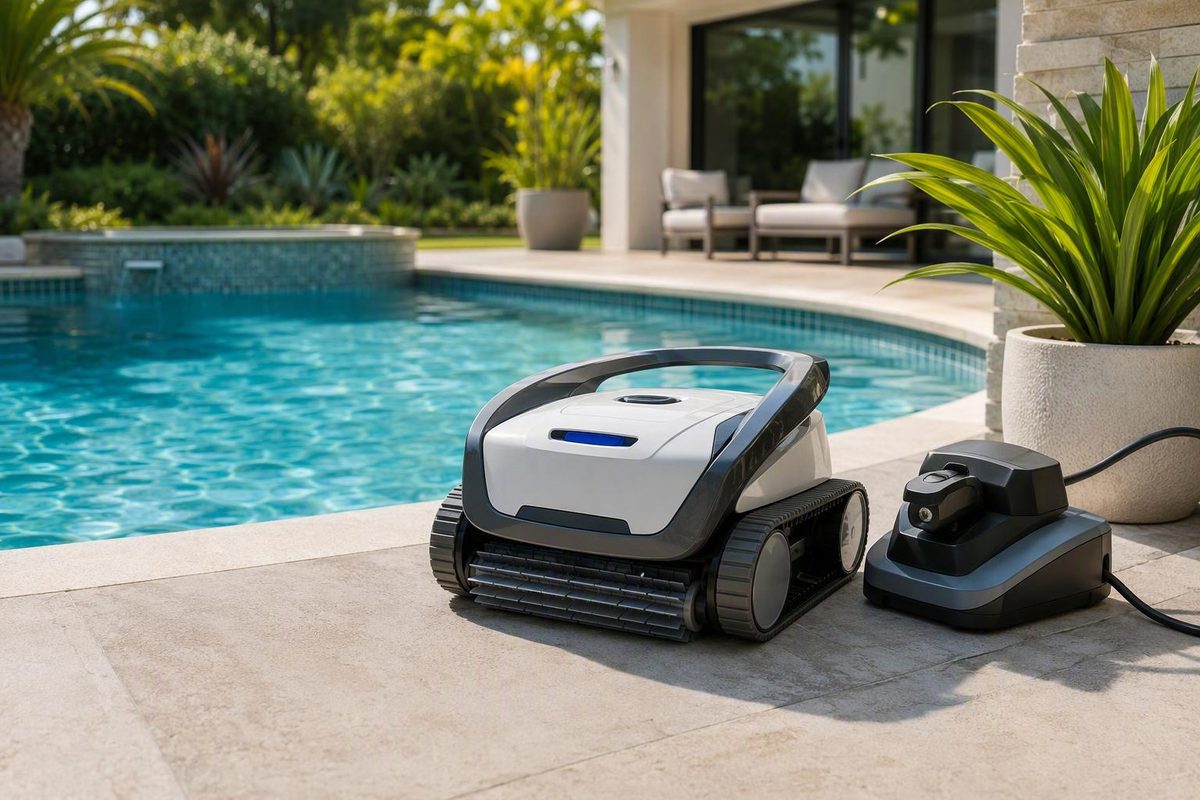
Yes. A cordless robotic pool cleaner’s lithium-ion battery can catch fire. The clearest documented triggers are charging an affected True Blue cleaner in hot weather or direct sunlight; recalled Wybot cleaners have also overheated or burned while charging and while unplugged. Do not charge in direct sun, outside the permitted temperature range, with an unapproved charger, or after any abnormal heat, swelling, odor, leakage, noise, or charging behavior.
Choose your cleaner, charging setup, temperature, battery condition, and recall status for a charge-or-stop verdict.
This screens the setup for known stop conditions. “Low” means no listed concern was selected; it does not mean zero fire risk.
Check the exact model and serial number before charging.
The default cordless setup has no reported battery symptom, but its recall status is unknown. A shaded outdoor location must also meet the manual’s moisture, surface, and ventilation rules.
Safest next step: Verify the recall status, then use a cool, dry, shaded location away from combustibles and exits if the manual permits it.
| Selection | Rating | Reason | Required Action |
|---|---|---|---|
| Corded, no onboard battery | LOW for onboard battery fire | The specific onboard lithium-ion hazard is absent. | Follow the cleaner’s electrical and operating instructions. |
| Recall status not checked | MEDIUM | Recall eligibility depends on the complete model and serial number. | Check the current regulator notice before charging. |
| Exact unit is recalled | STOP | Normal appearance does not cancel a recall. | Do not charge or test; follow the official remedy. |
| Direct sunlight | STOP | The True Blue notice identifies direct-sun charging as a fire condition for affected units. | Do not begin or continue charging there. |
| Below 0°C or above 40°C | STOP | Outside the general USFA lithium-ion charging range. | Wait for a permitted temperature and follow any narrower manual limit. |
| Third-party or uncertain charger | STOP | A fitting plug does not prove compatibility. | Obtain the manufacturer-specified equipment. |
| Slow charge or reduced runtime | STOP | Abnormal performance requires model-specific assessment. | Stop use and charging; contact the manufacturer. |
| Heat, odor, color change, or noise | STOP | These are lithium-ion battery warning signs. | Keep people away and obtain professional instructions. |
| Swelling, deformation, or leakage | STOP | Physical battery change requires immediate stop-use action. | Do not puncture, open, charge, or put it in household trash. |
| Smoke, sparks, venting, or flames | EMERGENCY | The product is actively failing. | Withdraw, keep others away, and call emergency services. |
A garage or shaded deck is not automatically safe: confirm that it is dry, within the cleaner’s permitted temperature range, away from combustible materials, and allowed by the manual.
Sources: Australian Product Safety recall PRA 2026/20991; U.S. CPSC recall 26-372; U.S. Fire Administration lithium-ion battery guidance. Ratings are precautionary screening results, not failure probabilities.
Stop Immediately for a Recall or Battery Warning Sign
A recalled cleaner should not be tested again simply because it looks normal. Match the complete model and serial number against the regulator notice, stop using an affected unit, and follow the official refund or replacement process.
For a stable affected True Blue cleaner, stop using it immediately. Unplug it and place it in a cool location only if that can be done safely. Call True Blue Customer Service on 1300 827 665 to arrange free courier collection. Bunnings will arrange a full refund after collection, according to the Australian Product Safety recall notice.
For an affected Wybot cleaner, stop using it and contact Wybotics for the free replacement process described in CPSC recall 26-372. Do not recharge it or run another cleaning cycle. Reports associated with this recall involved cleaners both while charging and while not charging, so unplugging the unit does not make it safe to resume using.
If a cleaner is excessively hot, swollen, leaking, discolored, deformed, producing an unusual odor, or making unfamiliar sounds, stop using and charging it. Keep people away, avoid unnecessary handling, and obtain instructions from the manufacturer, recall operator, local fire service, or hazardous-waste authority.
If it is smoking, sparking, venting, or burning, get everyone away and call emergency services. Do not put yourself at risk by unplugging, moving, opening, transporting, or submerging it.
Never put a damaged lithium-ion cleaner or battery in household trash. Government guidance identifies excessive heat, odor, shape or color changes, leakage, and unusual sounds as stop-use signs and directs consumers to keep lithium-ion batteries out of household trash (U.S. Fire Administration battery guidance).
The Fire Risk Is Real but Product-Specific
A defective, damaged, or improperly used lithium-ion battery can generate excessive heat. In some failures, the rising temperature drives reactions that produce still more heat. This self-accelerating process is commonly called thermal runaway, and it can lead to fire or explosion.
That mechanism is a general explanation, not a confirmed internal diagnosis for the True Blue or Wybot incidents. The official notices identify overheating and fire hazards but do not establish a detailed root cause.
The ACCC describes lithium-ion battery fires across consumer products as rare but serious and warns that they can be dangerous and difficult to extinguish. Those observations cover consumer batteries broadly, not robotic pool cleaners, and cannot establish a pool-robot fire rate (ACCC lithium-ion battery warning).
No reliable category-wide probability is available from the evidence reviewed here. Calculating one fire per a given number of cleaners would require consistent incident reporting, sales-adjusted data, product ages, and comparable definitions. The available evidence does not identify which cordless brand has the lowest fire rate.
An intact cordless cleaner outside a recall is not proven defective merely because it contains a lithium-ion battery. Conversely, an official recall or an abnormal battery symptom warrants immediate action even if a failure remains statistically uncommon.
Two Confirmed Pool-Robot Recalls Require Serial Checks
The confirmed recalls apply to specific products and serial numbers, not every cleaner sold under either brand.
| Product | Recall Details | Evidence | Remedy |
|---|---|---|---|
| True Blue rechargeable cleaner | Australia, PRA 2026/20991, August 6, 2026 | Fire while charging; hot weather or direct sunlight identified | Stop use; free collection and Bunnings refund |
| Wybot Osprey 700 Max and S1 | U.S., CPSC 26-372, April 9, 2026 | About 5,000 units; 10 overheating or fire reports, nine with property damage | Stop use; free WYBOT C2 replacement |
True Blue Cleaners Sold at Bunnings
The Australian recall covers affected True Blue rechargeable robotic swimming pool cleaners sold nationally by Bunnings Warehouse from November 1, 2023, through April 30, 2025. It does not cover every True Blue product.
Australian Product Safety published recall PRA 2026/20991 on August 6, 2026. The notice says the affected battery may overheat and ignite when charged in hot weather or direct sunlight. It reports cleaners catching fire while charging but gives no incident count or detailed technical cause.
The serial number is under the hood. Compare every character with the complete official affected-serial-number attachment. Entries including DF0460, ND8526, NE9267, and NF0014 show that several prefixes appear, but they do not define continuous ranges.
Do not infer coverage because a number falls between two listed entries or shares a prefix. If the label is faded or ambiguous, photograph it without dismantling sealed components and call 1300 827 665.
Wybot Osprey 700 Max and S1 Cleaners
CPSC recall 26-372, dated April 9, 2026, covers specified model-and-serial-number combinations for:
- Osprey 700 Max model WY3312MAX
- Osprey 700 Max model WY100MAX
- S1 model WY200
The CPSC reports approximately 5,000 units and 10 reports of overheating or fire, including nine involving property damage. No injuries were reported. Incidents occurred while cleaners were charging and while they were not charging.
The model and serial label is inside the top cover. Check both fields against the current CPSC notice; not every Osprey 700 Max or S1 is recalled. The official remedy is a free WYBOT C2 replacement, with Wybotics providing a return label.
Check the Complete Model and Serial Number
A recall lookup must be a literal comparison rather than an estimate based on appearance, purchase date, product family, or part of a serial number.
- Confirm the brand printed on the cleaner and its label.
- Record the complete model designation.
- Copy the entire serial number, preserving letters, digits, order, and leading zeroes.
- Use the regulator notice for the country where the product was sold.
- Compare the complete model-and-serial combination with the current criteria.
- Contact the recall operator if a character or criterion is unclear.
Do not recharge an uncertain cleaner to see whether it still works. A recalled unit can look undamaged and operate normally before a failure. Keep a photograph of the label, receipt, order confirmation, manual, and correspondence if available.
Charging Location and Equipment Determine the Verdict
A corded cleaner without an onboard lithium-ion battery avoids the specific hazard of an onboard battery failing. That does not prove every corded cleaner is safer overall; corded equipment has different electrical and operating considerations.
For a cordless cleaner, direct sun is a stop condition rather than a merely undesirable location. The True Blue notice specifically connects the fire hazard with charging affected units in hot weather or direct sunlight.
General U.S. Fire Administration guidance says not to charge lithium-ion batteries below 32°F (0°C) or above 105°F (40°C). These are not pool-cleaner-specific limits. Follow a narrower range whenever the cleaner’s manual specifies one.
A suitable charging area is cool, dry, away from combustible materials, and outside doorways or escape routes. Do not charge on bedding, upholstered furniture, or carpet. A shaded deck still has to satisfy the manufacturer’s moisture, surface, ventilation, and weather requirements. A garage is suitable only when its actual temperature and surroundings meet those requirements.
Use the cord, adapter, battery, dock, and charging equipment specified for the exact cleaner. A plug fitting the socket does not establish electrical compatibility. FDNY guidance advises using manufacturer-specified batteries, cords, and power adapters and keeping lithium-ion devices away from flammable materials (FDNY lithium-ion battery safety).
If the original charger is missing or damaged, obtain the correct approved replacement from the manufacturer or an authorized source. Do not substitute a third-party adapter while waiting.
Inspect and Dry the Cleaner Before Charging
Follow the cleaner’s model-specific post-use cleaning, drying, and inspection instructions. There is no universal drying period for every pool robot.
A pool cleaner is designed to become wet during normal operation, but that does not mean every component may be charged while wet. Follow the manual for opening covers, removing baskets, drying accessible areas, and inspecting charging contacts. Do not open a sealed battery enclosure.
Before charging, inspect the accessible exterior, charging port, cable, adapter, and housing. Stop if you find deformation, cracks, corrosion, leakage, damaged connections, or evidence that water entered an area intended to remain dry.
Reduced runtime, slow charging, charging failure, or unexplained shutdown is not proof that a fire is imminent. It is still a reason to stop normal use and charging and obtain model-specific guidance rather than repeatedly cycling the battery.
Disconnect the cleaner when fully charged if its instructions require disconnection. Do not leave it in direct sunlight after charging. For longer storage, follow the manual’s battery-level and maintenance instructions and keep approved components protected from damage.
Match the Response to the Cleaner’s Condition
| What You Observe | Required Response |
|---|---|
| Recalled but stable True Blue | Stop use; unplug and move to a cool place only if safe; arrange collection and refund |
| Recalled but stable Wybot | Stop use; do not recharge or test; arrange replacement |
| Slow charge or unexplained shutdown | Stop use and charging; contact the manufacturer |
| Heat, swelling, odor, leakage, deformation, or noise | Keep people away and obtain professional instructions |
| Smoke, sparks, venting, or flames | Withdraw and call emergency services |
This guidance does not prescribe a universal extinguishing agent, water-submersion method, isolation container, transport procedure, or separation distance. An actively failing lithium-ion product can be dangerous and difficult to extinguish, so emergency responders should assess it.
After an incident, preserve product and purchase records only if they can be reached safely. Report the event to the manufacturer and the relevant national product-safety regulator. Take photographs or video only without entering the hazardous area.
Cordless Buyers Should Verify the Exact Product
For buyers considering a cordless model, search the current recall database using the exact model rather than relying on brand reputation. Read the manual’s charging temperatures, drying rules, storage requirements, and prohibited locations before purchase.
Confirm that approved replacement charging equipment is available. Review battery warranty coverage, authorized service, shipping restrictions, and the manufacturer’s process for safety complaints.
A recognized certification mark can be useful, but verify what it covers. A mark on a charger, plug, or battery component does not necessarily mean the complete cleaner was evaluated as a system. Match the listing to the exact model, charger, and battery combination. Certification cannot guarantee that a battery will never fail or be recalled.
Save a photograph of the model and serial label, receipt, manual, charger identifiers, warranty, and manufacturer contact details. These records make a serial-number recall easier to handle.
Common Battery-Fire Questions
Fire Can Occur While the Cleaner Is Unplugged
The Wybot recall includes reports of affected cleaners overheating or catching fire while charging and while not charging. Unplugging an affected Wybot is therefore not enough. Stop using it and follow the recall process.
A Recall Does Not Cover Every Cordless Cleaner
The evidence does not show that every cordless pool robot is defective or likely to catch fire. Confirmed recalls apply to particular products and serial numbers. No recall also does not prove that a product is risk-free.
Visible Condition Does Not Override a Recall
Do not keep using a recalled cleaner because it looks undamaged. Stop using an affected True Blue or Wybot and follow the official refund or replacement instructions without another charge or cleaning cycle.
Household Trash Is Not an Acceptable Disposal Route
Do not place a damaged or recalled lithium-ion cleaner in household trash or curbside recycling. Use the recall operator’s collection process or instructions from the relevant hazardous-waste authority. Do not open the cleaner to remove individual cells.