
Does the FCC Robot Ban Affect Pool Cleaners?
Check whether an underwater, waterline, or surface-skimming pool robot is excluded, grandfathered, or at risk under the FCC authorization rule.
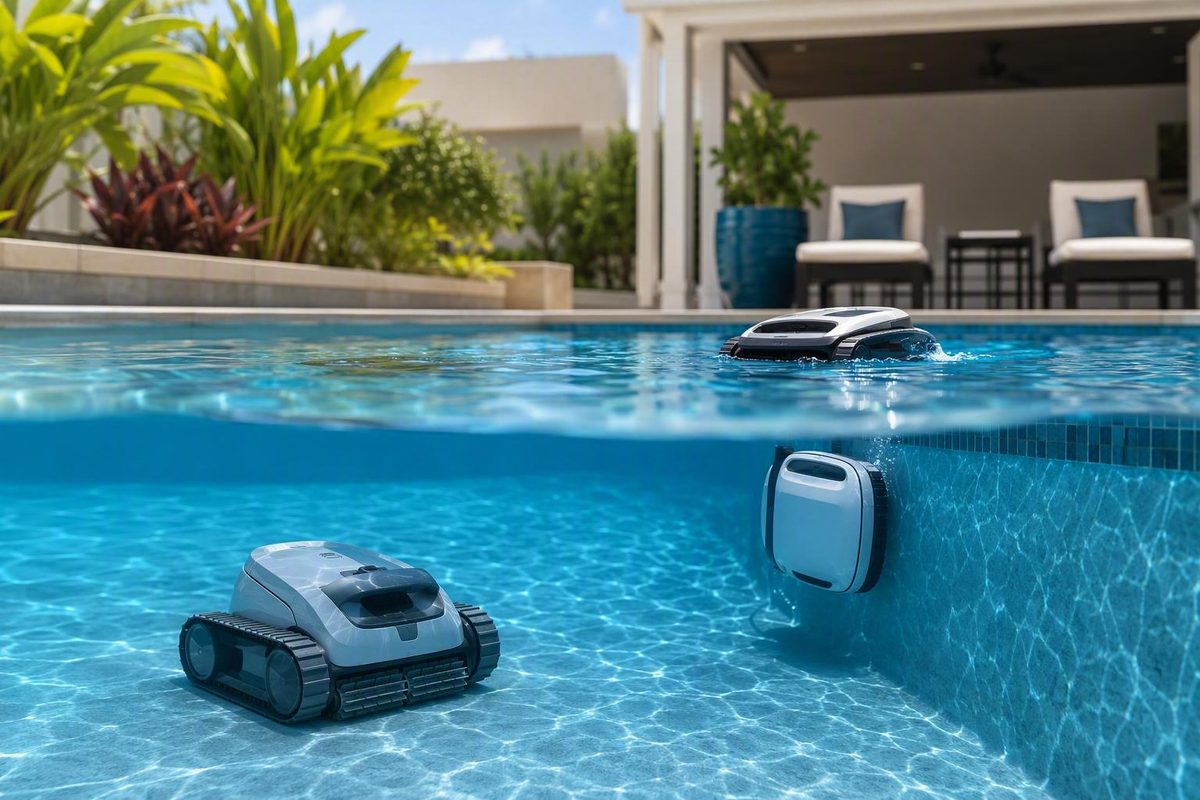
The FCC robot ban does not cover every robotic pool cleaner. Underwater-only autonomous cleaners are generally excluded; robots that also skim the surface or operate above water lose that automatic exclusion. Lawfully purchased cleaners can keep working, and models already holding the necessary FCC authorization may generally continue to be imported, marketed, sold, and used.
For a new cleaner to face the authorization restriction, it generally must fall outside the underwater exclusion, satisfy every applicable element of the FCC’s advanced-robot definition, be foreign-produced, need a new FCC equipment authorization, and lack Conditional Approval or another exception. Surface capability starts that inquiry; it does not settle it (FCC guidance on robots and the Covered List).
Choose the exact cleaner’s operating mode, origin, authorization status, and technical features to see its likely position.
Use exact model documentation where possible. Unknown specifications produce an “unresolved” result instead of an assumed pass or failure.
This lawfully purchased cleaner is not disabled or confiscated by the FCC action. Its previously authorized status also generally permits continued importation, marketing, sale, and use.
- Keep the model number, hardware revision, regulatory label, and receipt.
- Treat future app, parts, or cloud support as a separate commercial issue.
Combined cleaner and applicable station weight threshold.
Connectivity threshold in either direction.
Domestic-component standard: over 65% for 2024–2028; over 75% beginning in 2029.
| Exact Situation | Likely Status | Buying Meaning | Missing Check |
|---|---|---|---|
| Lawfully owned cleaner | Use continues | No FCC-driven replacement required | Support remains a separate issue |
| Previously authorized exact model | Grandfathered | May generally remain importable and sellable | Match model and hardware revision |
| Underwater-only autonomous cleaner | Generally excluded | Strongest unmanned-underwater-vehicle case | Confirm no surface or above-water mode |
| Submerged waterline cleaner | Likely excluded, verify | Do not equate waterline brushing with skimming | Confirm body remains submerged |
| Floor plus surface-skimming cleaner | Not automatically excluded | Could face new-authorization restriction | Technical elements, origin, approval |
| Pool plus deck or above-water robot | Not underwater-only | Full assessment required | Technical elements, origin, approval |
| Confirmed domestic end product | Foreign-production test not met | Not covered on that basis | Use exact-model production evidence |
| Foreign-produced but one required technical element absent | Definition not complete | Likely outside this restriction | Verify absence with documentation |
| New foreign dual-use model meeting every element | Potentially covered | May be unable to obtain ordinary authorization | Conditional Approval or exception |
| Brand origin known, model origin unknown | Unresolved | Do not classify by headquarters | Final assembly and production evidence |
Source: FCC Covered List FAQs for robots and inverters; FCC pool-specific guidance as reported by Android Authority. This checker applies the article’s cited thresholds and does not provide a binding model classification.
The Rule Restricts New Authorizations, Not Existing Owners
Calling the FCC action a “robot ban” obscures how it works. Covered equipment cannot obtain a new FCC equipment authorization through certification or the Supplier’s Declaration of Conformity. Because relevant electronic devices generally need authorization before they can be imported, marketed, or sold in the United States, an affected new model ordinarily cannot enter the consumer market through those routes.
The action does not prohibit consumers from owning robotic pool cleaners. It does not direct owners to surrender their equipment, establish a recall, or remotely disable cleaners. Consumers may continue using devices they lawfully purchased.
Previously authorized models are also in a different position from new models awaiting approval. They may generally continue to be imported, marketed, sold, and used. The decisive question is not simply when an individual unit was manufactured. It is whether the exact model already has the required authorization or now needs a new one.
| Cleaner Situation | Likely Position | What to Verify |
|---|---|---|
| Underwater-only | Generally excluded | No surface or above-water mode |
| Underwater plus surface | Not automatically excluded | All technical criteria and origin |
| Previously authorized | Generally grandfathered | Exact model and revision |
| New foreign-produced model | Potentially restricted | Authorization and approval status |
A previously authorized cleaner can still disappear from stores because its manufacturer discontinues it, runs out of inventory, withdraws support, or replaces it. Those commercial decisions do not mean the FCC prohibited ownership of the existing model.
Basic software and firmware updates remain permissible under an FCC waiver. That does not guarantee continuing app access, cloud service, replacement parts, repairs, or manufacturer support. The available evidence establishes no guaranteed support period.
Underwater-Only Cleaners Have the Strongest Exclusion
The advanced-robot definition excludes an “unmanned underwater vehicle that is able to operate without a human occupant.” A robot that cleans the submerged floor, climbs submerged walls, and cannot skim the surface or travel onto the deck has the strongest basis for that exclusion.
A dual-use machine is different. The FCC’s pool-specific guidance states that dual-use robots are not excluded, according to reporting on the update. A cleaner does not retain the underwater exclusion merely because part of its cycle occurs below the surface if it also meets the definition while operating at the surface or above ground (Android Authority’s report on the pool-cleaner guidance).
A floating robot that skims leaves from the top of the water presents the clearest dual-use case. A cleaner that brushes the waterline while its body remains submerged is less certain. The supplied evidence does not definitively classify every waterline-cleaning design, nor does it conclusively decide whether movement along a pool floor counts as movement “on the ground.” For a submerged cleaner, the express underwater-vehicle exclusion remains the better starting point.
The practical categories are:
- Submerged floor cleaner: Generally the strongest candidate for exclusion if it operates without an occupant and has no surface or above-water mode.
- Submerged wall-and-waterline cleaner: Potentially excluded if it remains underwater, but its exact operating envelope needs confirmation.
- Floor-and-surface robot: Not automatically excluded if it can switch to floating surface skimming.
- Pool-and-deck robot: Outside the clean underwater-only case and subject to the remaining tests.
Being outside the underwater exclusion does not automatically make a robot covered. Every applicable technical and production element must still be present.
A Surface-Capable Cleaner Must Meet the Full Definition
A single app, sensor, battery, or surface mode cannot establish coverage. Once the underwater exclusion is unavailable or uncertain, check the following elements together.
Mobility and Autonomous Response Must Qualify
Document how the cleaner moves, navigates, avoids obstacles, and responds to operators or sensor data. Relevant functions can include route planning, wall detection, mapping, autonomous path selection, and movement after the user starts a cycle.
Marketing terms such as “smart navigation” are clues, not regulatory classifications. The supplied evidence also does not establish how every start button, tether, or handheld controller should be treated.
Combined Weight Must Exceed 4.4 Pounds
The stated threshold is more than 4.4 pounds, including an applicable ground or docking station. Use the cleaner’s net weight and the documented weight of any relevant station, not shipping weight that includes packaging and unrelated accessories.
If the documentation does not identify whether an accessory is an applicable dock or ground station, the figure is unknown. The product’s retail name does not resolve that question.
Environmental Sensing Must Be Present
Relevant hardware may include cameras, lidar, depth sensors, proximity sensors, sonar-like systems, or other environmental-detection equipment. A camera is not required if the cleaner perceives its surroundings through other sensors.
Conversely, a camera or proximity sensor alone is insufficient. Sensing is only one part of the definition.
Connectivity Must Support the Stated Data Rate
The relevant connectivity capability is at least 200 kilobits per second in either direction. “Has Wi-Fi” is not the test by itself.
Check Wi-Fi, Bluetooth, cellular service, proprietary wireless links, and communication through a dock, gateway, or controller. A cleaner advertised as offline could still use a radio for setup or diagnostics. A basic remote-control link also does not prove that the required network threshold is met without technical documentation.
Software Must Control Relevant Functions
Determine whether local or remote software or firmware controls movement, navigation, sensing, perception, obstacle response, route planning, or remote commands. Many modern cleaners contain firmware, but firmware’s mere presence does not establish coverage.
If any required element is genuinely absent, the cleaner may fall outside the advanced-robot definition. If a specification is unavailable, record it as unknown rather than assuming it passes or fails.
Production Origin Depends on the Exact Model
Corporate nationality and manufacturing origin are separate questions. A U.S.-headquartered company can sell a foreign-produced robot, while a foreign-headquartered company can offer a domestically produced device. Branding, design offices, warehouses, and customer-service addresses do not determine production status.
Under the cited domestic-end-product standard, an item manufactured in the United States must have domestic-component costs exceeding 65% for delivery years 2024 through 2028. That threshold rises to 75% beginning in 2029 (Consumer Reports’ explanation of the production standard).
Aiper illustrates why brand-level verdicts are unreliable. The company describes itself as based in Atlanta, Georgia, while saying most of its components are produced in Asia and that it has multiple Asian manufacturing bases (Aiper’s manufacturer FAQ). Those statements do not establish final assembly, domestic-component percentage, authorization status, connectivity, operating mode, or Conditional Approval for any exact cleaner.
There is consequently no sound basis for saying that all Aiper, Beatbot, or other foreign-associated pool cleaners are banned. One brand can simultaneously sell underwater-only machines, dual-use surface cleaners, previously authorized products, and new models made under different production arrangements.
Reporting has identified the Beatbot Sora 70 and AquaSense 2 Ultra as possible candidates because of reported surface-cleaning capability. That is not a model-specific FCC determination. Surface operation means the remaining criteria need examination; it does not establish that either model is prohibited.
Authorization Status Can Decide Whether Stores May Keep Selling It
Record the full model number, hardware revision, regulatory-label information, and FCC ID if one is supplied. An authorization associated with a similar cleaner or product-family name does not necessarily cover a successor, revised circuit board, different dock, or marketplace variant.
Ask the manufacturer a precise question: “What FCC authorization applies to model X and hardware revision Y?” Also ask whether that exact unit relies on a previous authorization, requires a new authorization, uses an exclusion, or has Conditional Approval.
An FCC ID is useful evidence for the identified device, but the supplied evidence does not establish the authorization scope of every revision, accessory, or successor. Obtain confirmation rather than copying an identifier from a review of a similar model.
A foreign-produced robot that meets the technical criteria is not necessarily permanently shut out. A qualifying device or class may receive Conditional Approval following the required government determination. Manufacturers can also change production, alter features, rely on an applicable exclusion, continue an authorized model, or decline to launch a new model in the United States.
Narrow exceptions also allow small batches of unauthorized devices to be imported solely for development or testing when they are not marketed or sold. Equipment imported and sold exclusively for the federal government receives different treatment. Neither route permits ordinary consumer sales.
Buyers Should Verify the Delivered Model, Not Just the Listing
For someone shopping for a future model, the safest process is to preserve model-specific evidence before the return window closes.
Record the model number, hardware revision, manufacturing code, regulatory label, cleaner weight, dock weight, listed radios, sensor specifications, and stated operating modes. Ask whether waterline cleaning occurs while the body remains submerged and whether the robot can float, skim, or travel onto a deck, ramp, dock, or coping.
Request written answers to these questions:
- Does this exact unit operate only while submerged?
- Can it skim or navigate at the water’s surface?
- What is the combined listed weight of the cleaner and any applicable station?
- Does its connectivity support at least 200 kilobits per second in either direction?
- Where is this exact model manufactured and finally assembled?
- What authorization, exclusion, or Conditional Approval applies to it?
Save the listing, receipt, label photographs, manual, and manufacturer response. Marketplace pages sometimes combine several versions, bundles, or sellers. Compare the delivered cleaner’s identifiers with the promised model before deciding to keep it.
Current owners do not need to replace a functioning cleaner solely because of a ban headline. Keep the same records so an authorization question can be separated from an ordinary app, repair, or end-of-life problem.
Likely Market Effects Remain Unproven
The confirmed consequence is narrow: a covered new model may be unable to obtain the equipment authorization ordinarily needed for U.S. importation, marketing, and sale.
Manufacturers might redesign products, seek Conditional Approval, change production arrangements, delay launches, cancel U.S. releases, or continue selling previously authorized models. Selection, compliance costs, and retail prices could change, but the supplied evidence does not demonstrate guaranteed shortages or price increases.
Previously authorized inventory may reduce short-term disruption. Different manufacturers may also choose different technical and production responses.
Answers for Current Owners and Buyers
Will My Current Pool Robot Stop Working?
No, not merely because foreign-produced advanced robots were added to the Covered List. The FCC action does not remotely disable, confiscate, recall, or require surrender of a lawfully purchased cleaner.
Cloud access, repairs, parts, and app support can still change for unrelated commercial or technical reasons.
Are All Underwater Pool Robots Exempt?
Not automatically. A strictly underwater cleaner capable of operating without an occupant generally fits the unmanned-underwater-vehicle exclusion. A robot that also operates at the surface or above water does not receive that automatic protection.
Waterline brushing is not necessarily surface skimming. If the cleaner remains submerged, verify its exact operating mode rather than assuming either classification.
Does a Cleaner Without Wi-Fi Fall Outside the Rule?
Possibly, but the absence of a Wi-Fi label does not settle the connectivity element. The cleaner may use Bluetooth, a proprietary radio, a controller, or a connected dock. Conversely, a wireless remote does not by itself prove the specified data rate.
All required elements must be satisfied, so a verified missing element can change the result.
Are Aiper or Beatbot Cleaners Categorically Banned?
No brand-wide determination is supported by the supplied evidence. Each exact model must be checked for underwater or surface operation, technical features, production origin, previous authorization, exclusions, and Conditional Approval.
The reliable rule is model-specific: underwater-only cleaners are generally excluded; existing lawfully purchased cleaners keep working; previously authorized models may generally remain on sale; and a new foreign-produced dual-use cleaner is potentially affected only if it satisfies the complete definition and lacks an approval pathway.