
Best Robotic Pool Cleaners by Pool and Job in 2026
Premier, Sigma and Quantum recur for inground pools. Escape is the recurring above-ground option, while Cayman is value-oriented. Compare coverage and debris fit.
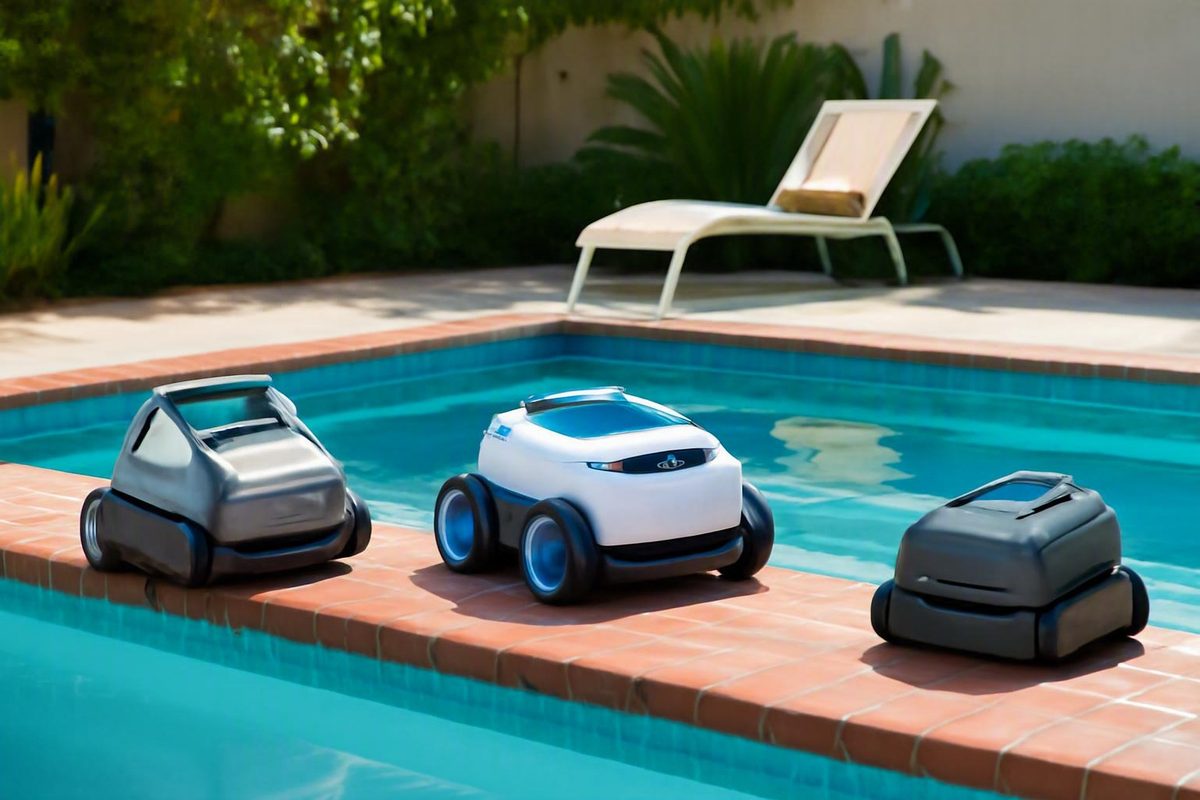
Match the right pool robot to your pool—not someone else’s ranking.
The best robotic pool cleaners are not interchangeable. A machine suited to a flat above-ground pool may be a poor fit for a large inground pool with a deep end, benches, heavy leaf fall, and a waterline that needs regular scrubbing. Likewise, an app or elaborate navigation system adds little value if the cleaner cannot handle the pool surface or collect the debris that actually accumulates.
The useful question is not “Which robot ranks first?” It is “Which cleaner’s reported compatibility, coverage, filtration, power format, and ownership requirements fit my pool?”
This is a source-informed shortlist, not an original head-to-head test or a comprehensive comparison of the entire market. The supplied evidence is heavily weighted toward Dolphin models and comes primarily from specialist affiliate publishers, a robotic-cleaner retailer, manufacturer materials, marketplace rankings, and an archived guide. It supports a research shortlist but does not establish an objective universal winner. Before buying, verify every material specification in the current manual and written warranty for the exact model number.
The short answer: leading robotic pool cleaners by use case
There is no evidence-supported universal winner. Within the supplied source set, the most defensible shortlist divides cleaners by job:
- For an inground pool needing floor, wall, and waterline cleaning: Compare Dolphin Premier, Dolphin Sigma, and Dolphin Quantum or Quantum Pro. Specialist guides repeatedly associate these models with premium inground or waterline cleaning, but buyers should verify the exact model’s pool compatibility, cleaning zones, and included filters.
- For an above-ground or entry-level cleaner: Start with Dolphin Escape, the most consistent recurring recommendation in the supplied guides. Dolphin E10 is another entry-level candidate, but The Pool Nerd describes it as floor-focused rather than as a substitute for a wall-and-waterline cleaner.
- For value: Put Dolphin Cayman on the shortlist. The label comes from publishers and does not prove that Cayman has the lowest lifetime cost or best measured performance.
- For heavy leaves: Consider Dolphin Premier. Poolbots and Robotic Reviews associate it with an oversized leaf bag and multiple filter formats, making it the most frequently cited leaf-oriented candidate in this evidence set.
- For cordless convenience: Compare Beatbot AquaSense 2 Ultra and Polaris Freedom. The Pool Nerd names them its leading and runner-up cordless selections; that placement does not show that they outperform corded cleaners overall.
- For floating leaves and insects: Consider Betta SE or Betta SE Plus, but treat them as surface skimmers rather than substitutes for submerged floor, wall, or waterline cleaners.
The Pool Nerd’s use-case guide calls Premier “best overall,” Escape “best entry-level,” Sigma “best splurge,” Quantum Pro “best inground,” and Cayman “best value.” It also selects AquaSense 2 Ultra and Polaris Freedom for the cordless category. These are recommendations from an affiliate publisher that may earn commissions, not results produced under a common industry test standard. See The Pool Nerd’s use-case selections and disclosure.
Poolbots, a retailer that sells the products it recommends, organizes several of the same models differently. Its guide associates Escape with above-ground pools, Cayman with value, Quantum with automatic cleaning, Premier with leaves, and Sigma with inground pools. Poolbots reports floor-only coverage for Escape, floor-and-wall coverage for Cayman, and floor, wall, and waterline coverage for Quantum, Premier, and Sigma. Review Poolbots’ reported roles and coverage.
Even pages from the same publisher can conflict. The Pool Nerd’s numbered 2026 ranking places Dolphin Sigma first and Dolphin Premier second, while an editor’s-choice block on that page calls Premier its number-one pick. These are not independent endorsements; they are conflicting placements within one publisher’s coverage. Compare the numbered ranking and editor’s-choice block.
Surface skimmers need their own category. Betta SE and Betta SE Plus travel across the water’s surface and collect floating debris before it sinks. A submerged robot travels along the floor and, when designed for it, climbs walls or scrubs the waterline. Some pools may benefit from both, but the products do different jobs.
What counts as a robotic pool cleaner?
A submerged robotic pool cleaner is a self-contained cleaning device with built-in drive or pump motors and onboard filtration.
Common components include:
- Motors for movement and water flow
- Tracks or wheels
- One or more scrubbing brushes
- Suction inlets
- A removable filter, basket, or debris bag
- Navigation logic or sensors
- A power supply or rechargeable battery
- Optional timers, Wi-Fi, apps, or remote steering
That definition separates robotic cleaners from two other automatic-cleaner categories:
- Suction-side cleaners connect to the pool’s suction system and depend on flow from the pool pump.
- Pressure-side cleaners use pressurized water from the circulation system, sometimes with a separate booster pump.
These products can automate cleaning, but they are not self-contained robotic cleaners in the same sense. Their installation, filtration paths, dependence on pool equipment, and operating tradeoffs differ. A manufacturer-affiliated buyer’s guide similarly defines robotic cleaners as self-contained devices with built-in motors and filtration, unlike suction- and pressure-side products that depend on the pool pump. Read the category distinction.
Coverage creates another important division:
- Floor-only cleaners primarily collect debris from the bottom.
- Floor-and-wall cleaners add climbing ability but may not remain at or actively scrub the waterline.
- Floor, wall, and waterline cleaners claim coverage of all three zones.
These labels describe intended capability, not guaranteed access to every feature.
Surface robots are different again. A solar- or battery-powered skimmer patrols the top of the water, collecting floating leaves, insects, and similar material. It does not replace a submerged robot once dirt has settled on the floor or attached to a wall.
The required archived Pool Robotic guide used a broader and questionable taxonomy by presenting suction-side and pressure-side products as robotic-cleaner types. It selected Dolphin Nautilus CC Plus as its leading cleaner, but the page identifies itself as a 2023 article and supplies no standardized comparative measurements in the available extract. Its taxonomy, recommendation, and product details should not be transferred uncritically to current products. View the archived 2023 guide.
Choose by pool compatibility before comparing features
Start with the pool, not the brand. Navigation, app controls, and filter options are irrelevant if the cleaner cannot negotiate the pool’s shape, reach the necessary zones, or complete the intended job under its documented operating conditions.
Record these characteristics before creating a shortlist:
- Above-ground or inground construction
- Maximum length and width
- Shallow-end and deep-end depths
- Floor shape and slope
- Wall material and surface finish
- Curved or sharp floor-to-wall transitions
- Steps, benches, seats, and tanning ledges
- Main drains or raised drain covers
- Ladders and handrails
- Tight corners, columns, or unusual shapes
- Typical debris and seasonal debris peaks
Next, define the required cleaning zone. If most debris settles on a flat floor and you are prepared to brush the walls manually, a floor-focused cleaner may be sufficient. If grime regularly accumulates on walls or at the waterline, verified climbing and waterline capability may reduce manual work. Do not pay for all-zone coverage by default; buy it because the pool creates a recurring need.
“Above-ground compatible” is not a complete answer. Above-ground pools differ in length, depth, liner construction, wall flexibility, bottom profile, and the presence of coves or wrinkles. Some have flat floors; others have dished or contoured bottoms. An above-ground recommendation is only the beginning of the compatibility check.
The same principle applies to inground models.
Verify the exact product, not just the family name
Similar names can also conceal differences in filters, power supplies, cables, chargers, and included caddies.
Before buying, match all of the following:
- Full model name and model number
- Model year or hardware revision, if provided
- Manual corresponding to that model number
- Supported pool type and surface
- Listed cleaning zones
- Included and optional filters
- Power-supply or charger part number
- App and connectivity requirements
- Included cable, retrieval hook, or caddy
- Written warranty for that exact version
If the current manual is unavailable, request it from the manufacturer or an authorized seller. A marketplace title, product bullet list, or old review is not a substitute for operating documentation.
Consider retrieval as part of compatibility
Dry weight does not describe the complete retrieval experience. A cleaner leaving the water must drain, be guided to the edge, lifted clear of the coping, emptied, and moved to storage.
Before ordering, determine:
- How the cleaner is brought to the edge
- Which retrieval method the exact manual permits
- How the cleaner drains
- Whether its handle is easy for the intended user to reach
- Whether removal requires kneeling or reaching below the coping
- Whether a caddy would simplify transport and storage
Treat these as usability questions and evaluate them against the intended user’s strength, reach, and mobility. For model-specific handling and electrical instructions, follow the current manual rather than generalized online advice.
Pre-purchase compatibility checklist
Do not place the order until you can answer each item:
- [ ] What are the pool’s maximum dimensions and deepest point?
- [ ] Does the current manual support the applicable pool type?
- [ ] Is the pool surface explicitly supported?
- [ ] Does the robot clean the floor only, the floor and walls, or the floor, walls, and waterline?
- [ ] Does the manual specify an operating-depth range?
- [ ] Are there documented limitations involving steps, ledges, drains, slopes, ladders, or unusual shapes?
- [ ] For a corded model, is the supplied cable suitable for the pool and permitted power-supply location?
- [ ] For a cordless model, does the documented runtime suit the intended cycle?
- [ ] How is the cleaner retrieved, drained, emptied, transported, and stored?
- [ ] Do the seller’s written terms permit a return after a wet compatibility test?
How the recurring contenders differ
These profiles describe source-attributed roles rather than independently proved performance positions. The supplied comparisons do not provide a common pool, identical debris loads, raw pickup measurements, standardized missed-area results, or long-term failure data sufficient to rank the models objectively.
Dolphin Premier is the contender most often associated in the supplied guides with multiple filtration formats. The Pool Nerd calls it best overall, while Poolbots emphasizes heavy leaves. Those sources report floor, wall, and waterline coverage, weekly scheduling, an oversized leaf bag, and multiple filter options. The Pool Nerd also reports a three-year warranty, but buyers should confirm the scope and exclusions in the current written warranty. See the reported Premier features and warranty duration.
Dolphin Sigma is positioned as a premium inground cleaner. It occupies first place in The Pool Nerd’s numbered 2026 ranking, which attributes three motors and gyroscope-based navigation to the model. Those features may affect movement or control, but their presence does not prove more complete cleaning.
Poolbots uses Quantum, while The Pool Nerd uses Quantum Pro, so buyers should not assume that the two names represent identical current packages. Confirm the complete model number, manual, filtration system, scheduling method, and included equipment.
Dolphin Cayman is the recurring value-oriented candidate. The supplied guides associate it with floor-and-wall cleaning and a weekly timer. “Value” remains an editorial judgment dependent on current price, included equipment, repairability, filter needs, and whether the cleaner covers the necessary parts of the pool.
Dolphin Escape is the recurring above-ground and entry-level candidate. Poolbots reports floor cleaning and describes its timer as an added-cost upgrade rather than included equipment. Because that is financially material, verify the current bundle and price before ordering. Check Poolbots’ reported Escape coverage and timer arrangement.
Dolphin E10 appears in The Pool Nerd’s ranking as an entry-level, floor-focused above-ground option. It should not be treated as equivalent to a cleaner selected for wall and waterline coverage.
Dolphin Nautilus CC and Dolphin Nautilus CC Plus are separate products. Amazon’s captured bestseller page placed Nautilus CC first, while the archived Pool Robotic guide chose Nautilus CC Plus. A sales leaderboard and an editorial recommendation answer different questions and cannot be combined into one performance claim.
| Model | Source-attributed role | Reported cleaning zones | Reported power format | Reported scheduling | Filtration emphasis | Verification status and caveat |
|---|---|---|---|---|---|---|
| Dolphin Premier | The Pool Nerd overall pick; Poolbots leaf-oriented option | Floor, walls, and waterline | Corded | Weekly timer | Multiple formats and oversized leaf bag | Publisher- and retailer-reported; no common leaf-pickup test supplied |
| Dolphin Sigma | Premium inground contender | Floor, walls, and waterline | Corded | Weekly or app-based scheduling | Fine-particle filtration emphasized | Publisher- and retailer-reported; navigation features do not prove superior coverage |
| Dolphin Quantum / Quantum Pro | Inground and automatic-cleaning contender | Floor, walls, and waterline | Corded | Weekly scheduling reported for Quantum | Fine filtration emphasized | Names and packages vary by source; exact model requires verification |
| Dolphin Cayman | Value-oriented candidate | Floor and walls | Corded | Weekly timer | Standard filtration; guide-specific upgrades promoted | “Value” is editorial and depends on current price and needs |
| Dolphin Escape | Above-ground and entry-level candidate | Floor | Corded | Poolbots reports an optional paid upgrade | Debris collection with promoted filter upgrades | Not a direct substitute for all-zone cleaning |
| Dolphin E10 | Simpler above-ground option | Floor-focused | Corded | Not established in the supplied current documentation | Entry-level filtration | Appears in one ranking; current configuration requires verification |
| Dolphin Nautilus CC | Marketplace sales leader at capture time | Seller listing claimed floor and wall capability | Corded | Not established here | Seller claimed top-load filtration | Seller-reported; sales rank is not performance evidence |
| Dolphin Nautilus CC Plus | Archived editorial pick; current manufacturer family name | Varies by version and source | Corded versions shown | Older guide reported scheduling | Cartridge filtration emphasized | Reviews may concern different years, hardware, or connectivity packages |
The table intentionally labels model-level features as publisher-, retailer-, or seller-reported. None should be treated as a current manufacturer-confirmed specification until matched to the exact model’s manual.
Corded versus cordless: practical ownership tradeoffs
Neither power format is universally better. The choice depends on how the cleaner will be deployed, scheduled, retrieved, charged, and stored.
When corded operation makes sense
A corded robot receives power during its cleaning cycle, so an onboard battery does not determine whether the cycle can continue. This can suit owners who prioritize recurring scheduled operation or do not want to manage recharging.
The ownership tradeoffs include:
- Locating and storing the power supply as directed by the exact manual
- Deploying, collecting, and storing the cable
- Managing excess cable around the deck
- Evaluating ladders, steps, rails, and other possible interaction points
- Deciding whether a caddy is useful
- Accounting for cable condition and replacement availability
Electrical setup requirements vary by product. Use only the connection method, power-supply placement, and operating procedure stated in the current manual for the exact cleaner. The supplied evidence does not support universal electrical instructions that override model-specific documentation.
When cordless operation makes sense
A cordless robot removes the operating cable from the pool. That can simplify deployment and reduce cable management during a cycle.
In exchange, buyers need to evaluate:
- Runtime for each supported cleaning mode
- Recharge time
- Whether every cycle must be restarted manually
- Battery-specific warranty coverage
- Battery replacement availability and process
- Charger storage requirements
- Expected performance as the battery ages
- Whether the cleaner can complete the intended pool before stopping
The Pool Nerd gives a general cordless runtime range of two to three hours and a recharge range of three to five hours. Those are publisher-reported category estimates, not specifications for every model. The same guide places Beatbot AquaSense 2 Ultra first and Polaris Freedom second among its cordless selections. Review the cordless selections and reported time ranges.
A manufacturer-authored comparison identifies cable setup and storage as corded ownership considerations and describes cordless cleaners as rechargeable units that operate without an outlet connection during the cleaning cycle. Because the manufacturer sells pool cleaners, this is useful for framing the tradeoff rather than proving that one format performs better. Read the manufacturer’s corded-versus-cordless discussion.
Broad safety declarations are not supported. The evidence does not justify calling every cordless cleaner unsafe or claiming that corded cleaners carry no risk. Evaluate the exact product, manual, charger or power supply, physical condition, and any official model-specific notice.
A practical decision rule is:
- Favor corded operation when recurring scheduling, power throughout a cycle, and avoiding recharge management are priorities.
- Consider cordless operation when eliminating cable handling matters more and the exact model’s documented runtime, charging routine, battery warranty, and coverage suit the pool.
Filtration, coverage, and automation features that matter
Features are easier to assess when divided into essentials, pool-dependent capabilities, and conveniences.
Essentials
Every viable shortlist should address:
- Verified compatibility with the pool
- Coverage of the required cleaning zones
- Brushes appropriate for the intended task
- Filtration suited to the usual debris
- Filter access the owner can use comfortably
- A practical retrieval and drainage process
- A realistic cleaning and storage routine
Filtration deserves more attention than branded terminology. Fine sand, pollen, and silt require a filter intended to retain smaller particles. Pools that collect both large leaves and fine sediment may benefit from interchangeable filters or staged cleaning.
Terms such as “ultra-fine,” “NanoFiltration,” and “multi-media” should not be treated as standardized ratings simply because they sound technical. Ask what is included, what each filter is intended to capture, how it is cleaned, and whether comparable particle-retention measurements are available. Without measured ratings, treat these as product descriptions.
Pool-dependent capabilities
Wall climbing and waterline cleaning may justify a higher price when those areas otherwise require frequent manual brushing. They may be unnecessary when the main task is collecting settled material from a small, flat floor.
Waterline capability is not the same as obstacle handling.
- Stair treads and risers
- Benches and seats
- Shallow tanning ledges
- Tight inside corners
- Areas around drains
- Narrow passages
- Beach-entry transitions
Return terms are particularly important for pools with these features because a broad coverage label cannot predict every interaction.
Robotic Reviews recommends Premier, Sigma, and Quantum for waterline cleaning and reports that Premier includes an oversized leaf bag, an ultra-fine filter, and a standard cartridge filter. The page does not publish standardized debris-removal measurements sufficient to prove that one model is universally superior. See the guide’s waterline and filtration claims.
Conveniences
Timers, apps, Wi-Fi, remote steering, mapping, gyroscopes, and AI labels can improve control or reduce repetitive setup. They are not proof of better cleaning.
Distinguish among four scheduling arrangements:
- Built-in weekly timer: The cleaner’s power system can initiate recurring cycles on supported days.
- App-based scheduling: A connected app controls or customizes the schedule.
- Manual restart: The owner must initiate every cycle.
- Optional timer upgrade: Scheduling requires an additional purchase.
These arrangements create different ownership experiences even when all are marketed as “automatic.” Determine whether the cleaner may remain in the pool between scheduled cycles, whether its filter should be emptied first, and whether an app is required for basic operation.
Wi-Fi can make status checks more convenient. A gyroscope may influence orientation, while an AI label may refer to navigation or object recognition. None of these features proves that a cleaner collects more leaves, retains finer sediment, reaches every step, or lasts longer.
Maytronics places Nautilus CC Plus with Wi-Fi, Nautilus Titan, Nautilus CC Supreme, Explorer E50, and newer Nautilus EON models in a manufacturer-defined “best performance” category and displays app indicators. That establishes how Maytronics markets its products, not superiority over competing brands. View the manufacturer’s category.
Everyday usability and maintenance
Small ownership details may matter more than headline technology:
- Can the basket be removed without turning over the dirty cleaner?
- Does the filter rinse clean easily?
- Are wet leaves difficult to remove?
- Can the owner tell when the filter is full?
- Does the cable store neatly?
- Is a caddy included, optional, or unavailable?
- Where will the cleaner, charger, or power supply be stored?
- How much handling is required during retrieval?
- Are filters, brushes, tracks, cables, and batteries replaceable?
A manufacturer-affiliated maintenance guide recommends cleaning the filter after each use, storing the cleaner in a shaded, dry location, and periodically inspecting brushes and moving parts for wear. Apply those steps only as consistent with the exact product’s manual.
A robotic cleaner removes physical debris. The supplied evidence does not support crediting these machines with controlling bacteria, preventing algae, reducing chemical demand by a specific amount, producing dramatic energy savings, or guaranteeing sanitation or universal durability. Robotic cleaning does not replace proper circulation, water testing, filtration, and sanitation practices.
Why ‘best’ lists disagree—and how to read the evidence
Unless the scoring weights and raw measurements are visible, the final order reflects editorial judgment as well as product capability.
The clearest conflict involves Dolphin Sigma and Premier. The Pool Nerd’s numbered 2026 ranking places Sigma first and Premier second, but the same page calls Premier its editor’s-choice number-one pick. A separate use-case article from The Pool Nerd also calls Premier best overall. These are multiple pages from the same publisher, not independent corroboration.
Dolphin Nautilus CC Plus illustrates ranking instability. The archived Pool Robotic article selected it as its leading cleaner in 2023, while The Pool Nerd’s 2026 ranking placed it twenty-second and attached a negative editorial label. The available evidence does not establish whether that reversal reflects product changes, different versions, changed priorities, different comparison sets, or inconsistent experiences.
The comparative sources generally do not publish enough of the following to resolve such disagreements:
- Identical test pools and surfaces
- Controlled leaf, sand, and silt loads
- Before-and-after debris weights
- Repeat-cycle results
- Measured missed-area percentages
- Standardized step and ledge tests
- Battery-degradation data
- Cable, motor, or track failure rates
- Complete scoring calculations
- Multi-season warranty and repair outcomes
A statement that a product was “tested” can still be informative, especially when the publisher describes observed behavior and limitations. But the word itself is not a methodology. Readers need to know the test conditions, number of repetitions, comparison products, measurements, and scoring method.
Account for the commercial context
The supplied evidence includes:
- Affiliate publishers that may earn commissions
- A retailer selling recommended cleaners
- Manufacturer storefronts and buying guides
- A marketplace sales ranking
- An archived editorial guide
None is automatically useless. Each source simply answers a different question.
A retailer page can document what that seller listed, bundled, or charged at a particular time. A current manufacturer manual is generally the appropriate source for operating instructions and model-specific limitations. A marketplace leaderboard shows what was selling. An affiliate review can identify possible strengths and usability questions to investigate.
Problems arise when one form of evidence is used to support a claim it cannot prove.
Amazon explicitly describes its bestseller list as based on sales and updated frequently. In the supplied snapshot, Dolphin Nautilus CC ranked first while Betta SE—a surface skimmer performing a different task—ranked second. That demonstrates relative sales popularity at that moment, not controlled cleaning performance, durability, compatibility, or value. Review Amazon’s description of its sales-based ranking.
Likewise, a manufacturer’s “best performance” label establishes how that company groups its own products. It does not show that those models outperform another brand. A retailer’s “best match” sort should not be treated as an editorial award unless its ranking method is explained.
Pool Robotic states that its articles draw on hands-on experience, that quoted prices and specifications are attributed, and that manufacturers do not pay for placement. Those are the publisher’s first-party editorial-policy statements, not independent verification of any particular review’s methods or independence. Read Pool Robotic’s editorial-policy statement.
Use an evidence hierarchy
Give different sources different jobs:
- Current manuals and written warranties: Use these for exact specifications, approved operation, compatibility, care, component coverage, and exclusions.
- Official government or manufacturer records: Use these for recalls, corrective actions, and model-specific safety notices.
- Transparent controlled tests: Use these for comparative pickup, coverage, filtration, navigation, runtime, and repeatability.
- Retailer pages: Use these for date-stamped price, stock, bundles, seller identity, and return terms.
- Manufacturer marketing: Use this to identify claimed features and intended positioning, then verify material details in the manual.
- Customer reviews and sales rankings: Use these as secondary clues about popularity, sentiment, and issues to investigate—not proof of quality.
The strongest decision combines several layers: publisher recommendations to create a shortlist, manuals to remove incompatible products, transparent testing to compare relevant performance, and written seller terms to manage the risk of trying a cleaner in a specific pool.
Final buying checklist: price, warranty, service, and total ownership
Prices, discounts, stock, and bundles change. Record the date and time of every offer you compare, and save the listing or order confirmation. The same model may be sold with different filters, caddies, power supplies, chargers, connectivity features, or retailer-specific accessories.
The supplied Leslie’s snapshot illustrates the category’s range but was not accompanied by a precise capture date. It showed visible robotic cleaners from a Dolphin Proteus DX3 at $669 through a Polaris VRX iQ+ at $1,499, alongside cordless products and surface skimmers. Those figures are examples from the supplied retailer record, not current guaranteed offers. See the retailer assortment and listed snapshot prices.
Immediately before ordering, verify:
- Exact model number and model year
- New, refurbished, or open-box condition
- Included filters, bags, and baskets
- Included caddy or storage stand
- Power supply and cable for a corded unit
- Charger for a cordless unit
- Wi-Fi, Bluetooth, and app compatibility
- Retrieval accessories
- Written warranty document
- Seller identity and authorization status
- Return window and wet-use conditions
- Return shipping and restocking fees
Read the warranty by component
A prominent duration does not reveal what the warranty covers. Check the written terms for:
- Drive and pump motors
- Power supply
- Floating cable and swivel
- Battery and charger
- Tracks, brushes, wheels, and other wear items
- Filters and debris baskets
- Labor and diagnostic charges
- Shipping to and from a service center
- Commercial-use exclusions
- Registration or proof-of-purchase requirements
Battery coverage may differ from coverage for the rest of a cordless machine, and wear parts may be excluded. A long headline warranty has limited practical value if the failed component is excluded or service is difficult to access.
Ask whether replacement filters, brushes, tracks, cables, power supplies, chargers, and batteries are stocked. Also ask who performs repairs, where the cleaner must be shipped, and what happens when a part is unavailable. The supplied evidence does not establish which brand offers the best long-term service or parts support, so obtain important commitments in writing.
Protect the right to test compatibility
A complex pool is difficult to evaluate from a product description. Before getting the cleaner wet, determine:
- Whether opened or wet products can be returned
- Whether the return window begins at purchase or delivery
- Who pays return freight
- Whether a restocking fee applies
- Whether filters must remain unused
- Whether packaging and serial labels must be retained
- Whether a trial is offered by the manufacturer or seller
- Whether a marketplace seller imposes separate conditions
Keep the packaging until the cleaner has completed several representative cycles. Test ordinary debris, the shallow-to-deep transition, walls, corners, steps, benches, and retrieval. A clean floor alone does not establish acceptable performance in every promised zone.
Compare total ownership, not just checkout price
Potential ownership costs include:
- Replacement filters or bags
- Brushes, tracks, and wheels
- Cable replacement
- Battery replacement
- Charger or power-supply replacement
- A caddy or cover
- Electricity
- Shipping for service
- Out-of-warranty diagnostics and repairs
Do not invent a lifetime dollar estimate without credible prices and a realistic replacement schedule. Instead, compare the current availability and cost of major parts for the finalists. A low-priced cleaner with unavailable batteries or filters may be poor value; a premium model with features the pool does not need may be equally wasteful.
Use this five-step decision path:
- Define pool compatibility. Match the exact model to pool type, dimensions, depth, surface, slope, and obstacles.
- Choose required cleaning zones. Decide whether the pool needs floor-only, floor-and-wall, or floor-wall-waterline cleaning.
- Match filtration to debris. Prioritize large-debris capacity for leaves and appropriate fine filtration for sand, pollen, or silt.
- Choose corded or cordless operation. Balance recurring scheduling and power throughout a cycle against cable-free deployment and battery management.
- Compare warranty and return terms. Include component coverage, parts availability, service access, and the right to test the cleaner in the pool.
The best purchase is the cleaner whose verified compatibility, coverage, filtration, and ownership routine match the pool. Within the supplied source set, Premier, Sigma, and Quantum or Quantum Pro are recurring inground contenders; Escape is the recurring above-ground candidate; Cayman is a value-oriented shortlist option; and Beatbot AquaSense 2 Ultra or Polaris Freedom may suit buyers prioritizing cordless convenience. Betta surface skimmers belong in a separate floating-debris category.
Buy a premium cleaner only when its added coverage, filtration, or automation solves a defined problem. A higher price does not guarantee better cleaning in a particular pool. Before paying, verify the exact model’s current manual, written warranty, included accessories, return policy, price, and availability.
What is the best robotic pool cleaner for an inground pool?
There is no universal winner. Within the supplied specialist guides, Dolphin Premier, Dolphin Sigma, and Dolphin Quantum or Quantum Pro are recurring candidates for inground pools requiring floor, wall, and waterline coverage.
Choose among them by verifying the exact model’s supported pool dimensions and surface, filtration, scheduling, cable reach, obstacle limitations, warranty, and current bundle. Premier warrants attention for heavy leaves because Poolbots and Robotic Reviews associate it with an oversized leaf bag and multiple filter formats. Sigma is positioned as a premium inground candidate, while Quantum or Quantum Pro recurs as an all-zone option.
If the pool primarily needs floor cleaning, a less expensive model may be more appropriate than any of these premium candidates.
What is the best robotic pool cleaner for an above-ground pool?
Dolphin Escape is the most consistent above-ground or entry-level recommendation in the supplied source set. That does not mean it fits every above-ground pool. Confirm the pool dimensions, bottom shape, surface compatibility, operating depth, slope, and included scheduling equipment.
Dolphin E10 is another entry-level candidate, but The Pool Nerd describes it as floor-focused. Treat it as a simpler alternative rather than as an equivalent to a wall-and-waterline cleaner.
Are corded or cordless robotic pool cleaners better?
Neither format is universally better.
Corded cleaners suit buyers who prioritize recurring scheduling and operation without battery-recharge interruptions. They also require management of the power supply and cable according to the exact model’s instructions.
Cordless cleaners remove the operating cable but require charging. Runtime, recharge time, battery warranty, replacement availability, and performance as the battery ages become central ownership questions.
Favor corded operation when scheduling and power throughout a cycle matter most. Consider cordless operation when eliminating cable handling is more important and the exact model’s documented runtime can complete the intended job.
Do robotic pool cleaners clean steps and the waterline?
Some models claim waterline cleaning, some climb walls without actively cleaning the waterline, and others are floor-only.
Step cleaning is less predictable. A wall-climbing robot may still miss stair treads, risers, benches, tanning ledges, tight corners, drains, and beach entries. For a complex pool, review documented limitations and choose a seller whose written return terms permit a meaningful wet compatibility test.
Why do reviews disagree about the Dolphin Nautilus CC Plus?
The archived Pool Robotic guide selected Nautilus CC Plus as its leading cleaner in 2023, while The Pool Nerd’s numbered 2026 ranking placed it twenty-second. Compare the archived guide with the later ranking.
The available sources do not provide enough standardized raw data to determine whether the reversal reflects hardware changes, different configurations, changed scoring priorities, different test conditions, or inconsistent experiences. Also distinguish Nautilus CC Plus from Nautilus CC and from current Wi-Fi variants. Verify the complete model number and evaluate that exact product against the pool rather than transferring a ranking from another version.