
Cartridge Filter for a Swimming Pool: Size, Clean, Diagnose
Size and maintain a swimming-pool cartridge filter using actual flow, clean pressure, safe rinsing steps, and clear fault patterns for pressure and flow.
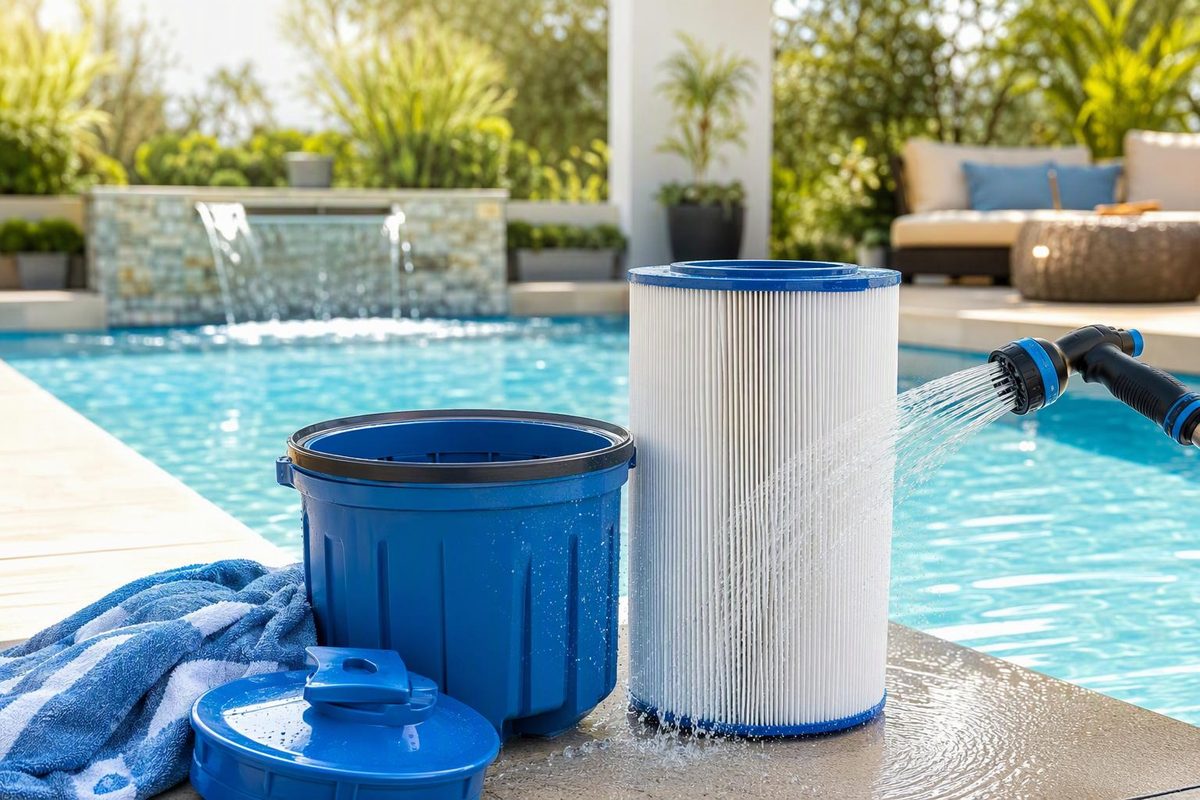
A swimming-pool cartridge filter is the right choice when you want filtration without routine backwashing, but it must be sized by actual system flow and maintained from a recorded clean-pressure baseline. Clean it when pressure rises by the amount specified in its manual—often roughly 8–10 psi—or when flow drops significantly. Replace damaged or poorly fitting elements, and never open the tank until power is disconnected and all pressure is relieved.
A cartridge filter traps suspended debris in pleated elements. The cartridge is removed and rinsed rather than backwashed, which saves backwash water but makes the pressure gauge, cartridge fit and tank-opening procedure especially important. Hayward’s comparison of filter types explains this distinction.
A filter does not sanitize water or correct pH. Jandy’s manual separates removal of suspended particles from sanitation and chemical balance (Jandy CS manual). If pressure and return flow are normal but the pool is hazy, follow a test-led cloudy-water diagnosis instead of assuming the cartridge needs replacement.
Enter your clean and current pressure; the checker identifies the first place to look.
Cartridge Filter Pressure Checker
Compare readings taken at the same pump RPM and normal valve positions.
Enter Both Pressure Readings
Source: Pentair cartridge-filter manuals specify cleaning at approximately 10 psi above clean pressure, or sooner when flow drops significantly; the exact model manual controls.
Establish the Clean-Pressure Baseline First
There is no universal correct pressure for a cartridge filter. The reading depends on pump speed, plumbing, valve positions, the heater and the condition of the filter.
Establish a baseline after properly cleaning the cartridge:
- Empty the skimmer and pump baskets.
- Set every valve to its normal filtration position.
- Run a variable-speed pump at the RPM normally used for filtration.
- Purge air according to the filter manual.
- Record the gauge reading and pump RPM as the clean starting pressure.
The RPM matters. A pressure reading taken at one pump speed cannot be compared reliably with a baseline recorded at another.
Many manufacturer manuals call for cleaning at roughly 8–10 psi above the clean baseline, not when the gauge reaches one fixed number. Pentair specifies approximately 10 psi above clean pressure—or sooner if flow drops significantly—and says a variable-speed pump must be at the same RPM used to establish the baseline (Pentair Clean and Clear Plus manual). Use the threshold in the manual for your exact filter if it differs.
Stop and replace the gauge if it does not return to zero after the pump is off and pressure has been relieved. Replace it as well if it is damaged or unreadable. Diagnosis based on a false reading is unreliable.
Read Pressure and Return Flow Together
Pressure alone does not show whether the restriction is in the cartridge, suction plumbing or return path. Compare the gauge with the strength of the return flow and, where applicable, with the amount of air moving through the system.
| What You Observe | Check First | Next Step |
|---|---|---|
| Pressure is 8–10 psi above baseline and return flow is weaker | Loaded cartridge | Clean it using the model’s procedure. |
| Pressure stays high after cleaning | Deposits, an exhausted cartridge or a return restriction | Use an approved cleaner, check return valves and the heater path, then replace the element if cleaning does not restore flow. |
| Pressure is low and return flow is weak | Pump water supply, baskets, suction line or impeller | Check water level and both baskets before blaming the filter. |
| Air bubbles reach the pool or the filter repeatedly vents air | Suction-side air entry | Check water level, skimmer starvation, the pump-lid seal and suction plumbing. |
| Pressure and flow are normal but water is cloudy | Chemistry, circulation, fine contamination or internal bypass | Test the water, then inspect the cartridge, manifolds and seals. |
Pentair’s troubleshooting guidance directs a low-pressure complaint first to the skimmer basket, pump basket, impeller and suction line. It also identifies bubbles in the pump basket or returns as signs that air may be entering on the suction side (Pentair Clean & Clear guide).
Do not continue operating a filter that repeatedly traps air. Shut the system down and find the source rather than repeatedly venting the tank.
Clean the Cartridge Without Damaging It
A pool filter is a pressure vessel. Trapped air can force the lid off violently. Never loosen a clamp, lock ring, gauge or air-relief assembly while the pump has power or the tank is pressurized.
Use the manual for the model shown on the tank label. Clamp designs, opening procedures and torque specifications differ. The general sequence is:
- Disconnect power. Turn off the pump and automatic controls at the breaker so the system cannot restart while the filter is open.
- Relieve pressure. Open the manual air-relief valve, stand clear and wait until airflow stops and the gauge reads zero. If the filter is below pool level, close its isolation valves as directed and drain the tank.
- Open the tank as specified. Do not improvise with the clamp or use tools to pry the tank halves apart.
- Remove and inspect the element. Examine the pleats, bands, center core and end caps. Replace a torn, cracked, collapsed or poorly fitting cartridge.
- Rinse between every pleat. Use a garden hose and straight-flow nozzle, working from top to bottom. Pentair specifies holding the water stream at about 45 degrees. Hayward warns against pressure washing because it can damage the element (Hayward SwimClear manual).
- Treat deposits only when needed. For body oils or sunscreen, use a cartridge cleaner approved for the element and follow its label. Mineral scale may require the model-specific acid-soaking procedure, but oils and cleaning agents must be removed first. Pentair warns that reversing this order can cause premature cartridge failure (Pentair Clean and Clear Plus manual). Do not invent an acid ratio or combine cleaning products.
- Inspect the tank seal. Clean the sealing surfaces and replace a damaged O-ring. Use only the lubricant type named in the manual—often silicone- or PTFE-based, with petroleum products prohibited.
- Reassemble to specification. Seat the cartridge, manifolds, O-ring and clamp exactly as the manual shows.
- Restart with the air relief open. Open the suction and return paths, stand clear and start the pump. Close the relief only after a steady stream of water appears.
- Record the restored baseline. Use the same pump RPM as in earlier readings.
Stop immediately if the clamp leaks, pressure appears before water reaches the relief valve or the filter does not purge air as its manual describes.
Do not clean solely by the calendar. Leaves, bather load, algae, construction dust and filter area all affect the interval. A rapid pressure rise after every correct cleaning is a fault to investigate, not a reason to keep rinsing the same cartridge indefinitely.
Size the Filter by System Flow and Filter Area
Pool volume alone does not select a cartridge filter. Turnover arithmetic can estimate a circulation-flow target, but it does not establish the flow an installed pump will produce through actual plumbing.
If a designer has chosen an eight-hour circulation period, required flow in gpm equals pool volume in gallons divided by 8 and then divided by 60.
A 20,000-gallon pool would require about 41.7 gpm to move that nominal volume in eight hours. Eight hours is an example, not a universal residential requirement. Public-pool rules are established by the applicable jurisdiction. Residential operating requirements also depend on sanitation, skimming, heating and other system goals.
For an existing pool, determine the expected or measured operating flow at the pump speed normally used. For new equipment, the pump curve, plumbing resistance and every component limit belong in the hydraulic design.
Check that:
- actual operating flow does not exceed the filter’s listed maximum;
- no pump operating condition can exceed the pressure or flow rating of the filter or another component;
- the filter provides enough area and debris-holding capacity for practical cleaning intervals;
- plumbing connections match the installation;
- there is enough overhead and side clearance to remove the lid and cartridges;
- the equipment pad supports the unit and permits safe drainage; and
- the exact replacement cartridge remains identifiable and available.
Larger filter area generally provides more debris-holding capacity and can extend the time between cleanings, but the model ratings still control. Jandy, for example, lists the CS100 as a 100-square-foot filter with a 100-gpm maximum; other sizes and product families have different limits (Jandy CS specifications). A generic square-feet-per-gallon shortcut is not a substitute for the exact data sheet.
The highest advertised filter flow is not automatically the best choice. The selected unit must accommodate the system’s real circulation demand without exceeding the limits of the filter, pump, heater, plumbing or other equipment.
Match Replacement Cartridges by Model and Part Number
Use the tank model and specified cartridge part number when buying a replacement element. Dimensions alone are insufficient because the end-cap shape, center core, filtration area and manifold fit also matter.
An element that is too short, incorrectly capped or unable to seal against the manifold can allow water to bypass the pleated media. A cartridge with torn pleats, cracked end caps, broken bands or a collapsed core should be replaced rather than repeatedly cleaned.
If a project or local code requires certification, verify the exact filter or element in the certifier’s current listing. NSF says NSF/ANSI/CAN 50 includes baseline requirements such as cleanability and turbidity reduction. Enhanced claims such as dirt-loading capacity or finer particle removal require additional performance validation (NSF).