
Clear Cloudy Pool Water Fast by Finding the Cause
Test water and verify flow first. Repeated blind shocking wastes time when results do not show a sanitation or organic-contamination problem.
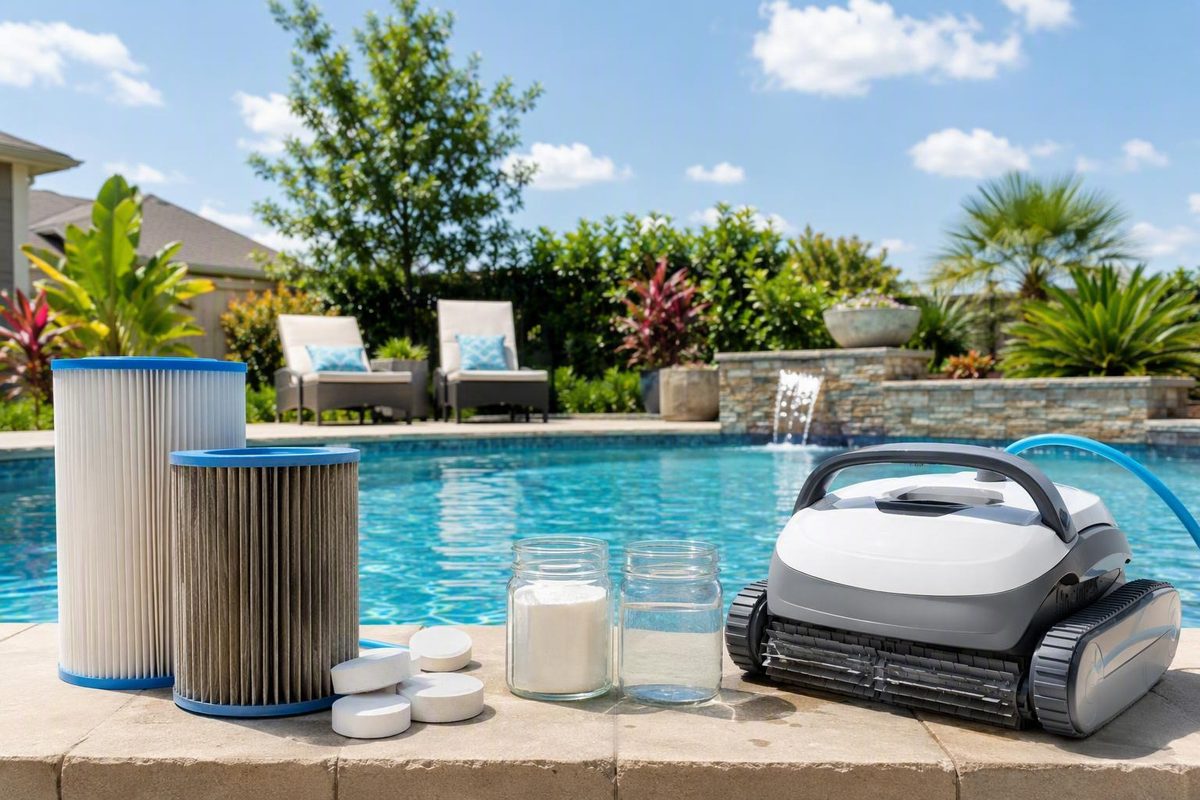
Shock may help an under-sanitized pool, but it cannot repair a damaged filter. Clarifier may help a sound filter capture fine particles, but it does not kill active algae. Flocculant can remove a heavy particle load quickly, but only when the pool can settle undisturbed and the material can be removed correctly.
The practical sequence is straightforward: remove debris, test the water, verify circulation and filtration, correct the diagnosed problem, and use a compatible particle-removal aid only if residual haze remains.
The first-hour checklist: stop guessing and start filtration
If you need to clear cloudy pool water fast, spend the first hour gathering information and restoring basic operation—not pouring in several chemicals at once.
- Stop swimming. Keep everyone out if you cannot clearly see the bottom or main drain, chemistry is outside acceptable operating limits, or treatment residue is visible. Commercial pool-care guidance likewise advises against swimming in cloudy water because visibility and chemistry both matter. Leslie’s cloudy-water guide
- Skim leaves and coarse debris. Remove material before it breaks down or reaches the filter.
- Empty the skimmer and pump baskets. Full baskets can restrict water flow.
- Brush the walls, steps, ladders, corners, and floor. This exposes material clinging to surfaces so sanitation and filtration can address it.
- Verify return flow. Look and feel for meaningful water movement from the return fittings.
- Record filter pressure. Compare it with the filter’s known clean starting pressure rather than relying on a generic number.
- Test before treating. Record free chlorine, pH, total alkalinity, and cyanuric acid, or CYA.
- Check calcium hardness or saturation balance when appropriate. This is particularly relevant when the water is gray-white, contains fine white particles, or became cloudy after a major pH or calcium change.
- Begin extended filtration. If the pump and filter are functioning normally, run them longer than usual while correcting the cause and monitoring pressure and flow.
Poor visibility is a safety problem, not merely a cosmetic defect. Do not reopen the pool until the water is clear enough to see the floor and main drain, chemistry is acceptable for the pool, visible residue is gone, and the treatment label’s requirements have been met. Beatbot’s swimming and equipment guidance
Write down the test results. They help distinguish a sanitation problem from a water-balance or filtration problem and provide a baseline for the next test. If your testing method reports combined chlorine, record that result as well.
Before dosing anything, calculate or confirm the pool’s water volume. Treatment amounts depend on volume, current readings, sanitizer system, formulation, and concentration. Products with similar names can contain different ingredients or strengths, so a remembered dose from another container is not a safe substitute for the current label.
Some corrections begin working quickly, but an overnight transformation is not guaranteed. A service-company troubleshooting guide uses 24–48 hours of effective filtration as a practical clearing and reassessment period, not a promise that every pool will be clear by then. C2C Pools’ cloudy-water procedure
Chemical-safety rules
- Read and follow the current product label.
- Store pool chemicals separately.
- Keep pool chemicals away from children.
- Add chemicals to water rather than adding water to chemicals.
The storage, child-safety, and mixing-direction instructions above are stated in Pool Robotic’s chemical-safety notice. For dose, protective equipment, circulation, spacing, cleanup, and disposal, follow the specific product label rather than assuming that one product’s directions apply to another.
Check every label for compatibility and required spacing before adding another treatment.
Diagnose the cloudiness before choosing a treatment
Most cloudy-water problems fit into four practical paths:
- Inadequate sanitation or active biological growth
- Chemical imbalance or mineral precipitation
- Suspended environmental or swimmer contaminants
- Weak, overloaded, or defective circulation and filtration
More than one problem can occur at the same time. A storm may introduce dirt and leaves, increase sanitizer demand, and overload the filter. Addressing only one part may produce temporary improvement without stable clarity.
| What you observe | What it may suggest | What to check next | First response |
|---|---|---|---|
| Greenish or tinted water, slippery surfaces, or unusual odor | Possible algae growth or substantial organic contamination | Free chlorine, applicable combined-chlorine result, pH, CYA, and response to brushing | Remove debris, restore sanitation when testing supports it, brush, and filter |
| Dull haze after a party or hot weekend | Swimmer contaminants and increased sanitizer demand | Chlorine, pH, baskets, filter pressure, and return flow | Retest, remove debris, correct sanitation if needed, and extend filtration |
| Cloudiness after rain or wind | Dirt, pollen, leaves, dilution, or increased sanitizer demand | Full water test, baskets, water level, and filter loading | Skim, brush or vacuum, retest, and filter |
| Milky gray or white water with fine white particles | Possible mineral precipitation | pH, calcium hardness, alkalinity, saturation balance, and recent additions | Correct balance carefully and filter; do not assume more shock is needed |
| Cloudiness immediately after shock | Oxidized material, dead algae, calcium-related effects, or inadequate filtration | Chlorine trend, pH, pressure, filter condition, and visible growth | Let the treatment work as labeled, brush, and improve particle removal |
| Acceptable chemistry but persistent haze | Weak flow, filter bypass, worn media, damaged internals, or minerals | Returns, valves, baskets, pump prime, pressure behavior, and filter components | Correct the mechanical or mineral problem before adding more chemicals |
| Rising filter pressure while clarity improves | The filter may be capturing debris | Pressure against the clean baseline and manufacturer instructions | Clean or backwash when indicated |
| Weak return flow with abnormal pressure | Restriction, low water, full baskets, valve error, pump trouble, or filter obstruction | Water level, valves, baskets, prime, plumbing, and filter | Correct the mechanical issue first |
| Severe cloudiness with a heavy suspended or settled load | Dead algae or another large particle load | Sanitation status, filter condition, and ability to vacuum to waste | Correct the cause, then consider compatible particle removal |
Greenish, tinted, odorous, or slippery water increases suspicion of biological growth or organic contamination, but appearance alone cannot confirm algae or bacteria. Testing, recent sanitizer history, surface condition, and the response to brushing provide better context.
The same caution applies to milky water. Fine white particles combined with high pH, elevated hardness, or a scale-forming saturation result can indicate mineral precipitation, but those signs are not proof. A commercial retailer’s guide to milky pool water similarly distinguishes possible mineral precipitation from microorganism-related cloudiness by considering color, fine particles, pH, hardness, odor, and surface condition.
Rain, pollen, dust, dirt, sunscreen, cosmetics, body oils, leaves, and heavy swimmer use can all add contaminants or increase sanitizer demand. Recent history is therefore diagnostically useful: “The water turned cloudy after Saturday’s party” tells you more than color alone.
If sanitizer, pH, alkalinity, and CYA appear reasonable but haze persists, shift attention toward circulation and particle removal. Possible causes include an overloaded filter, weak flow, water bypassing the media, worn media, a torn cartridge, damaged D.E. grids, broken sand-filter laterals, or mineral precipitation.
A cloudy saltwater pool follows the same diagnostic framework. Test the water rather than assuming the chlorine generator is keeping up. Confirm that the generator is operating, has adequate flow, and is producing sanitizer under the salt, cell, and operating conditions specified in its manual. Then inspect circulation and filtration as you would in any other pool.
Test and correct the water in a controlled sequence
The core tests answer different questions:
- Free chlorine indicates the measurable sanitizer available at that moment. Interpret it in the context of CYA, recent use, sunlight, weather, sanitizer type, and applicable product or system instructions.
- pH affects water balance and treatment conditions. High pH can accompany calcium precipitation and may interfere with an effective correction.
- Total alkalinity influences pH stability. A substantial alkalinity adjustment can also move pH, so it should be made deliberately.
- Cyanuric acid affects chlorine behavior in outdoor pools. Too little or too much can complicate sanitation, but one chlorine target is not appropriate for every CYA level, pool, or sanitizer system.
- Calcium hardness or saturation balance becomes particularly relevant when the water is milky, gray-white, scale-prone, or recently experienced a large pH or calcium change.
A pH range of 7.2–7.6 is recommended in HTH’s manufacturer guidance for cloudy-water troubleshooting. A treatment label or pool-specific condition may call for a different temporary target, so do not replace product directions with a generic range. HTH’s cloudy-water guide
A controlled adjustment sequence is generally:
- Confirm the test results and pool volume.
- Correct total alkalinity if it is materially out of range and requires adjustment.
- Recheck and adjust pH.
- Restore sanitizer according to the measured condition, CYA context, sanitizer system, and product directions.
- Recheck calcium hardness or saturation balance if mineral precipitation is plausible.
- Circulate for the period specified by the treatment and retest before making another major correction.
This sequence is not permission to chase every reading with another product. Minor deviations may not explain severe cloudiness, and each chemical addition can affect later measurements. Make one justified correction at a time, allow the directed mixing or circulation period, and retest.
If you are unsure whether the free-chlorine result is adequate for the measured CYA and sanitizer system, consult the sanitizer instructions, the test-kit guidance, applicable local operating requirements, or a qualified water-testing professional. Do not substitute a universal chlorine-to-CYA formula that may not apply to the pool.
Apparently normal chemistry does not rule out early algae, particularly if sanitizer was recently depleted. Nor does it rule out weak circulation, filter bypass, worn media, damaged internals, or mineral precipitation. One test is a snapshot; recent trends and physical inspection matter.
Avoid adding shock, clarifier, algaecide, phosphate remover, stain-and-scale treatment, and flocculant together. Different formulations may require different pH conditions, circulation patterns, or spacing. The current labels must govern dose, sequence, circulation, and compatibility.
Finally, clarity and sanitation are separate outcomes. Water can look clear while sanitation is inadequate, and properly sanitized water can remain temporarily hazy while particles await removal. Success requires acceptable readings as well as stable visibility.
Make circulation and filtration do the removal work
Chemicals can oxidize contaminants, alter water balance, or bind tiny particles, but they do not make the resulting material disappear. Suspended matter must ultimately be captured by a functioning filter or physically vacuumed out.
Temporarily extended or continuous filtration can accelerate removal while the underlying cause is being corrected. Treat the earlier 24–48-hour period as a monitoring window rather than a guaranteed clearing time. Discount Salt Pool’s commercial maintenance guide also recommends extended filtration while identifying damaged laterals, cartridges, and D.E. grids as possible causes of persistent cloudiness. Discount Salt Pool’s filtration troubleshooting guide
Check the circulation path methodically:
- Maintain the water level required by the pool and skimmer system.
- Empty the skimmer and pump baskets.
- Confirm that valves are in their intended operating positions.
- Verify that the pump is primed according to its manual.
- Check for obvious restrictions or leaks.
- Confirm meaningful flow at the return fittings.
- Compare filter pressure with the clean starting pressure.
- Brush corners, steps, and low-flow areas so material can reach the circulation system.
Pump runtime alone does not prove adequate filtration. A pump can operate for a long period while moving too little water or while damaged filter components allow particles to bypass the media.
Use pressure relative to the filter’s clean starting pressure, observed flow, the filter type, and the equipment manual to decide when maintenance is needed. A universal backwashing schedule is inappropriate because filter designs and debris loads differ, and cartridge filters are cleaned rather than conventionally backwashed.
| Filter type | Appropriate cloudy-water maintenance | Common faults to investigate |
|---|---|---|
| Sand | Backwash and rinse when pressure, flow, and model instructions indicate; restore the valve to the specified filtration position afterward | Worn media, channeling, damaged laterals, or valve problems |
| Cartridge | Shut the system down as directed, remove the cartridge, and clean it according to the manual | Torn, crushed, worn, or poorly seated cartridges |
| D.E. | Follow the model-specific cleaning, inspection, backwashing, and media-recharge procedure | Torn grids, manifold damage, assembly errors, or an incorrect media charge |
A pressure rise accompanied by improving clarity often suggests that the filter is capturing debris. A rapid or unusual rise may indicate heavy loading or restriction. Persistent haze with little pressure change and no visible progress may instead point to weak flow, bypass, worn media, particles too fine for the current setup, or an incorrect diagnosis.
Stop adding chemicals and obtain equipment help if the pump will not prime, return flow remains weak after basic checks, the filter leaks, pressure behaves abnormally, or internal damage is suspected. Follow the equipment manufacturer’s shutdown and service instructions rather than opening or reconfiguring pressurized equipment based on generic advice.
When shock helps—and when it wastes time
Shock is cause-dependent. It may be appropriate when testing shows inadequate sanitizer, a substantial organic load has consumed sanitizer, an applicable combined-chlorine result calls for oxidation, or active algae is suspected.
A sanitation-focused workflow is:
- Remove leaves and coarse debris.
- Test the water and confirm pool volume.
- Adjust chemistry as required by the shock product’s label.
- Apply the correct product amount for the measured conditions.
- Brush the walls, steps, corners, and floor.
- Operate circulation as directed.
- Filter or vacuum out oxidized contaminants and dead biological material.
- Retest rather than assuming the dose completed the job.
Do not use a generic shock dose copied from another pool. Products differ in active ingredient and concentration, while the required treatment depends on volume, current readings, CYA, sanitizer system, contamination level, and label directions.
Shock cannot repair a damaged filter, improve circulation mechanically, or directly remove precipitated minerals. If calcium has come out of solution, another shock dose may complicate the water balance without addressing the actual problem.
A pool may remain cloudy—or temporarily become hazier—after shocking because:
- Contaminants are still being oxidized.
- Dead algae or other residue remains suspended.
- The filter is overloaded, worn, damaged, or bypassing particles.
- Circulation is insufficient to carry debris to the filter.
- Some calcium-hypochlorite formulations may affect calcium or pH balance.
- The original diagnosis was incorrect.
Leslie’s commercial troubleshooting guidance also treats shock as conditional on sanitation or organic-load findings and recommends inspecting circulation and filtration when chemistry appears acceptable. Its cause-first cloudy-pool procedure
Repeated blind shocking wastes time when results do not indicate a sanitation or organic-contamination problem. It can also make diagnosis more difficult by moving several water-balance variables at once.
Before adding clarifier, flocculant, algaecide, phosphate remover, stain-and-scale treatment, or another specialty chemical after shock, follow the spacing and compatibility directions on every relevant label. There is no universal waiting period that applies to all formulations.
There is likewise no universal post-shock swimming time. Reopen only after the product’s requirements have been satisfied, chemistry is acceptable for the pool, the bottom and drain are clearly visible, and no treatment residue remains.
Clarifier versus flocculant: choose by severity and equipment
Clarifier and flocculant are secondary particle-removal tools. Before using either, correct inadequate sanitation, major water-balance problems, weak circulation, and filter defects. Neither product repairs those underlying conditions.
Clarifier binds very small suspended particles into larger clusters that remain in circulation. A functioning filter then captures the clusters. Clarifier is generally the better fit for slight-to-moderate residual haze when the bottom is mostly visible, circulation is sound, and the filter is working correctly.
Improvement after clarifier is often assessed over roughly 12–48 hours, although particle load, circulation, filter condition, and formulation can extend that period. This range comes from commercial pool-care guidance rather than comparative independent testing. LayorCare’s clarifier-versus-flocculant guide
Flocculant binds suspended particles into heavier material that settles on the pool floor. The settled layer generally must be vacuumed slowly to waste instead of being sent through the filter. Floc can be faster for a severe particle or dead-algae load, but it requires compatible plumbing, undisturbed settling, careful removal, replacement water, and subsequent chemistry checks.
| Factor | Clarifier | Flocculant |
|---|---|---|
| Best fit | Slight-to-moderate residual haze | Severe suspended-particle or dead-algae load |
| Expected speed | Gradual; often assessed over about 12–48 hours | Potentially faster after settling and vacuuming |
| Pump operation | Usually runs so the filter can capture clusters, subject to label | May circulate briefly and then stop for settling, subject to label |
| Labor | Lower | Higher |
| Filter dependence | High | Lower during final removal when material is vacuumed to waste |
| Water loss | Usually limited to filter maintenance | Often significant because vacuuming to waste removes water |
| Equipment needs | Product must be compatible with the filter and sanitizer system | Requires a workable waste route or another label-approved method |
| Common failure | Overdose worsens haze or overloads the filter | Settled debris is resuspended or routed through unsuitable equipment |
| What it cannot do | Kill algae, sanitize, balance water, or repair equipment | Kill algae, sanitize, balance water, or repair equipment |
A label-controlled flocculation workflow generally looks like this:
- Confirm that active algae and sanitation problems have been treated.
- Balance the water as the flocculant label requires.
- Confirm that the plumbing can remove settled material without routing it through unsuitable equipment.
- Dose for the actual pool volume and product concentration.
- Circulate briefly only if directed.
- Stop circulation and leave the pool undisturbed for the directed settling period.
- Vacuum the deposit slowly to waste without stirring it up.
- Monitor the water level during removal.
- Refill as necessary.
- Retest and rebalance the water.
- Restore filtration and maintain the equipment as directed.
Vacuuming to waste lowers the water level. Leslie’s comparison warns that allowing the level to fall below the skimmer opening can risk pump damage and distinguishes filter-captured clarifier clusters from settled floc that must be removed to waste. Leslie’s clarifier and flocculant comparison
If the pool has no suitable waste setting or bypass route, do not send conventional settled floc through equipment that is not designed for it. Instead:
- Correct the underlying cause.
- Clean the filter appropriately.
- Restore effective circulation.
- Brush to move fine material toward the filter.
- Use extended filtration while monitoring flow and pressure.
- Consider only a label-directed clarifier compatible with the installed equipment.
- Clean the filter again when pressure, flow, the manual, or the treatment label indicates.
This is particularly important with cartridge systems. Flocculant is not automatically compatible or incompatible with every cartridge installation; the formulation, plumbing, waste route, filter design, and manufacturer instructions determine whether it is practical. Without a separate removal route, clarifier and repeated cartridge cleaning are usually the more workable approach.
Measure carefully. Too much clarifier may worsen haze or load the filter excessively. Mishandled floc can be resuspended or clog unsuitable equipment. Do not combine clarifier and flocculant unless their labels explicitly permit it.
Follow the right recovery path for common cloudy-water scenarios
The event immediately preceding the cloudiness often identifies the fastest route.
After rain or heavy swimming: Remove leaves, dirt, and other incoming debris. Empty the baskets, brush or vacuum, and retest sanitizer and water balance. Storms and swimmers can add contaminants and increase sanitizer demand, so restore sanitation only as the results require and extend filtration.
After seasonal opening: Remove as much accumulated debris as possible before asking the filter to handle the fine material. Restore the water level, inspect the pump and filter, test and correct chemistry deliberately, establish sanitizer, brush, and begin an extended filtration period. One additive rarely compensates for accumulated debris, stagnant water, and dormant equipment.
After shock: Determine whether active algae remains or whether dead and oxidized material is simply awaiting removal. Brush suspicious surfaces and inspect the filter before adding more shock. If sanitation is holding and new growth is not appearing, filtration or vacuuming may now be the limiting step.
After phosphate remover, clarifier, or another particle-binding treatment: Temporary haze may occur while bound particles remain suspended and await filtration. Monitor pressure and perform label-directed filter maintenance. If haze worsens or shows no reasonable improvement, reassess the diagnosis, dose, compatibility, and filter operation rather than automatically adding another product.
After sand-filter backwashing: Use the rinse cycle before returning to filtration when the filter’s instructions require it. Follow the model’s valve-position and pump-operation procedure exactly.
Milky water with high pH or mineral indicators: Prioritize controlled water-balance correction and particle removal. Check calcium hardness or saturation balance, correct pH as appropriate for the condition and products, and filter. Chlorine does not physically remove precipitated calcium, so repeated shock is not a mineral-removal strategy.
Normal tests but persistent haze: Verify pump operation, valve positions, filter pressure, and actual return flow. Inspect the condition and seating of the media and internal components. Also consider mineral precipitation or recent chemical interactions.
Saltwater pool: Test free chlorine rather than relying only on a display light or output percentage. Confirm flow, cell condition, salt level, operating status, chemistry, and filtration using the generator and equipment manuals. Continuous generation does not establish that production is meeting current demand.
Reassess at 24–48 hours and prevent the problem from returning
Use a timed review rather than adding another chemical whenever the water does not change immediately.
During the first several hours:
- Confirm that the pump remains primed.
- Check for meaningful return flow.
- Watch for leaks, unusual noise, or abnormal pressure.
- Verify that the treatment is circulating—or settling—as its label directs.
- Brush as appropriate unless the treatment requires still water.
- Keep swimmers out.
Overnight:
- Monitor filter pressure and flow.
- Look for improving bottom visibility.
- If flocculating, leave the water undisturbed for the directed period.
- If filtering, note whether debris capture is changing the pressure.
- Do not add another product merely because complete clarity has not returned.
At the 24–48-hour checkpoint:
- Retest free chlorine, pH, total alkalinity, and other relevant parameters.
- Compare visibility with the starting condition.
- Check whether surfaces remain slippery or develop new discoloration.
- Recheck return flow and filter pressure.
- Decide whether the correction is working, stalled, or making conditions worse.
The 24–48-hour checkpoint is supported by service-company guidance that combines testing, balancing, debris removal, and continuous filtration; it is not a guaranteed clearing deadline. C2C Pools’ rapid-recovery guidance
Success means more than a temporarily polished appearance. Look for:
- Stable, clear water
- Clearly visible floor details and main drain
- Acceptable sanitizer and water-balance readings
- No visible treatment residue
- No continuing slippery growth or discoloration
- Normal return flow
- Expected filter-pressure behavior
If the water is improving, continue the diagnosed process. Clean or backwash the filter when pressure, flow, the equipment manual, or the treatment label calls for it. Adding another product “for speed” may interrupt a correction that is already working.
If the water is unchanged or worse at the checkpoint, stop indiscriminate dosing and reassess:
- Free chlorine in relation to CYA and the sanitizer system
- pH and total alkalinity
- Calcium hardness or saturation balance
- Recent products and possible incompatibilities
- Water level, baskets, pump operation, valves, and return flow
- Filter cleanliness, media condition, and internal integrity
- Whether the original diagnosis confused minerals, active algae, dead material, or ordinary debris
Seek professional water analysis or equipment service when algae repeatedly returns, chemistry remains unstable, sanitizer cannot be maintained, the pump malfunctions, pressure is abnormal, internal filter damage is suspected, or severe cloudiness cannot be safely removed with the installed system.
To reduce recurrence:
- Test routinely and record trends.
- Maintain sanitizer and water balance for the specific pool.
- Remove leaves and debris promptly.
- Brush and vacuum as needed.
- Keep skimmer and pump baskets clear.
- Maintain filter media according to pressure, flow, and manufacturer guidance.
- Record the clean filter pressure after proper maintenance.
- Respond promptly after storms and heavy swimmer loads.
- Confirm salt-chlorine-generator operation instead of assuming production is adequate.
- Treat clarifier, flocculant, and other specialty additives as optional tools—not substitutes for sanitation, balance, circulation, and filtration.
The cause-first decision is the fastest dependable one: test before treating, restore sanitation only when readings and symptoms support it, and make sure water is moving through a sound filter. Reserve clarifier or flocculant for particles the system cannot otherwise remove efficiently.
The goal is stable clarity, acceptable chemistry, and reliable equipment—not the largest or quickest chemical dose. If the pool is not visibly improving at the reassessment point, remains too cloudy to see through safely, or shows pump or filter trouble, stop adding products and obtain professional testing or repair help.
Can I swim in a cloudy pool if the chlorine reading looks normal?
No—not when the bottom or main drain cannot be seen clearly. A normal-looking chlorine result does not establish adequate visibility, complete sanitation, safe water balance, or the absence of treatment residue.
Keep swimmers out until the pool is visibly clear, chemistry is acceptable, the treatment label’s requirements have been met, and no residue remains. Beatbot’s commercial guidance likewise advises waiting until the water is clear, balanced, and free of visible residue. Beatbot’s swim-safety guidance
Why is my pool still cloudy after I shocked it?
Shock may have oxidized contaminants or killed algae without removing the resulting particles. Dead material can remain suspended until the filter captures it or it is vacuumed out. The filter may also be overloaded, worn, damaged, bypassing particles, or receiving too little flow.
Other possibilities include mineral precipitation, calcium or pH effects from some shock formulations, or an incorrect initial diagnosis. Retest, brush, inspect circulation and filtration, and avoid another shock dose unless the results and symptoms support it.
How long should I run the filter to clear cloudy pool water?
Temporarily extended or continuous filtration is often useful, with approximately 24–48 hours serving as a practical reassessment period rather than a guarantee. Cloudy-pool filtration guidance
Monitor pressure, flow, pump operation, and water level throughout. Maintain the filter according to its type, clean-pressure baseline, manual, and any treatment label. Longer runtime cannot compensate for weak flow, bypass, damaged media, or defective components.
Is clarifier or flocculant faster for cloudy water?
Flocculant can be faster for a severe suspended-particle or dead-algae load because it settles material for direct removal. However, it requires undisturbed water, careful vacuuming to waste, compatible plumbing, more labor, replacement water, and chemistry rechecking.
Clarifier is generally slower but easier for slight-to-moderate residual haze. It keeps bound particles in circulation so a functioning filter can collect them. It is usually the more practical route when the pool lacks a suitable waste setting, provided the formulation is compatible with the equipment.
Neither option sanitizes the pool, kills active algae, corrects water balance, or repairs filtration.
What should I do if the water is still cloudy after 48 hours?
Stop adding products indiscriminately and perform a fresh diagnosis. Retest free chlorine, pH, total alkalinity, CYA, and mineral balance where relevant. Inspect water level, baskets, pump operation, valves, return flow, filter pressure, media condition, and internal filter components.
Review every recently added product for dose, timing, and compatibility. If chemistry will not stabilize, sanitizer will not hold, algae returns, flow remains weak, filter damage is possible, or the bottom remains invisible, obtain professional water testing or equipment service.