
Clear Cloudy Pool Water After Shock in the Right Order
By about 48 hours, persistent haze despite corrected chemistry and proven filtration calls for fresh water analysis and closer equipment inspection.
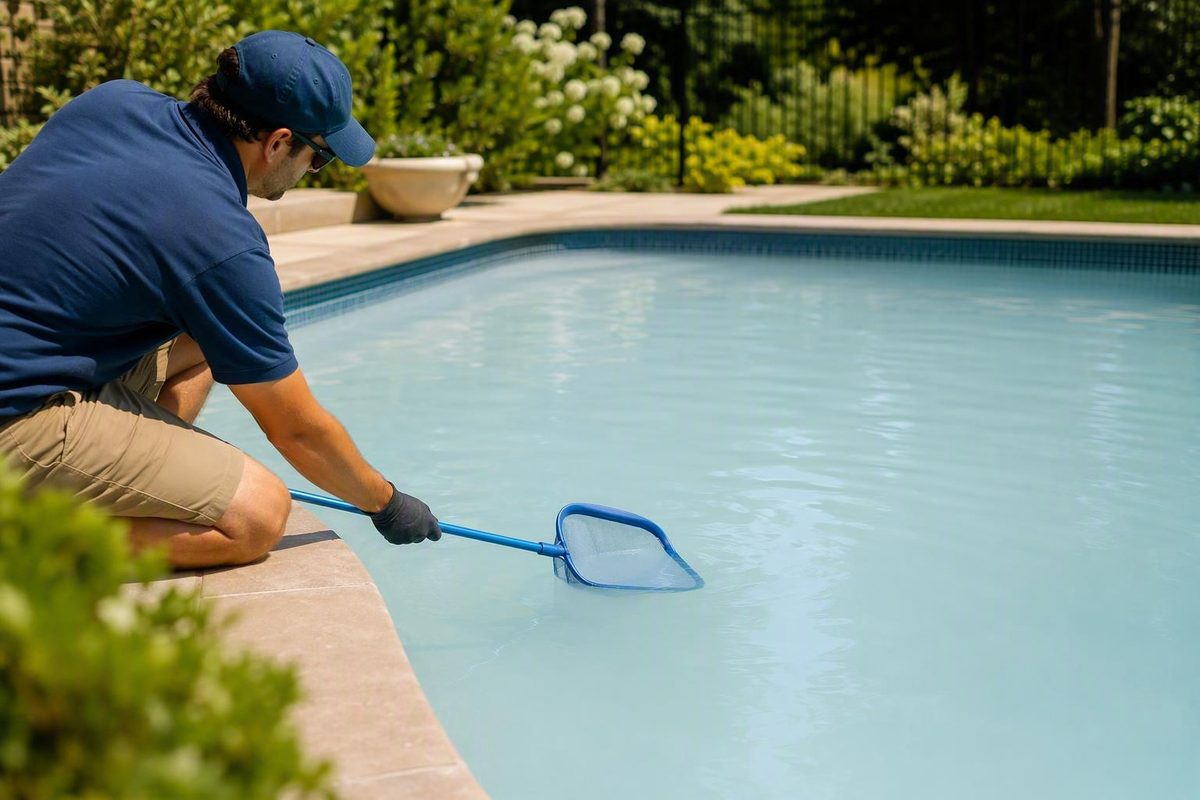
Cloudy pool water after shock can be a temporary part of cleanup. Dead algae, oxidized contaminants, fine debris, or dispersing granules may remain suspended until circulation and filtration remove them.
But cloudiness is a symptom, not proof that the treatment worked. The same haze can indicate active algae, ineffective sanitation, calcium precipitation, imbalanced chemistry, weak circulation, or a filter that cannot capture fine particles.
Before adding anything else:
- Identify the exact shock product and dose.
- Test the water.
- Confirm normal circulation and filtration.
- Skim, brush, and vacuum.
- Use more sanitizer, clarifier, or flocculant only when the evidence supports it.
Is cloudy water after shocking normal?
A brief haze can be normal after shocking. Fine material may remain suspended after contaminants have been oxidized or algae has been killed, and granular shock may temporarily cloud the water as it disperses. Commercial post-shock guidance describes this as a possible short-term cleanup effect, while emphasizing that persistent cloudiness needs further diagnosis (Beatbot’s post-shock troubleshooting guide).
Do not assume every cloudy pool is improving, however. The same hazy or milky appearance can result from:
- Active or remaining algae
- Too little effective sanitizer for the contaminant load
- High pH or another chemical imbalance
- Calcium precipitation
- Weak or uneven circulation
- Dirty, worn, damaged, or unsuitable filter media
- Heavy loads of dirt, pollen, leaves, sunscreen, or swimmer waste
- Multiple chemical additions made too close together
Timing and appearance offer clues, but they do not establish the cause.
Cloudiness that appears immediately after granular shock may reflect product dispersion. A sudden, uniform white or milky appearance may also be consistent with precipitation, especially if calcium-hypochlorite shock was added when pH or calcium hardness was already elevated.
A green pool that becomes blue or blue-gray but remains hazy may contain suspended dead algae. By contrast, continuing green color, slippery surfaces, recurring growth, or rapid sanitizer loss suggests that the underlying problem may not be resolved.
Before treating the latest visual symptom, record:
- Pool volume
- Product name and formulation
- Amount added
- Time of application
- Whether the shock was granular, liquid, chlorine-based, or non-chlorine
- The pool’s appearance before treatment
- Test results before and after treatment
- Other recent chemical additions
- Recent storms, heavy use, runoff, or debris
- Pump operation and filter cleaning already performed
Then reassess at useful checkpoints rather than waiting for a guaranteed clearing time:
- After the product has dispersed: Follow the exact label procedure and allow the application process to finish.
- After a meaningful filtration period: Confirm that water is moving normally and the filter is capturing material.
- At about 24 hours: Retest, compare visibility, inspect the filter, and remove settled debris. Commercial post-shock guidance commonly uses approximately 24 hours as a troubleshooting point for persistent cloudiness, not as a promise that every pool will be clear by then (In The Swim’s post-shock guide).
- By about 48 hours: If chemistry has been corrected and filtration is demonstrably effective but visibility remains poor, obtain fresh test results and reconsider the diagnosis. Commercial clearing estimates commonly extend to 48 hours for particle-removal treatments, but actual recovery varies with the pool and filter (LayorCare’s clarifier and flocculant guide).
Treat those intervals as editorial reassessment points—not evidence-based deadlines. Move to active diagnosis sooner if the water becomes more opaque, stays green, develops recurring growth, feels slippery, loses sanitizer rapidly, or shows no improvement despite normal flow and a clean filter.
Match the appearance and timing to the most likely cause
Appearance and timing can narrow the possibilities, but neither can conclusively distinguish dead algae, active algae, calcium precipitation, or undispersed product. Use visual clues to decide what to test and inspect next.
| Likely cause | Supporting clues | Checks to perform | Next cautious action |
|---|---|---|---|
| Dead algae or oxidized debris | Pool was green or heavily contaminated before shock; water is now blue or blue-gray but hazy; fine material settles when circulation stops | Test sanitation and balance; inspect filter pressure, flow, and settled residue | Brush, filter, clean the filter as required, and vacuum settled material |
| Active or remaining algae | Green tint continues; surfaces feel slippery; growth returns; sanitizer is consumed rapidly | Retest free chlorine, combined chlorine, pH, and cyanuric acid; inspect steps, ladders, corners, and shaded areas | Address the confirmed sanitation problem according to the sanitizer and shock labels; do not rely on clarifier to treat algae |
| Calcium precipitation | Uniform white or milky cloud appears soon after calcium-hypochlorite shock; pH or calcium hardness was already elevated | Test pH, total alkalinity, and calcium hardness; review recent calcium-containing or balance-related additions | Pause calcium-based additions and correct only the measured imbalance |
| Excess cyanuric acid or reduced chlorine effectiveness | Stabilized chlorine has been used repeatedly; cloudiness or algae returns despite an apparently adequate chlorine result | Test cyanuric acid and interpret chlorine in that context | Do not automatically add more stabilized shock; determine the appropriate pool-specific correction |
| Poor circulation | Weak or uneven return flow; obvious dead zones; air in the pump basket; repeated loss of prime | Check water level, pump prime, baskets, valves, returns, and obvious obstructions | Restore normal flow before adding a clearing aid |
| Ineffective filtration | Cloudiness persists despite acceptable chemistry; pressure is abnormal relative to the clean baseline; media is dirty or damaged | Inspect the filter and compare pressure and flow with normal clean operation | Clean, backwash, recharge, repair, or replace components as the equipment instructions require |
| Contaminant overload | Cloudiness follows a storm, party, runoff event, heavy sunscreen use, or a large debris load | Test sanitation; inspect baskets and filter loading; remove visible debris | Remove contaminants physically, maintain label-directed sanitation, and continue effective filtration |
| Recent or incompatible additions | Haze begins immediately after several products were added close together | Review every product, amount, sequence, and application instruction | Stop adding products and obtain reliable testing before attempting a correction |
Storms, heavy swimmer use, chemistry imbalance, poor sanitation, and ineffective filtration can overlap. Worn cartridges, sand, diatomaceous-earth media, or grids may also lose fine-particle capture ability, according to Leslie’s retailer troubleshooting guide (cloudy-water diagnosis and filter checks).
Dead algae and active algae require different responses. Once the organic problem has been controlled, suspended dead material must be removed through filtration, brushing, filter cleaning, and vacuuming. If algae remains active, particle-removal products may change the appearance without correcting the sanitation failure.
Calcium-related milkiness is plausible, not visually certain. Calcium hypochlorite contributes calcium, and precipitation is more plausible when the water is already prone to it. Test before adjusting pH, alkalinity, or calcium-related conditions.
Repeated dichlor use affects the diagnosis. Dichlor contributes cyanuric acid as well as chlorine. If cyanuric acid has accumulated, another stabilized dose may add to the existing condition rather than correct the haze.
Equipment may be the primary problem. Balanced water can remain cloudy when flow is weak, valves are positioned incorrectly, baskets are blocked, or the filter cannot retain fine particles. If the pool looks unchanged after effective filtration should have produced some improvement, verify that filtration is truly effective.
Test before deciding whether the pool needs more shock
Cloudiness alone is not a reason to add another shock dose. Before choosing another treatment, record:
- Free chlorine
- Combined chlorine
- pH
- Total alkalinity
- Calcium hardness
- Cyanuric acid
Use a test method appropriate for the pool and follow its instructions. If the result appears inconsistent with the pool’s condition—or falls outside the test method’s stated range—confirm it with another suitable method or an independent water analysis.
Do not interpret free chlorine in isolation. Its practical meaning depends on the sanitizer system, cyanuric acid, pH, current contaminant demand, recent treatment, and the guidance that applies to the specific product and pool.
Use the results to distinguish between two broad situations:
- Low or ineffective sanitation: Testing and the pool’s condition indicate an unresolved biological or contaminant problem. A label-directed sanitizer response may be necessary.
- Adequate sanitation with suspended particles: Chemistry no longer points to an active contaminant problem, so circulation, filtration, brushing, and vacuuming become the priority.
The formulation matters:
- Calcium hypochlorite contributes calcium. Repeated use may be a poor fit when calcium hardness is already excessive or precipitation is occurring.
- Dichlor contributes cyanuric acid. Repeated stabilized shock can compound an excessive-cyanuric-acid condition.
- Non-chlorine shock oxidizes certain waste. It should not be presented as an independent treatment for active algae.
In The Swim’s commercial guide similarly separates high pH, calcium hardness, cyanuric acid, contamination, and poor filtration into different causes requiring different responses rather than one universal post-shock treatment.
If chlorine is already high but the water remains cloudy, pause indiscriminate additions and check:
- Whether the test result is dependable
- pH
- Cyanuric acid
- Calcium hardness
- Whether the original contamination is returning
- Return flow and circulation coverage
- Filter cleanliness, pressure, and media condition
- Whether settled material can be vacuumed
More oxidizer will not clear a blocked circulation path, restore damaged filter media, or physically remove dead algae.
Confirmed excessive calcium hardness or cyanuric acid is not removed by ordinary filtration. A pool-specific correction may involve replacing some water, but the appropriate approach depends on the pool, its equipment, the replacement water, and site conditions. Do not begin draining based on generic online instructions; verify the procedure appropriate to the installation and check any requirements that apply where the water will be discharged.
Avoid universal dosing charts. The correct dose depends on verified pool volume, current readings, product concentration, treatment objective, and the exact label.
Chemical-handling precautions
- Keep pool chemicals apart and away from children.
- Do not mix pool chemicals with one another.
- Never pour water into concentrated pool chemical.
- Do not assume a product should be pre-dissolved; apply it exactly as its label directs.
- Let the product label control application, protective measures, storage, and disposal.
Pool Robotic’s own safety notice specifically says to store pool and spa chemicals apart, keep them from children, and add chemicals to water rather than the reverse (Pool Robotic’s terms and safety notice).
If a container or chemical mixture appears to be reacting, stop routine pool work and keep people away while obtaining qualified assistance. Do not improvise a neutralization or cleanup procedure.
Restore circulation and make the filter do the cleanup
Before buying another chemical, establish that water is moving through the pool and filter normally.
Use this checklist in order:
- Check the water level. Confirm it is appropriate for the pool’s skimming and circulation system.
- Confirm the pump is primed. Look for persistent air accumulation or repeated loss of prime.
- Empty the skimmer and pump baskets. Heavy debris restricts flow.
- Check valve positions. Make sure water is not unintentionally being diverted away from part of the system.
- Inspect return flow. Compare it with normal operation and look for weak or uneven returns.
- Look for air intrusion or an obvious obstruction. Return bubbles, weak suction, or a pump that will not remain primed indicate a circulation problem requiring diagnosis.
- Check circulation coverage. Steps, benches, corners, and the deep end should not remain persistent dead zones.
- Compare filter pressure with the clean baseline. Use the reading recorded after that specific filter was properly cleaned.
- Inspect and service the filter according to its type and manual.
A pressure rise above the system’s established clean baseline may indicate that the filter is capturing debris and becoming loaded. Clean or backwash it when the manufacturer’s instructions call for service.
Do not substitute a retailer’s pressure threshold for the filter manufacturer’s procedure. The transferable principle is to track pressure and flow relative to the same system when it is clean and operating normally.
Filter-specific checks include:
- Sand filter: Backwash according to the model’s pressure or flow criteria. If normal pressure and flow return but fine-particle capture remains poor, the filter may need further equipment-specific diagnosis.
- Cartridge filter: Remove and clean the cartridge as directed, then inspect it for damage and correct seating.
- Diatomaceous-earth filter: Follow the model-specific instructions for cleaning, inspecting internal components, and replacing the required filter media.
Extended filtration can help while clearing suspended material, but no single runtime is appropriate for every installation. Pump condition, flow, filter loading, and manufacturer instructions must control. Monitor pressure and return flow rather than leaving the system unattended indefinitely.
Detailed shutdown, opening, cleaning, backwashing, recharging, and restart procedures vary by model. Follow the pump, valve, and filter manuals rather than generic service instructions.
Seek equipment diagnosis if:
- The pump repeatedly loses prime
- Return flow stays weak after baskets and obvious obstructions are addressed
- Abnormal pressure quickly returns after filter service
- Water is leaking from equipment
- The pump makes unusual noises or repeatedly stops
- Filter components appear damaged
- Debris returns through the pool returns
Brush, skim, and vacuum without sending debris back into suspension
Shock can oxidize or kill contaminants, but it does not physically remove all resulting material. Dead algae, pollen, dust, organic fragments, and precipitated particles can remain in the pool until they are filtered or vacuumed out.
Use this cleanup sequence:
- Skim floating debris. Remove leaves, insects, and other material before it sinks or adds to the contaminant load.
- Brush walls and fixtures. Include steps, ladders, seams, corners, benches, fittings, and shaded areas.
- Brush the floor methodically.
- Allow circulation to move loosened material toward the filter.
- Monitor filter pressure and return flow.
- Vacuum settled material slowly.
- Clean or backwash the filter when its instructions call for it.
- Repeat the physical cleanup before layering in another chemical.
Slow vacuuming matters when a fine deposit has settled. Fast passes or aggressive movements can resuspend the material before the vacuum captures it.
The correct vacuum route depends on the system:
- Vacuuming through the filter may suit an ordinary debris load if the filter can retain the particles.
- Vacuuming to waste may suit a heavy settled load when the plumbing and valve arrangement provide that function.
- Some systems do not have a waste or bypass route.
Follow the valve and filter manuals when selecting or changing operating modes. If vacuuming to waste is available, monitor the water level and stop before the circulation system can no longer operate normally. Verify how discharged pool water should be handled at the property before beginning.
An automatic or robotic cleaner may help with ordinary settled debris. Do not assume it can replace the label-directed waste-removal step during a floc treatment, because the required removal route depends on the product and plumbing.
During cleanup, watch for evidence that the process is working:
- Is visible depth increasing?
- Is the floor deposit shrinking after vacuuming?
- Is filter pressure changing as material is captured?
- Does flow improve after filter cleaning?
- Does green growth return?
- Are sanitizer readings stable or dropping rapidly?
If brushing repeatedly produces green clouds or surfaces become slippery again, return to the sanitation diagnosis. If the water stays uniformly white despite physical cleanup, reassess water balance and possible calcium precipitation. If nothing changes despite appropriate chemistry, concentrate on circulation and filtration.
Clarifier or flocculant: choose by the removal method
Neither clarifier nor flocculant fixes active algae, inadequate sanitation, imbalanced chemistry, poor circulation, or defective filtration. Use either only after the underlying cause has been addressed.
The basic distinction is:
- Clarifier helps a functioning filter capture particles.
- Flocculant settles particles for removal from the floor, commonly through a waste route.
Consider clarifier for mild-to-moderate suspended haze when:
- Chemistry has been addressed
- Algae is not continuing to grow
- Pump flow is normal
- The filter is clean, intact, and capable of capturing the resulting clusters
- Fine suspended particles remain after physical cleanup
Clarifier binds small particles into larger clusters that the filter can capture more readily. It generally requires continued filtration and monitoring of pressure and flow.
Commercial guidance reports visible improvement in approximately 12 to 48 hours, depending on particle load, circulation, and filtration. That is a seller-provided estimate rather than a guaranteed clearing time; the exact product label controls the procedure (LayorCare’s clarification guidance).
More clarifier is not necessarily better. Overdosing may burden the filter or worsen cloudiness. Use one label-compatible dose for the verified pool volume and allow the prescribed process to finish before reconsidering the treatment.
Consider flocculant for a severe suspended-particle load only when:
- Chemistry and sanitation have already been addressed
- The product is compatible with the pool and equipment
- The label-directed circulation and settling procedure can be followed
- The system can remove settled material by the route specified on the label
- The water level and pump operation can be monitored during removal
Flocculant forms heavier masses that settle on the pool floor. The process is more labor-intensive and commonly requires a circulation stage, a still-water settling period, and slow removal. Exact times and system settings vary, so do not substitute a generic online schedule for the label.
A cartridge filter does not automatically make every floc treatment impossible. The practical limitation is whether the installation can bypass the cartridge and remove settled material to waste. Retailer guidance cautions against floc treatment in cartridge systems that lack a suitable waste route (EZ Pools’ flocculant and clarifier comparison).
Vacuuming to waste lowers the water level and may require refilling followed by retesting and rebalancing. Confirm that the system supports the procedure before choosing floc.
Do not stack clarifier and flocculant closely together. Choose one removal pathway based on the confirmed problem and finish that product’s label-directed process before changing strategies.
Use 24- and 48-hour checkpoints instead of a fixed clearing promise
There is no universal clearing time for cloudy pool water after shock. Recovery depends on:
- The original algae or contaminant load
- Whether sanitation is now effective
- Shock formulation
- pH, alkalinity, calcium hardness, and cyanuric acid
- Particle size
- Pump flow and circulation pattern
- Filter type, size, cleanliness, and condition
- Brushing and vacuuming
- New contamination during cleanup
Commercial guides commonly describe light haze improving within a day or two, while acknowledging that algae, calcium conditions, excessive cyanuric acid, and weak filtration can extend the process. Treat those figures as troubleshooting estimates, not safety guarantees.
At the first checkpoint, after the product has dispersed according to its label:
- Confirm that the pump is primed
- Check normal return flow
- Verify that the filter is in the intended operating mode
- Look for obvious pressure or flow abnormalities
- Remove floating debris
- Record whether visibility is improving, worsening, or unchanged
At approximately 24 hours:
- Retest the relevant chemistry
- Compare visibility with the previous observation
- Inspect pressure relative to the clean baseline
- Clean or backwash the filter if its instructions call for it
- Brush areas where material remains attached
- Vacuum settled debris slowly
- Check whether algae is returning
The 24-hour point is a practical reassessment interval reflected in commercial post-shock troubleshooting—not a deadline by which every pool should be clear (In The Swim’s cloudy-after-shock guide).
If the pool is improving, continue the same physical-removal process. Do not interrupt a working strategy by adding unnecessary products.
If there is no improvement, revisit the diagnosis. Ask what evidence supports adding more shock, clarifier, acid, baking soda, or another balance chemical.
By approximately 48 hours, persistent haze despite corrected chemistry and demonstrably effective filtration should prompt fresh water analysis and closer equipment inspection. The 48-hour point is another reassessment interval, not a guaranteed clearing deadline; commercial clarifier guidance itself gives a variable window of up to about 48 hours depending on circulation, filtration, and particle load.
Recovery may take longer when:
- The pool began with a heavy algae load
- Conditions continue to favor calcium precipitation
- Cyanuric acid is excessive
- Filter media cannot capture fine material
- Circulation leaves substantial dead zones
- Dirt or organic debris continues entering the pool
- Water balance is being corrected in stages
- Vacuumed material is returning to the water
Seek independent testing or professional equipment help when the deepest floor remains invisible, algae returns, sanitizer demand remains unexplained, measured conditions are difficult to correct, circulation remains weak, filter pressure behaves abnormally, or damaged media is suspected.
Do not swim until both the water and the view are safe
Do not decide to swim solely because a fixed number of hours has passed or one sanitizer result appears acceptable.
Use this entry check:
- Confirm that the treatment label permits entry.
- Confirm that measured chemistry meets the guidance for the specific pool and sanitizer system.
- Confirm that the entire bottom, including the deepest area or main drain, is clearly visible.
Leslie’s commercial pool-safety guidance likewise advises against swimming in cloudy water, even when cloudiness may have more than one cause (Leslie’s cloudy-pool safety guidance).
Do not rely on a universal eight-hour rule or a generic chlorine range. Product formulations, doses, pool conditions, cyanuric acid, contaminants, and label restrictions vary. If you cannot identify the applicable guidance, consult the exact product label and the sanitizer-system instructions or obtain qualified pool-care advice.
During a floc treatment, follow the product’s entry restrictions and settling procedure. Commercial floc guidance says swimming should not occur while the water must remain still and particles are settling (EZ Pools’ floc-treatment guidance).
Stop routine troubleshooting, keep swimmers away, and obtain qualified help when chemicals appear to be reacting unexpectedly, strong fumes are present, equipment cannot be operated normally, an electrical fault is suspected, or visibility cannot be restored despite corrected chemistry and effective filtration.
Why did calcium-hypochlorite shock make my pool look milky?
Calcium hypochlorite contributes calcium. If pH, calcium hardness, or the water’s overall tendency toward calcium precipitation was already elevated, adding it may contribute to uniform white or milky water.
Appearance alone cannot confirm the cause. Dispersing granules and suspended debris can look similar. Pause additional calcium-based products and test pH, total alkalinity, and calcium hardness. Also review whether another calcium-containing or balance-adjusting product was recently added.
If excessive calcium hardness is confirmed, ordinary filtration will not remove the dissolved excess. Any corrective water replacement should be planned for the specific pool rather than based on a universal draining instruction.
Should I add more shock if the chlorine is already high?
Not because of cloudiness alone. Check the reliability of the test, then review pH, cyanuric acid, calcium hardness, circulation, filtration, and the original contamination.
Another label-directed sanitizer treatment may be appropriate if testing and the pool’s condition show that the biological or contaminant problem remains unresolved. If the remaining cloud is dead algae or fine debris, more sanitizer will not remove it. Filter, brush, vacuum, and clean the filter instead.
Can I use flocculant with a cartridge filter?
Possibly, but only when the product label permits it and the plumbing provides an appropriate way to bypass the cartridge and remove settled material as directed.
The limitation is not simply that the system contains a cartridge. Floc is intended to settle a heavy particle load for removal. If the installation has no suitable waste-vacuum pathway, the treatment may be impractical. Clarifier may be the better fit when the cartridge is clean, intact, and able to capture enlarged particles.
Does baking soda clear cloudy pool water after shock?
Not directly. Baking soda raises total alkalinity. It may be appropriate when reliable testing shows that alkalinity needs to be increased, but it does not remove dead algae, restore weak circulation, repair a filter, or collect suspended debris.
Adding it without a measured need can complicate the diagnosis. Swim University’s cloudy-water guidance likewise identifies baking soda as an alkalinity adjustment rather than a direct particle-removal treatment (its cloudy-pool troubleshooting article).
Is it safe to swim when the chemistry tests correctly but the bottom is not visible?
No. An acceptable-looking chemistry result does not remove the visibility hazard. Wait until the treatment label permits entry, measured conditions meet the guidance for the specific pool and sanitizer system, and the entire bottom—including the deepest area or main drain—is plainly visible.
The final approach should be minimal and evidence-based:
- Stop adding products.
- Identify exactly what was used.
- Verify the pool volume.
- Test free chlorine, combined chlorine, pH, total alkalinity, calcium hardness, and cyanuric acid.
- Restore circulation.
- Clean and monitor the filter.
- Skim, brush, and vacuum.
- If suspended particles remain, choose at most one label-directed clarification method that fits the available removal route.
Elapsed time is not the safety test. Keep swimmers out until the product label allows entry, measured conditions are acceptable for the pool, and the entire bottom is clearly visible. If cloudiness persists after chemistry is corrected and filtration is proven effective, replace chemical trial and error with independent water testing or equipment diagnosis.