
Pool Filter Balls vs Sand: Weight, Cleaning and Fit
Sand is the safer default. Filter balls can solve lifting and access problems, but compatibility depends on the exact filter and fiber product.
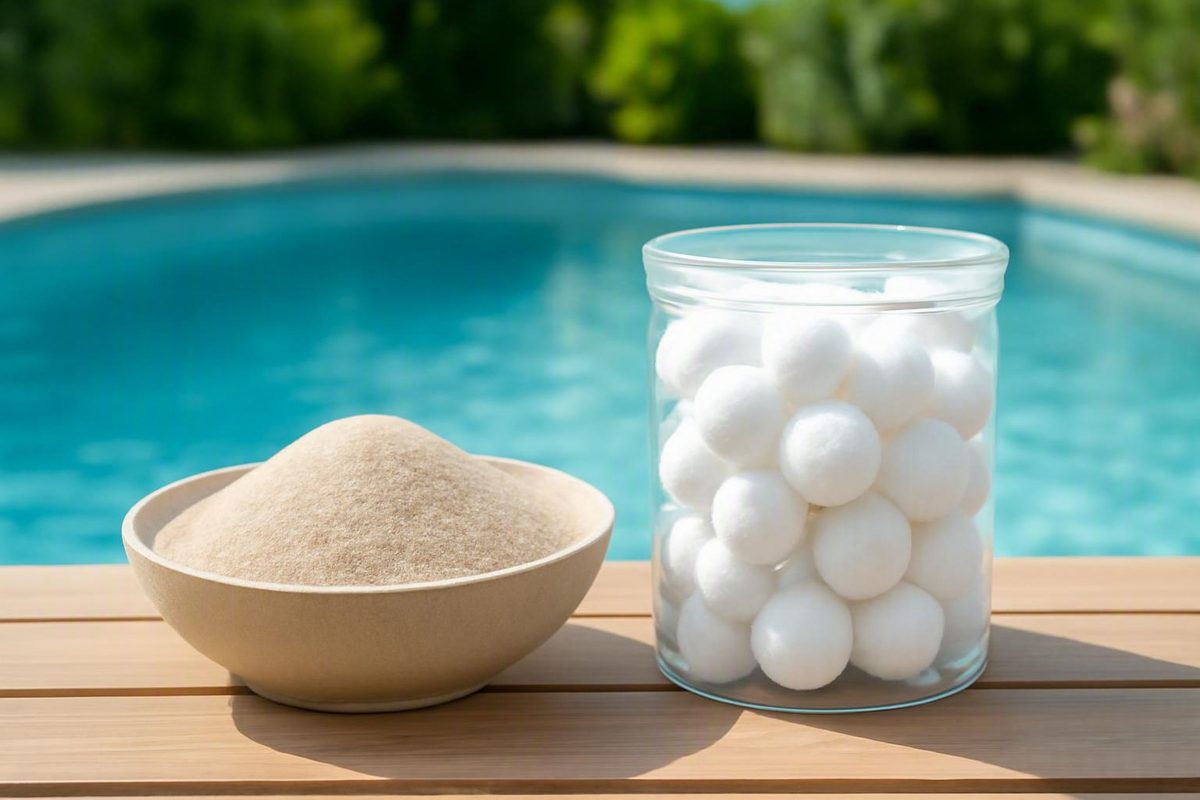
The short answer: sand is the safer default, but filter balls solve specific problems
For most pool owners, filter sand remains the lower-uncertainty choice. Choose sand when your priorities are familiar operation, broad availability, straightforward in-place backwashing, and a maintenance routine that pool technicians already understand.
Filter balls become more compelling when the weight of sand presents a genuine obstacle. Transporting tens or hundreds of pounds of dry sand—and eventually removing heavier, wet media—can be difficult for owners with lifting limitations or restricted access to the equipment pad. A compatible fiber product can reduce that burden to a few lightweight packages.
Pool filter balls are not a separate type of filter. They are masses of synthetic fibers intended to replace sand inside some vessels originally designed as sand filters. The vessel, pump, valve, laterals, standpipe, and plumbing remain in place. A product that fits inside the vessel is not necessarily approved for that filter, suitable for its internal geometry, or compatible with its warranty.
| Decision factor | Filter sand | Filter balls |
|---|---|---|
| Handling weight | Heavy; larger filters may contain hundreds of pounds | Commercial conversion recommendations typically call for only a few pounds |
| Advertised particle capture | Commercial sources commonly cite about 20–40 microns | Vendors advertise approximately 3–15 microns, depending on the product |
| Evidence behind micron ratings | Limited comparable test information | Predominantly manufacturer, seller, or commercial-publisher claims |
| Hydraulic resistance | Familiar and predictable when correctly sized, installed, and clean | Lower pressure or freer flow is frequently claimed but not established for every system |
| Routine cleaning | Normally backwashed in place | Some products are backwashable; others may require removal and thorough washing |
| Algae cleanup | Familiar backwashing routine, although severe contamination may still require additional work | Fibers may be harder to clean fully after algae, oils, or heavy organic contamination |
| Sizing | Based on the filter maker’s specified sand grade and weight | Brand- and model-specific; there is no universal conversion ratio |
| Compatibility | Intended medium for conventional sand filters | Exact vessel, internals, media depth, flow, and warranty must be checked |
| Lifespan evidence | Commercial estimates vary, but operating history is extensive | Commercial estimates conflict, and controlled durability evidence is lacking |
| Cost evidence | Purchase cost is easy to compare, but water and labor still matter | Purchase price, cleaning labor, water, energy, and replacement frequency must all be counted |
The micron figures in this table are commercial descriptions rather than results from a shared independent test method. One commercial review, for example, assigns FilterBalls a range of 5–15 microns and sand a range of 20–40 microns, while also identifying compatibility and cleaning limitations in its filter-ball assessment.
Treat claims about finer filtration, reduced backwashing, lower water use, and energy savings as commercial assertions, not settled findings. The available sources do not contain an independent controlled comparison between filter balls and fresh, correctly installed filter sand.
A sensible decision therefore depends less on the smallest number printed on a package and more on five questions:
- Does the filter manufacturer authorize the selected medium for the exact model?
- Can the product’s required media depth and empty expansion space be maintained?
- Does the pool regularly experience algae, oils, or heavy debris?
- Is hands-on media removal and cleaning acceptable?
- Does lightweight handling solve an important physical or logistical problem?
If compatibility is uncertain, retain the specified sand. Ask the filter manufacturer or warranty issuer—not merely a media seller—to confirm official approval and warranty consequences. A qualified pool technician can separately assess the vessel’s condition, internal geometry, flow, and installation requirements. Commercial guidance warns that compatibility varies and that changing media may affect warranty coverage depending on the filter and product.
How sand and filter balls capture debris
A sand filter holds a deep bed of specially graded grains. Water moves through the spaces between those grains, and suspended material is retained within the bed. As contamination accumulates, resistance generally rises until the filter needs to be cleaned according to its operating instructions.
Filter balls replace the granular bed with a mass of intertwined synthetic fibers. Water passes through spaces within and between the balls, where the fibrous structure can retain debris. Despite the name, the material is generally soft rather than a collection of rigid plastic spheres.
Do not assume every fiber product is made or behaves the same way. Commercial descriptions identify products made from polyester, polyethylene, or polypropylene. Products may also differ in fiber density, ball dimensions, resilience, packing behavior, and cleaning instructions. These are brand-level differences, not interchangeable descriptions of the entire category; one commercial comparison identifies all three possible polymers when discussing filter-ball construction.
Commercially published filtration numbers also vary. Sellers and pool-industry publishers commonly assign sand a nominal range near 20–40 microns while advertising filter-ball products at approximately 3–15 microns. Those numbers should be treated as advertised or theoretical ratings rather than a proven head-to-head result.
The available pages generally do not disclose a shared test standard, challenge material, flow rate, media condition, particle-count method, or pass-through threshold. A “3-micron” claim from one vendor therefore may not be directly comparable with a “20-micron” description from another publisher.
More importantly, the smallest advertised particle size does not determine whole-pool clarity by itself. Visible performance also depends on:
- Circulation time and distribution
- Whether water bypasses the media
- Water balance and sanitizer management
- The type and quantity of contamination
- Media depth and installation quality
- Pump flow relative to the filter
- The condition of the media
- Whether cleaning restores normal pressure and flow
A fine nominal rating has limited value if water bypasses a poorly installed or unsuitable media bed. Conversely, a correctly sized sand filter with sound internals and adequate circulation may produce satisfactory clarity despite a larger advertised micron number.
Claim versus evidence
Claim What the available evidence supports “Filter balls capture smaller particles than sand.” Multiple commercial sources advertise smaller micron ratings, but they do not provide accessible independent tests using one common method. “The pool became clearer after conversion.” Individual owners and publishers report clarity observations, but fresh media, chemical treatment, or changed operating conditions may have contributed. “Pressure fell and flow increased.” One short, single-pool account recorded both changes after old sand was replaced. It was not a controlled comparison with fresh sand. “Filter balls save electricity.” Manufacturers and sellers make this claim. Actual electricity savings were not established by the available comparison. “Backwashing uses less water.” Commercially asserted, but no dependable multi-season comparison is supplied. “Filter balls last longer.” Published estimates conflict, and accessible controlled durability data are absent.
The evidence does not show that the advertised ratings are necessarily wrong. It shows that the available information is insufficient to declare either medium universally superior for real-world water clarity.
Pressure, flow, and energy use: what one pool test does—and does not—show
The strongest measured example in the available material is a short case report involving one residential pool. It contains actual gauge and flow readings, but it is not an independent experiment or a result every owner should expect.
The pool used a Hayward S244T filter containing approximately 250 pounds of five-year-old sand. Before conversion, the system operated at 20 psi and 38.3 gallons per minute. After FilterBalls were installed, the reported readings were 16 psi and 42.9 gallons per minute—an approximate 20% reduction in indicated pressure and a 12% increase in measured flow in the retailer’s 12-day account.
Those observations are meaningful for that particular pool, but the baseline matters. The filter did not contain fresh sand. Its sand was five years old, had poor flow, and had recently been treated with enzymes and filter cleaner. The example cannot separate the effect of fiber media from the effect of removing an obstructed sand bed and installing clean media.
The observation period was also only 12 days. During that time, the owner used an enzyme treatment, phosphate remover, and a shock treatment. Any improvement in apparent clarity could have resulted from several changes acting together.
The pump schedule was reduced from about 10 hours to about 6 hours on most days. Although that is a 40% reduction in scheduled runtime, it is not proof that the pump became 40% more efficient. The owner selected a shorter schedule; the account did not establish equivalent circulation and water care across a season, and no electricity bill had confirmed savings when it was published.
Lower filter pressure can be evidence of lower resistance when readings are taken with the same pump setting and a functioning gauge. It does not, by itself, prove:
- Finer particle removal
- Adequate circulation throughout the pool
- Improved sanitation
- Safe operation on a shorter schedule
- Lower pump wattage
- A lower electricity bill
- Better performance after the media accumulates debris
Energy outcomes depend on pump type, operating speed, plumbing resistance, required flow, water features, heaters, treatment equipment, filter condition, and the pool’s circulation needs. A change in pressure may justify further measurement, but it does not establish a universal runtime reduction.
If you trial filter balls for hydraulic reasons, use a controlled process:
- Record clean pressure, pump setting, runtime, and flow if a meter is available.
- Determine whether the existing sand is simply overdue for cleaning or replacement.
- Keep chemistry and other operating variables as stable as practical.
- Install the approved quantity of fiber media.
- Record pressure and flow at the same pump setting after the system stabilizes.
- Track clarity, pressure rise, cleaning frequency, and energy use over time.
- Change pump speed or runtime only after confirming that circulation and water quality remain adequate.
A first-day pressure reading is useful, but a full-season record is much more informative.
Weight, sizing, compatibility, and warranty checks before switching
Low handling weight is the clearest practical advantage of filter balls. Commercial conversion recommendations call for only a few pounds of fiber media in applications where the original filter may require 50, 100, or several hundred pounds of sand. Even if filtration performance remains unchanged, avoiding the transport and removal of a large sand load may be valuable.
The complication is that conversion ratios differ. Commercial claims range roughly from one to two pounds of fiber media replacing 50 to 100 pounds of sand. These figures apply to particular products and must not be turned into a universal formula.
For example, a Filtra Balls retailer specifies two packages for selected 16-inch Hayward and Hydrotools systems, three packages for certain 18- or 19-inch systems, four for a Hayward S210T, five for an S230T, and six for listed 24-inch AquaPro and Hydrotools systems in its product-specific sizing table. That table applies only to the named Filtra Balls product and listed equipment. It is not a sizing chart for every fiber brand or every filter with a similar diameter.
Filter diameter and nominal sand capacity may not tell the whole story. Suitability can also depend on:
- The density and construction of the selected fiber media
- Required bed depth
- Shape and location of the lateral assembly
- Standpipe and hub arrangement
- Potential for media to shift around the laterals
- Empty space above the media
- Pump and backwash flow
- Valve configuration
- The filter manufacturer’s permitted media types
The FilterBalls manufacturer, for example, specifies at least 12 inches of its media above the laterals and enough empty vessel space for backwashing. For filters designed for 250 pounds of sand or less, or beds shallower than 12 inches, it recommends a smaller product or blend to reduce potential bypass in its product FAQ. Those are instructions for that manufacturer’s products, not general rules for all fiber media.
Pre-purchase checklist
- Identify the exact filter manufacturer and model number.
- Read the current filter manual rather than relying only on a retailer’s compatibility statement.
- Ask the filter manufacturer whether the specific medium is authorized.
- Ask the manufacturer or warranty issuer how conversion would affect coverage.
- Check the vessel’s specified media capacity.
- Confirm operating flow and any required cleaning or backwash flow.
- Determine the fiber product’s minimum media depth.
- Verify the required empty space above the media.
- Inspect or obtain information about the laterals and hub.
- Check the standpipe arrangement and valve configuration.
- Use the selected product’s model-specific quantity.
- Read its cleaning and chemical-use restrictions before buying.
If the filter manual does not authorize alternative media, obtain clarification from the filter manufacturer or warranty issuer. A technician can assess whether the system appears physically suitable, but cannot independently rewrite the manufacturer’s approval or warranty terms.
Installation and startup checklist for either medium
Installation procedures vary by vessel and media product. The applicable filter manual and media instructions take precedence over any general checklist.
Before opening or filling the vessel, use the filter manufacturer’s exact shutdown, isolation, and pressure-relief procedure. Do not improvise from generic online instructions. If the correct manual is unavailable or the vessel cannot be made safe using its specified procedure, stop and use a qualified pool-equipment technician. The FilterBalls manufacturer likewise directs installers to follow the filter-housing manufacturer’s instructions and inspect components before installing its media.
After removing the old media, inspect accessible components for damage, wear, or blockage:
- Tank surfaces and opening
- Laterals and their connections
- Hub assembly
- Standpipe
- Valve and diffuser
- Seals and O-rings
- Drain components
- Passages obstructed by old media or debris
Replace damaged parts as required, but do not assume laterals must automatically be replaced during every media conversion. Undamaged internals may remain serviceable; cracked, loose, worn, or obstructed components require attention regardless of the chosen medium.
Protect and center the standpipe while filling. The standpipe must also remain correctly seated while the old medium is removed and the new medium is placed.
For sand:
- Confirm the specified filter-sand grade and quantity.
- Add water before sand if the filter manual requires it.
- Protect the standpipe opening.
- Add sand gradually and distribute it evenly without damaging the laterals.
- Reassemble the filter with clean, correctly seated seals.
- Complete the prescribed backwash or rinse sequence before normal filtration.
A commercial media guide describes centering the pipe, adding water before media, distributing the media evenly, and rinsing or backwashing before service in its general filling guidance. The filter’s own manual should still control the procedure for a particular vessel.
For filter balls:
- Confirm authorization for the exact vessel.
- Use the selected brand’s quantity rather than a generic weight conversion.
- Follow its placement and packing directions.
- Maintain any specified minimum depth above the laterals.
- Preserve the required empty or expansion space.
- Do not copy the old sand level unless the product instructions expressly require it.
- Reassemble and start the system according to the filter and media makers’ procedures.
After startup, allow the system to stabilize and record the clean filter pressure. If a flow meter is available, record flow at a documented pump speed or setting. These readings establish the filter’s maintenance baseline; a pressure number copied from another pool is much less useful.
Observe the returns and waste line during startup. Follow the equipment’s shutdown procedure and inspect the system rather than assuming the material will stop escaping.
Backwashing, manual cleaning, and algae recovery
Sand has the more familiar maintenance routine. When pressure, flow, or the filter instructions indicate that the bed is dirty, the owner backwashes the media in place. A rinse step may then resettle the bed before filtration resumes. Exact valve operation and cleaning triggers depend on the filter manual.
Filter-ball maintenance is less consistent across products. Some manufacturers describe their media as backwashable in the vessel. Other commercial guidance says embedded contamination may not be removed completely and that the balls may need to be taken out and washed thoroughly.
For its own product, the FilterBalls manufacturer recommends backwashing when pressure rises approximately 5–6 psi above the clean post-installation pressure in its maintenance guidance. That is a brand-specific trigger, not a universal rule for all fiber products or filters.
Algae, oils, sunscreen, heavy debris, and other organic contamination may make fibrous media more difficult to restore through backwashing alone. If pressure, flow, or clarity does not return to the clean baseline, removal and more thorough cleaning may be necessary where the product instructions permit it.
Before putting filter balls in a washing machine or dryer, soaking them in cleaner, or applying concentrated chemicals directly to the media, consult the selected brand’s instructions. A retailer’s statement that one product is machine washable does not establish that heat, detergent, agitation, or chemical treatment is suitable for every polymer or fiber construction.
Pools with recurring algae or consistently heavy debris tend to favor sand from a maintenance-certainty standpoint. This does not mean compatible filter balls cannot work in those conditions. It means the owner should be prepared for potentially more hands-on cleaning if backwashing does not restore performance.
Filter balls should not be described as maintenance-free or automatically lower-maintenance than sand. Their low installation weight may make a media change easier even when their seasonal cleaning procedure is more involved.
Use this maintenance sequence with either medium:
- Establish the clean baseline. Record pressure, pump setting, and flow if available.
- Respond to the specified change. Use the filter or media maker’s guidance rather than an arbitrary calendar.
- Assess the entire system. Check return flow, skimmer suction, baskets, valve position, and water clarity.
- Clean as directed. Backwash sand or clean fiber media by the permitted method.
- Recheck performance. Compare pressure and flow with the clean baseline.
- Inspect if recovery is incomplete. Look for hardening, channeling, clumping, compression, blockage, incorrect quantity, or damaged internals.
- Address pool conditions. Filtration cannot compensate indefinitely for unresolved algae, poor circulation, or unsuitable water chemistry.
Lifespan, failure modes, and troubleshooting
Published lifespan estimates do not identify a dependable winner. Commercial pages provide conflicting figures for both media. One retailer, for example, estimates approximately four to five years for sand and two to four years for filter balls, while qualifying both figures by use and maintenance in its media comparison.
These are commercial estimates rather than controlled durability findings. Media condition and system performance are more useful than a rigid replacement date. The same filter can behave differently depending on dust, oils, algae, mineral deposits, bather load, cleaning frequency, and operating conditions.
Sand can develop several operational problems:
- Oils and fine debris may foul the bed.
- Deposits may harden portions of the media.
- Water may form preferential channels.
- Backwashing may stop restoring the clean pressure.
- Flow may remain reduced after the normal cleaning sequence.
- Damaged internals may allow sand into the plumbing or pool.
Reported filter-ball concerns include compression, clumping, shifting, bypass, incomplete cleaning, fiber shedding, and media entering the return or waste line. Commercial reporting also mentions pressure and suction problems in incompatible systems while acknowledging that actual performance varies. These are plausible or anecdotal failure modes; the available evidence does not establish how frequently they occur.
| Symptom | Checks to make before blaming the medium |
|---|---|
| High filter pressure | Compare with the clean baseline; verify valve positions; check return restrictions, dirty media, excessive quantity, incorrect packing, and gauge condition |
| Low flow or weak suction | Check water level, skimmer and pump baskets, pump priming, impeller condition, suction leaks, valve position, plumbing blockage, and filter resistance |
| Cloudy water | Assess chemistry, circulation, runtime, algae, media bypass, cleaning condition, installation depth, and contaminant load |
| Sand, fibers, or balls in the pool | Inspect laterals, hub, standpipe, valve assembly, media quantity, installation, and product suitability |
| Media in the waste line | Check valve condition and position, standpipe connection, empty space, cleaning flow, and media placement |
| Performance does not recover after cleaning | Inspect for hardened or channeled sand, compressed or contaminated fibers, blocked internals, incorrect media quantity, pump problems, and unresolved water-quality issues |
A pressure symptom is not always a media symptom. Diagnose the circulation system as a whole.
Replace media when it is deteriorating, cannot be cleaned effectively, or no longer restores expected performance. Seek professional assessment when the vessel cannot be serviced using its prescribed procedure, filter internals are damaged, media repeatedly enters the plumbing, or abnormal pressure cannot be explained.
Choose by pool conditions—not by the smallest micron number
Sand is the conservative default for owners who want predictable operation, familiar service support, and straightforward in-place backwashing. Its main advantage here is not proven superiority in particle capture. It is the lower uncertainty surrounding installation, cleaning, and operation in a vessel designed for sand.
Compatible filter balls are worth considering when lifting limitations, awkward equipment access, or disposal of a large wet sand load creates a meaningful problem. The handling benefit may be decisive even if filtration, water-saving, and energy-saving claims remain unproven.
For a large pool, a high-debris environment, or a system with recurring algae, sand is generally the lower-uncertainty choice. Its established backwashing routine may be simpler than removing and cleaning a large mass of contaminated fibers. That is a practical preference, not proof that filter balls cannot function in those pools.
Owners of low-power or variable-speed systems may reasonably investigate lower-resistance media after compatibility has been confirmed. Treat conversion as a monitored trial:
- Measure pressure and flow before and after.
- Use the same pump setting for the initial comparison.
- Track clarity and cleaning intervals.
- Measure actual electricity use if energy savings matter.
- Do not shorten runtime solely because pressure fell.
- Reassess after the media has accumulated debris, not just on the first clean day.
For a budget comparison, include more than package price:
- Initial media cost
- Shipping or delivery
- Installation and removal labor
- Backwash water
- Pump electricity
- Manual cleaning time
- Permitted cleaning products
- Expected replacement frequency
- Disposal costs or restrictions
- The cost of correcting an incompatible installation
The evidence does not establish a lifecycle-cost winner. Claims about longer life, lower water consumption, and energy savings are too inconsistent or poorly documented to support a dependable multi-season calculation.
It requires its own compatibility, quantity, cost, and evidence review. The available information does not prove that glass universally outperforms sand or filter balls.
Before deciding:
- Verify approval for the exact filter and selected medium.
- Confirm warranty consequences with the manufacturer or warranty issuer.
- Use a product-specific quantity and minimum depth.
- Inspect the laterals, hub, standpipe, valve, and seals.
- Decide whether lightweight handling solves an important problem.
- Consider the pool’s algae and debris history.
- Decide how much manual media cleaning is acceptable.
- Confirm that the pump and vessel can support the required flow.
- Record clean pressure and flow after installation.
- Keep runtime appropriate for the pool rather than reducing it on faith.
- Evaluate cleaning effort, clarity, pressure, and media condition over a full season.
Where practical, change only one major variable at a time. Immediate clarity after installing any clean medium may be encouraging, but it does not reveal seasonal cleaning behavior, durability, energy use, or performance under a heavy contaminant load.
Can filter balls be used in any sand filter?
No. Compatibility depends on the exact filter and fiber product. Vessel depth, lateral geometry, standpipe arrangement, flow, empty space, and manufacturer approval may all affect suitability.
Check the filter manual and selected media instructions. If alternative media are not expressly authorized, ask the filter manufacturer or warranty issuer for clarification. Use a qualified technician to assess the equipment’s physical condition and installation requirements.
How many pounds of filter balls replace 50 or 100 pounds of sand?
There is no universal ratio. Commercial conversions vary by product construction and vessel requirements, so ratios from different brands should not be combined.
Use the selected manufacturer’s chart for the exact filter model. Package count, media depth, and empty vessel space may matter more than a generic pounds-to-pounds calculation.
Can pool filter balls be backwashed like sand?
Some can, according to their manufacturers, but cleaning instructions differ. Certain products are intended for in-place backwashing, while other commercial guidance says embedded algae, oils, or debris may require removal and thorough washing.
Follow the selected product’s procedure. Do not assume backwashing will always restore fiber media completely, and do not machine-wash, chemically soak, or dry it unless the manufacturer permits that treatment.
Do filter balls reduce pump pressure and electricity use?
They may reduce hydraulic resistance in a compatible system, but the available evidence does not establish universal electricity savings. The measured case report compared filter balls with aged, poorly flowing sand rather than fresh sand, so it could not isolate media type as the cause of the improvement.
Lower pressure may indicate less resistance. Electricity use still depends on the pump, operating speed, plumbing, required flow, runtime, and water-care needs. Measure actual energy consumption before claiming a saving.
How long do pool filter balls last compared with sand?
Commercial estimates conflict, and accessible controlled multi-season comparisons are lacking. Neither medium has a dependable evidence-based replacement interval that applies to every pool.
Judge media by condition and performance. Replacement is appropriate when cleaning no longer restores the expected pressure and flow, the material is deteriorating, or the filter cannot maintain performance after installation, circulation, chemistry, and internal components have been checked.