
Water Hardness Chart for Pools, Hot Tubs and Fill Water
Compare water hardness in ppm and grains per gallon, then use calcium-hardness ranges to decide what your pool or hot tub actually needs.
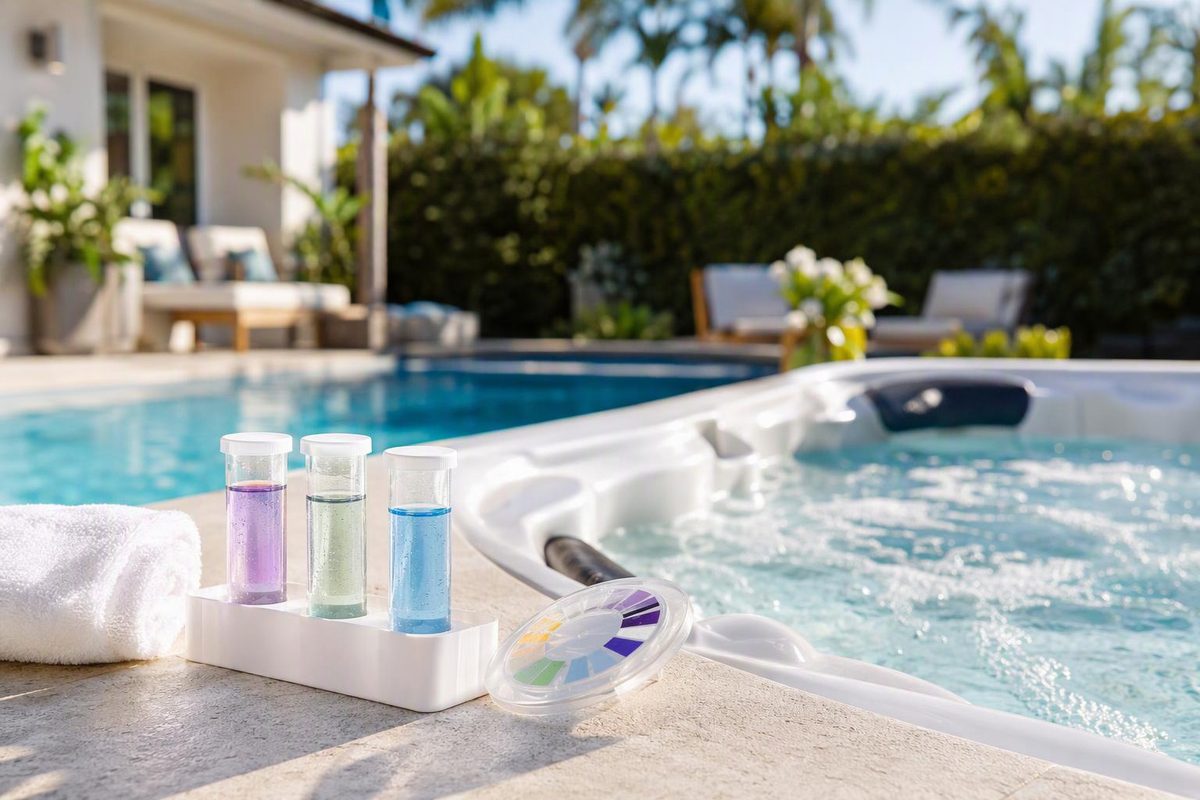
A general water hardness chart describes your fill water—not the ideal balance for your pool or hot tub. First check whether your result measures total hardness or calcium hardness. Total hardness includes calcium and magnesium; pool and spa water-balance calculations use the calcium component. They are not interchangeable readings. Taylor Technologies explains the distinction.
General water hardness chart
Use this chart to interpret a household water report or a total-hardness test of your fill water. The classifications follow the U.S. Geological Survey’s guidelines.
| Water classification | Total hardness, mg/L or ppm as calcium carbonate | Approximate grains per US gallon (gpg) |
|---|---|---|
| Soft | 0–60 | 0–3.5 |
| Moderately hard | 61–120 | 3.6–7.0 |
| Hard | 121–180 | 7.1–10.5 |
| Very hard | Above 180 | Above 10.5 |
These are conventional bands for whole-number results, not chemical treatment thresholds. The gpg bands are rounded; use the mg/L column to classify borderline results.
For these water tests, mg/L and ppm are numerically equivalent. To convert units:
- ppm ÷ 17.1 = grains per gallon
- grains per gallon × 17.1 = ppm
For example, 10 gpg is approximately 171 ppm. Montana State University Extension documents these unit relationships.
Unit conversion does not turn total hardness into calcium hardness. A utility report showing 250 ppm total hardness does not establish that your pool’s calcium hardness is 250 ppm.
Calcium-hardness chart for pools and hot tubs
Use a calcium-hardness result, expressed as ppm as calcium carbonate, with this chart. These are reference ranges, not one universal specification.
| Pool or spa situation | Calcium-hardness reference | How to use it |
|---|---|---|
| Swimming pool: Taylor’s general guidance | 200–400 ppm | Starting reference; check the finish and equipment requirements, plus overall water balance |
| Spa: Taylor’s general guidance | 150–250 ppm | General guidance only; your model’s manual may specify a different range |
| Hot Spring Hot Spot collection, 2025 manual, without salt system | 75–150 ppm; target 100 ppm | Applies to the models covered by that manual |
| Same collection with its optional salt system | 25–75 ppm; target 50 ppm | System-specific range—not a target for every saltwater pool or spa |
Sources: Taylor’s pool and spa guidance and the water-quality chart on printed page 9 of the 2025 Hot Spot owner’s manual.
Notice the apparent mismatch: water classified as “very hard” on the household chart can still fall within a pool’s calcium-hardness reference range. Do not soften pool water simply because the household chart calls it hard.
What to check before adjusting hardness
1. Confirm the test type and result
Look for “calcium hardness,” not just “hardness,” on the kit instructions. If the reading is unexpected or close to a treatment threshold, confirm it with a calcium-hardness drop test before adding chemicals. Follow the kit’s sample volume and drop multiplier; our pool and hot-tub hardness testing guide covers the method and troublesome endpoints.
2. Check the specification and the rest of the water balance
Record calcium hardness, pH, total alkalinity and water temperature. For a pool saturation-index calculation, also include stabilizer and dissolved-solids information as the calculator requires.
Hardness alone does not predict scale or surface damage. Taylor’s saturation-index guidance considers these readings together: calcium-carbonate deposits become more likely in scaling conditions, while calcium-deficient, poorly balanced water can damage plaster and grout. See Taylor’s explanation of water balance.
Stop here if you only have a total-hardness reading or do not know your spa’s specified range. Get the missing information rather than dosing from the wrong chart.
3. Choose the correction from the confirmed readings
- Below the applicable calcium-hardness range: A calcium-chloride hardness increaser may be appropriate. Record the water volume, current reading, target and product strength before calculating the label dose. Taylor notes that calcium chloride is sold in hydrated and anhydrous forms with different strengths, and it generates heat on contact with water. Follow the specific label’s addition method—not a generic bucket-mixing shortcut.
- Above the applicable range: Test the replacement water before planning an exchange. Partial replacement lowers calcium hardness only when the incoming water has lower calcium hardness. For a pool, confirm a safe draining procedure with the installer or service professional first. For a hot tub, follow its drain/refill and water-care instructions.
- Within range but showing scale or cloudiness: Check pH, alkalinity and overall balance before trying to lower hardness. If deposits are localized bumps on plaster rather than a widespread crust, use our calcium nodules versus scale guide before attempting removal.
Taylor’s adjustment guidance supports calcium-chloride addition and lower-hardness water replacement. Lowering pH can change scaling tendency, but it does not remove the calcium already dissolved in the water.
After treatment, circulate for the label-specified period and retest before adding more. Never mix chemicals together; store them separately, measure accurately and follow the product safety directions.