
Sodium Bicarbonate for Pools: Test, Calculate and Dose
Test total alkalinity, calculate a sodium bicarbonate dose by pool volume, circulate, and retest before adding more.
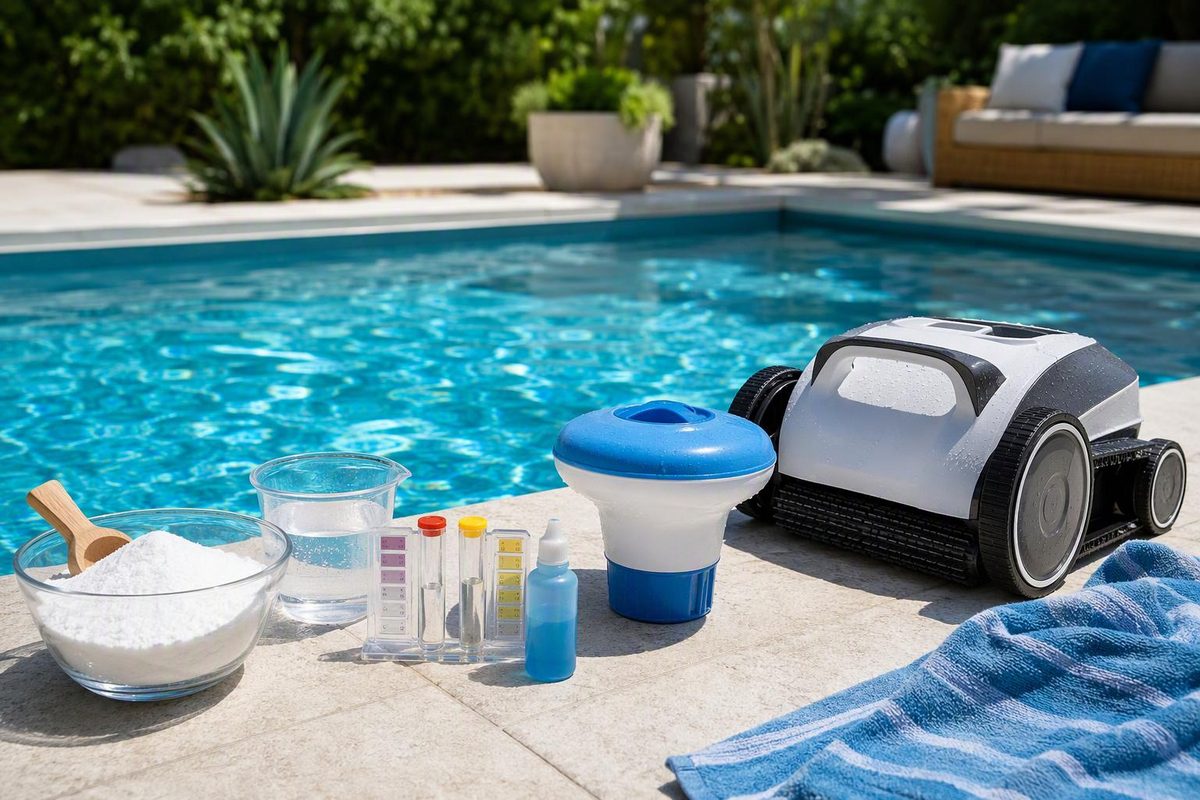
Sodium bicarbonate—ordinary baking soda—is mainly used to raise total alkalinity (TA) in pool water. It also raises pH slightly, but it is not the right first choice when TA is already in range and only pH is low.
Do not add it just because the water is cloudy or green. Sodium bicarbonate is not a sanitizer, and raising TA does not correct an algae, filtration or circulation problem. If clarity is the symptom, start with the test-led cloudy-water sequence.
Test before adding anything
Measure:
- Pool volume in gallons
- Total alkalinity
- pH
- Free chlorine
A practical TA target for many pools is 80–120 ppm. Taylor describes TA as the water’s resistance to pH change and notes that sodium bicarbonate raises TA while only slightly raising pH (Taylor Technologies). Equipment or chemical-product instructions may specify a narrower target, so follow those requirements when they differ.
For pH, Hayward’s chemistry guide uses 7.2–7.8 and directs owners to baking soda for TA but soda ash for pH (Hayward Chemistry Quick Start Guide). CDC’s residential guidance is pH 7.0–7.8, with at least 1 ppm chlorine in pools—or at least 2 ppm when cyanuric acid or stabilized chlorine is used (CDC). Correct alkalinity without neglecting sanitizer.
Decision point:
- Low TA: Sodium bicarbonate is appropriate.
- Low TA and low pH: Correct TA, circulate, and then retest pH.
- TA in range but pH low: Use the pH increaser specified by its label rather than adding unnecessary bicarbonate.
- High TA: Do not add sodium bicarbonate.
Use a reliable drop test where possible. If needed, follow these pool-water testing instructions.
Calculate the dose from gallons and the required TA increase
For a product labeled as 100% sodium bicarbonate, one manufacturer’s directions give this approximate dose:
1.5 pounds per 10,000 gallons raises TA by approximately 10 ppm.
HASA specifies that rate for its 100% sodium bicarbonate alkalinity increaser and says to circulate while adding, then retest after four hours (HASA product directions). Hayward’s chart gives a close figure of 1.4 pounds per 10,000 gallons for a 10 ppm increase. Treat the calculated dose as an estimate and give the follow-up water test the final word.
Use this formula only when your product label supports the 1.5-pound rate:
Pounds needed = (pool gallons ÷ 10,000) × (desired TA increase ÷ 10) × 1.5
| Pool volume | For a 10 ppm TA increase | For a 20 ppm TA increase |
|---|---|---|
| 5,000 gal | 0.75 lb (12 oz) | 1.5 lb |
| 10,000 gal | 1.5 lb | 3 lb |
| 15,000 gal | 2.25 lb | 4.5 lb |
| 20,000 gal | 3 lb | 6 lb |
Example: 15,000-gallon pool
Current TA is 60 ppm and the target is 90 ppm, so the required increase is 30 ppm.
(15,000 ÷ 10,000) × (30 ÷ 10) × 1.5 = 6.75 pounds
That is 6 pounds 12 ounces by weight. If the pool volume or test result is uncertain, add only part of the calculated amount, circulate, and retest rather than risk overshooting. Always use your product’s labeled dose if it differs from this calculation.
Add sodium bicarbonate in a controlled sequence
- Check the ingredient and strength. The calculation above applies to 100% sodium bicarbonate. If considering grocery-store baking soda, confirm that sodium bicarbonate is the only ingredient; a purpose-labeled pool product will also provide pool-specific directions and warnings.
- Run the circulation pump. Confirm normal flow before treatment.
- Weigh the dose. Do not substitute a kitchen-volume estimate for pounds or ounces by weight.
- Protect yourself from the powder. Follow the label’s protective-equipment instructions, avoid breathing dust, and do not handle it on a windy deck.
- Follow the product’s addition method. HASA directs users of its product to distribute it directly into the pool with the pump operating. Do not dump the full dose in one spot or pour it into the skimmer unless your label specifically directs that method.
- Keep it separate from other pool chemicals. Never combine concentrated products in a bucket or container. A sodium bicarbonate pool-product safety sheet warns against mixing it with acids or other concentrated pool or spa chemicals and calls for cool, ventilated, labeled storage out of children’s reach (Bio-Lab safety data sheet).
- Allow it to circulate, then retest. HASA specifies four hours for its product; another label may specify a different interval. Recheck both TA and pH before adding more.
Stop when TA reaches the selected target. More is not better: Taylor describes excessive TA as an overbuffered condition, which makes pH more resistant to adjustment.
What sodium bicarbonate will not fix
Baking soda has a narrow job:
- Green water or visible algae: Test free chlorine and follow an algae-removal process. Raising alkalinity does not disinfect the pool.
- Cloudiness after shock: Verify chemistry and filtration instead of repeatedly adding alkalinity increaser; use this post-shock troubleshooting order.
- Low pH with normal or high TA: Use the label-directed pH treatment, not more bicarbonate.
- High TA: Sodium bicarbonate moves the reading in the wrong direction.
Do not reuse the pool dose for a hot tub
A spa’s small water volume makes a pool-sized scoop a major overdose. Mathematically, the same 1.5-pound-per-10,000-gallon rate works out to only 0.96 ounce by weight (about 27 grams) for an estimated 10 ppm TA increase in 400 gallons.
That calculation does not replace spa-product directions. Use a product labeled for the spa, its stated dose, an accurate scale, and the spa’s confirmed water volume. Circulate and retest before making another small adjustment.