
Water Transfer Pump for Pools and Hot Tubs: Choose by the Job
Match a water transfer pump to pool or hot-tub draining: check pump type, temperature, hose size, real flow and safe discharge before buying.
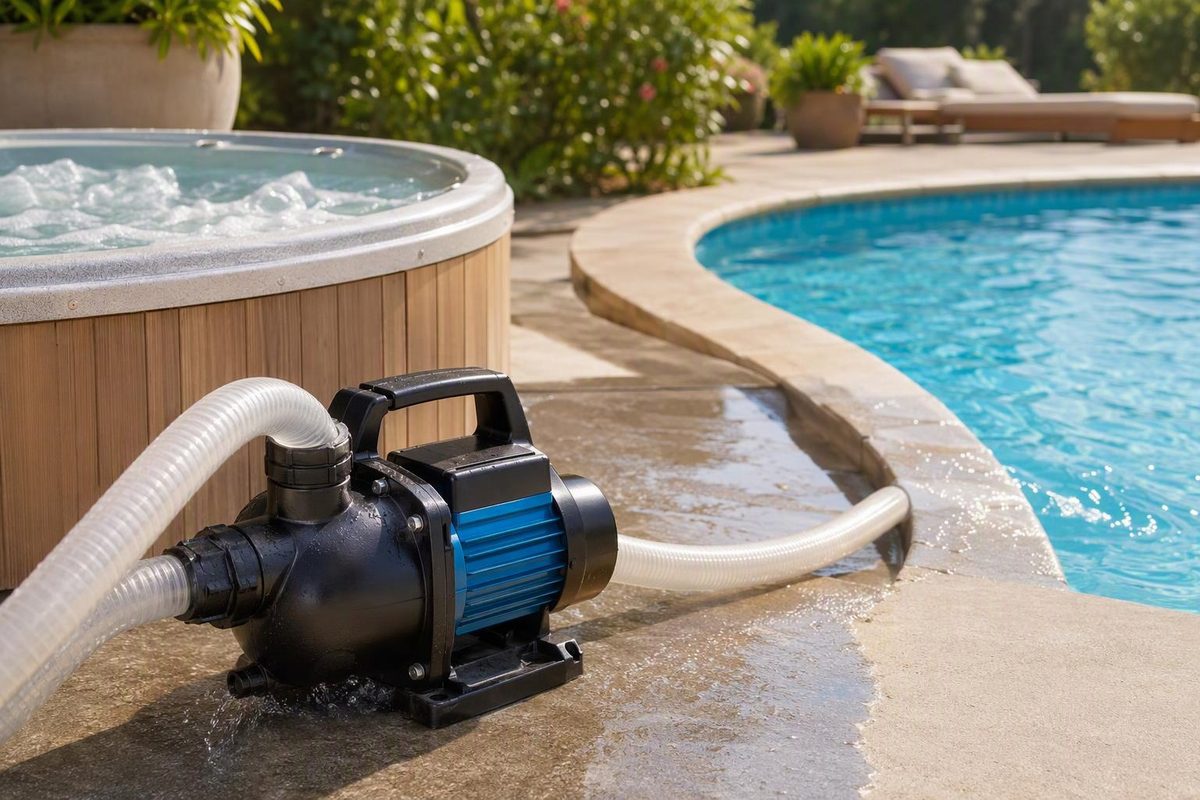
A water transfer pump moves water from one place to another. For pool and spa owners, the useful distinction is whether the pump sits outside the water and draws through a suction hose, or goes underwater and pushes water through a discharge hose.
Before buying, settle three things: how much water needs moving, whether lowering the water is safe, and where you may discharge it. A higher horsepower rating does not answer those questions.
1. Confirm the job before choosing the pump
Pool: Write down the pool volume in gallons, the reason for draining and the intended stopping level. If the goal is chemistry correction, confirm the water readings first. For high stabilizer, use the cyanuric-acid water-exchange guide to plan the exchange rather than assuming the whole pool must be emptied.
Stop before an inground water exchange if groundwater conditions or the safe minimum level are unknown. Removing water reduces the weight holding the pool down; surrounding groundwater can lift or damage the shell, and vinyl liners can float. Pool manufacturer River Pools recommends professional handling when draining is necessary. A smaller pump does not remove that structural risk.
Hot tub: Check the owner’s manual for the drain procedure. A built-in gravity drain may be enough, so you may not need a pump. Switch off the spa at its circuit breaker—not merely its topside controls—before draining so its pumps and heater cannot operate as the water falls. Jacuzzi’s draining guidance describes gravity drainage and pump-assisted removal.
2. Match the pump design to the water
| Pump type | What to check | Main limitation |
|---|---|---|
| Non-submersible transfer pump | Suction-lift limit, reinforced inlet hose, strainer and priming procedure | Motor must stay dry; suction leaks can prevent pumping |
| Submersible utility pump | Approved application, temperature limit, discharge size and minimum operating depth | Check required submergence; manual models need supervision |
| Pool-cover pump | Cover compatibility and automatic switching levels | Cover-water removal is not the same job as draining the pool |
For example, WAYNE’s WAPC250 manual describes automatic removal from a pool or spa cover and warns that a leaking cover can let the pump remove pool water too.
Read the exact model’s manual, not just a retailer’s “pool pump” category. Confirm compatibility with treated water and, where applicable, saltwater before buying. Clear-water equipment is not automatically suitable for leaves, sand, sludge or concentrated chemicals.
Two specifications deserve particular attention:
- “Self-priming” does not necessarily mean dry-starting. The WAYNE PC4 manual requires filling the pump with water before operation. It also warns that ordinary garden hose can collapse on the suction side; reinforced hose or approved pipe is required there.
- Check the hot-water rating. Little Giant lists a continuous-duty liquid-temperature rating of up to 96°F (30°C) for its 5 Series utility pumps. Water at 100°F exceeds that rating: let it cool or select equipment explicitly rated for your water temperature and intended use.
These are specification examples, not recommendations that either pump is suitable for every pool or spa. The 5 Series manual, for instance, excludes seawater and corrosive chemical solutions.
3. Size by working flow—not maximum flow
Record the hose diameter and length, the rise to the discharge point, and the gallons you intend to remove. Compare the manufacturer’s performance curve at the required head, allowing for elevation and resistance through hoses and fittings—not just the vertical rise.
For example, Little Giant’s 5 Series table lists 1,500 gallons per hour at 1 foot of head, 1,191 at 10 feet, and 528 at 20 feet. Its installation manual also says its garden-hose adapter reduces performance by approximately 15%. The headline capacity is not a promise of flow through your hose.
Estimate runtime using:
Minutes = gallons to remove ÷ actual gallons per minute
Hypothetical examples:
- A 400-gallon spa at 20 gpm takes about 20 minutes for bulk removal.
- A 3,000-gallon pool exchange at 25 gpm takes about 120 minutes.
Allow extra time for setup and residual water. Also check duty rating: the PC4 manual excludes long, extended continuous operation, whereas Little Giant rates its 5 Series for continuous duty. A large pool exchange may need different equipment from a brief household transfer.
4. Approve the discharge route before starting
Ask your local wastewater or stormwater authority where pool or spa water may go, what tests are required and what discharge rate is permitted. Do not assume that water safe for swimming is safe for a stream—or that every lawn, sewer connection or septic system can accept it.
For a local example, not a universal rule, Fairfax County’s discharge guidance, checked October 25, 2026, requires total residual chlorine or bromine below 0.1 mg/L, pH 6.0–8.0, and clear water free of algae, sediment and other pollutants for its permitted chlorinated/brominated pool-water route. It recommends draining over well-vegetated ground where possible, using storm drains or streams only as a last resort. For those outlets, it recommends 12–15 gpm, with a maximum of 25 gpm, and says salt-pool water should not be discharged there.
Follow your own jurisdiction’s requirements and test results, rather than relying on a fixed waiting period.
5. Run a supervised transfer—and stop on symptoms
Before connecting power, secure the hoses, inspect the cord and plug, and complete the model’s priming or placement procedure. Use the specified grounded, GFCI-protected supply; keep electrical connections dry. Extension-cord rules vary: the Little Giant 5 Series manual prohibits them. Disconnect power before touching or repositioning the pump, and keep everyone out of the water during transfer.
For a pool, switch off circulation and heating before draining; Leslie’s draining guidance warns that the installed circulation pump can lose prime during draining.
If flow is weak or stops, disconnect power before checking:
- External pump: Confirm the inlet remains underwater; check priming, suction leaks, collapsed hose and excessive suction lift.
- Either design: Check for a clogged intake, kinked discharge hose or excessive head.
- Repeated electrical trip, overheating or damaged cord: Stop using the pump. Do not keep resetting protection or attempt live electrical diagnosis.
Stop at the planned water level and before dry running. Little Giant’s manual specifically directs unplugging when pumping stops or the suction sound changes. After refilling according to the pool or spa manual, restore the normal operating level, verify circulation and retest water chemistry before use. If the spa develops low-flow trouble afterward, follow the circulation-pump diagnostic sequence rather than immediately buying another pump.